

You are writing an email about next quarter’s goals, a trip itinerary, or a woodworking project, and your fingers hesitate. One N or two? It is one of those small spelling questions that can make a sentence look careless if you get it wrong.
Here is the short answer. Planning (double N) is the word for making plans. Planing (single N) is a different word that comes from “plane,” and it describes smoothing a surface, a boat skimming over water, or a dental cleaning procedure. If you mean thinking ahead, you almost always want planning.
This guide explains both words, shows where each one belongs, and gives you simple tricks so the choice becomes automatic.
Quick Answer: Planing or Planning?
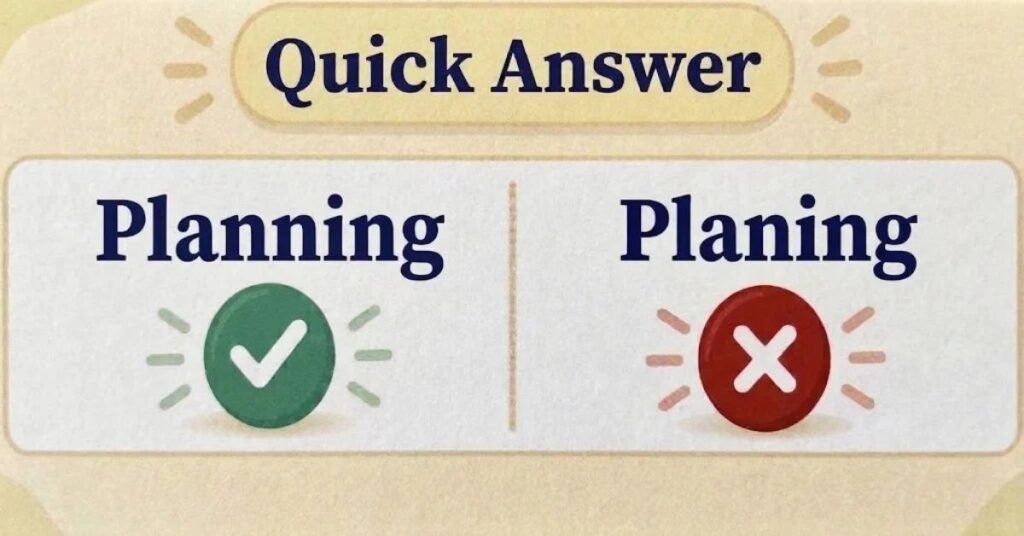
Use planning when you mean preparing, organizing, or deciding what to do. Use planing only when you mean working a surface with a plane, a hull rising on the water, or root planing at the dentist.
- “We are planning a surprise party.” Correct.
- “We are planing a surprise party.” Incorrect.
- “He is planing the door so it closes properly.” Correct.
Featured Snippet Answer
Planning is the correct spelling for making plans: it is the present participle of the verb “plan,” and the double N keeps the short “a” sound. Planing is a separate word, the present participle of “plane,” meaning to smooth wood, to glide over water, or to clean a tooth root.
Planing vs Planning at a Glance
| Feature | Planning | Planing |
| Root verb | plan | plane |
| Main meaning | Deciding and organizing future actions | Smoothing a surface, gliding, or dental root cleaning |
| Typical context | Business, travel, events, school, life | Carpentry, boating, aviation, dentistry |
| Vowel sound | Short “a,” as in “cat” | Long “a,” as in “late” |
| Spelling rule | Double the final N before -ing | Drop the silent E before -ing |
| Frequency | Very common | Rare and technical |
| Example | Careful planning saved the project. | Planing the board took ten minutes. |
If you keep only one row in your head, make it the first one. The root verb decides the spelling: plan gives planning, and plane gives planing.
What Does Planning Mean?
Planning is the act of thinking through what you want to achieve and deciding how to get there. It covers goals, steps, timing, and resources. As a noun, it names the process. As a verb form, it shows an action in progress.
You will see it in many everyday and professional settings:
- Personal life: “I am planning my week on Sunday night.”
- Business: “Strategic planning helps teams choose priorities.”
- Events: “She handled the wedding planning.”
- Government and cities: “Urban planning shapes how neighborhoods grow.”
- Finance: “Retirement planning starts earlier than most people think.”
A helpful distinction is the difference between a plan and planning. The plan is the finished product, such as a schedule or a strategy document. Planning is the activity that produces it. Project managers often put it this way: planning is the process, and the plan is the output.
Common synonyms include organizing, preparing, scheduling, strategizing, arranging, and mapping out.
What Does Planing Mean?
Planing comes from the verb plane, and it has three main meanings.
1. Smoothing or shaping a surface
A plane is a hand tool (or a machine) that shaves thin layers off wood. When you use it, you are planing.
- The carpenter spent the morning planing the oak boards.
- She is planing the edge of the door so it stops sticking.
You may also see the word in “planing mill,” a facility where rough lumber is made smooth. The phrase “sawmills and planing mills” is the correct form, not “planning mills.”
2. A boat or board skimming across water
When a boat gains enough speed, the hull lifts and rides on top of the water instead of pushing through it. That is called planing.
- The speedboat began planing once the throttle opened.
- A planing hull is built to rise and skim.
This is also why you hear about hydroplaning, where a tire rides on a film of water instead of gripping the road.
3. Gliding or soaring
Planing can also describe gliding through the air without flapping, as in a bird holding its wings steady.
- The gull was planing above the cliffs.
Bonus: root planing in dentistry
Dentists use “root planing” for smoothing the roots of teeth during a deep cleaning, often paired with “scaling.” If your dental paperwork mentions “scaling and root planing,” the single N is correct.
Synonyms for planing include smoothing, shaving, leveling, gliding, and skimming.
Planning in British English vs American English

There is no regional split to worry about. Both British and American English spell the word planning with a double N. The same goes for the past tense planned and the noun planner.
Where British and American writing differ is in some other doubled-consonant words, such as “travelling” (British) and “traveling” (American). Planning does not belong to that group, because the final N is doubled in every major variety of English.
You will also notice that “town planning” is the standard British term, while American writers more often say “city planning” or “urban planning.” The spelling stays the same.
Why Is Planning Spelled With Double N?
This is a spelling rule, not a quirk. English has a pattern for words that end in a single vowel followed by a single consonant. When you add an ending that starts with a vowel (like -ing or -ed), you often double the final consonant to protect the short vowel sound.
Here is the rule in plain steps:
- Look at the base word. Plan has one vowel (a) followed by one consonant (n).
- The vowel is short, as in “cat.”
- Before adding -ing, double the final consonant.
- Result: plan + n + ing = planning.
The same pattern works with many other words:
| Base word | Add -ing | Why |
| plan | planning | Short vowel + single consonant |
| run | running | Short vowel + single consonant |
| stop | stopping | Short vowel + single consonant |
| swim | swimming | Short vowel + single consonant |
| sit | sitting | Short vowel + single consonant |
Now compare with words that end in a silent E, like plane. When you add -ing, you drop the E and do not double the consonant. The long “a” sound is already protected by the silent E.
| Base word | Add -ing | Result |
| plane | drop E, add -ing | planing |
| shape | drop E, add -ing | shaping |
| hope | drop E, add -ing | hoping |
| bake | drop E, add -ing | baking |
A famous pair shows the same logic: hoping (from hope) versus hopping (from hop). One N or P, two different words. The pair planing and planning works exactly the same way.
Why People Confuse Planing and Planning
Several things make this pair tricky, even for confident writers.
- They look nearly identical. One extra letter is easy to miss while typing or proofreading.
- They are spoken differently, but people do not stop to say them aloud. Planning has a short “a,” and planing has a long “a,” but when you are writing quickly you may not “hear” either one.
- Typos slip past spellcheck. Both are real English words, so most tools will not flag “I am planing a trip.” Only a careful read or a context-aware checker catches it.
- Informal writing normalizes the error. Social posts, captions, and text messages sometimes show “planing” in the place of “planning,” and the mistake looks familiar after a while.
- Doubling rules feel arbitrary. If you have never learned the short-vowel rule, the second N seems optional.
Some websites have even listed “planing on going” as acceptable. It is not. That wording is a spelling slip, and the correct phrase is “planning on going.” When in doubt, trust the meaning: if you are talking about intentions or arrangements, write planning.
Common Phrases and Expressions Using the Word “Planning”
Planning shows up in a long list of everyday phrases. Knowing them helps you see how often the double N version appears.
- Planning ahead: thinking before you act. “Planning ahead saves money.”
- Planning permission: official approval to build something (a common British phrase).
- Planning application: a formal request for that approval.
- Planning process: the steps used to create a plan.
- Strategic planning: long-term goal setting for a company.
- Family planning: decisions about when and whether to have children.
- Financial planning: managing money to meet future goals.
- Event planning: organizing weddings, conferences, and parties.
- Project planning: defining tasks, timelines, and resources.
- Planning on (doing something): intending to do it. “I’m planning on leaving early.”
- Planning stage: the early phase before work begins.
- Contingency planning: preparing for things that might go wrong.
- Meal planning: deciding what to cook for the week.
- Lesson planning: how teachers prepare classes.
Notice that none of these phrases would ever use a single N. If the topic involves goals, schedules, or intentions, planning is the right word.
When Should You Use Planning?
Choose planning whenever your sentence is about preparing for the future. A quick test: can you replace the word with “organizing,” “preparing,” or “arranging”? If yes, you want planning.
Examples across different settings:
Everyday life
- We are planning a camping trip for August.
- I’m planning to start going to the gym.
Work and school
- The team spent Monday planning the product launch.
- Her essay covers the importance of early planning in construction.
Travel
- They are planning a three-week trip across Europe.
Community and government
- The council is planning a new bike lane on Main Street.
You can also use it as a noun without any helper verb: “Good planning prevents most last-minute stress.”
When Should You Use Planing?
Choose planing only for the technical or physical meanings covered earlier: smoothing a surface, a boat riding on top of water, gliding, or root planing in dentistry.
- The woodworker is planing the table leg until it is perfectly even.
- A planing hull skims across the water at high speed.
- The glider was planing silently on the warm air.
- Her dentist recommended scaling and root planing.
A helpful test: if a plane (the tool, the aircraft idea, or a flat surface) is involved, planing is possible. If the sentence is about schedules, goals, or intentions, it is not.
For most writers, planing will be a rare word. Unless you work in woodworking, boating, aviation, or dentistry, you probably use it a handful of times in a lifetime.
Common Mistakes With Planning

Here are the errors editors see most often, with fixes.
Mistake 1: Writing planing when you mean planning
- Incorrect: We are planing our summer vacation.
- Correct: We are planning our summer vacation.
Mistake 2: Writing planning when you mean planing
- Incorrect: The carpenter is planning the rough edges of the board.
- Correct: The carpenter is planing the rough edges of the board.
This one is rarer, but it happens in craft writing and product descriptions.
Mistake 3: Mixing up planed and planned
The same logic applies to the past tense.
- Planned means arranged ahead of time. “We planned the route yesterday.”
- Planed means shaved or smoothed with a plane. “He planed the board by hand.”
Incorrect: “The meeting was planed for Friday.” Correct: “The meeting was planned for Friday.”
Mistake 4: Writing “plan on” with the wrong ending
- Incorrect: I’m planing on going to the concert.
- Correct: I’m planning on going to the concert.
Mistake 5: Confusing plan, planning, and planner
- Plan: the noun or verb. “Here is the plan.”
- Planning: the process. “Planning takes time.”
- Planner: the person or the tool. “She is an event planner. I use a daily planner.”
Each of these forms keeps the double N when an ending is added, except when no ending is added at all.
How to Remember the Difference
Memory tricks work best when they are short and a little silly. Try one of these.
- Planing flies like a plane. Both words have a long “a,” and planing can mean gliding. The word “plane” sits right inside “planing.”
- Planning needs two Ns for two sides of a plan. Think of the double N as the two pillars holding up a good plan.
- Short vowel, double the consonant. If the vowel in the base word is short (plan), double the last letter. If the word ends in a silent E (plane), drop the E.
- Check the root. Ask yourself, “Is it from plan or plane?” That answer decides the spelling every time.
- Hoping vs hopping. If you remember that these two are different, you already understand the planing vs planning rule.
- Substitute a synonym. Swap in “organizing.” If the sentence still makes sense, use planning. Swap in “smoothing.” If that fits better, use planing.
How Do You Pronounce Planning and Planing?
The two words sound different, even though the spelling is close.
| Word | Pronunciation (approximate) | Vowel sound | Rhymes with |
| Planning | PLAN-ing | Short “a,” as in “man” | scanning, spanning |
| Planing | PLAY-ning | Long “a,” as in “day” | training (close), straining |
Saying the word out loud is a handy proofreading tool. If you naturally say “PLAN-ing” in your head, you want two Ns. If you say “PLAY-ning,” the single N spelling belongs to a plane or a smooth surface.
One note: in fast speech, people sometimes say “planning” almost like “plannin’,” dropping the final G sound. That does not change the spelling. Always write the full word.
Mini Practice Quiz
Also Read This:Sapphire vs. Saphire: Which Is Correct? Meaning, Spelling & Examples (2026)
Try these ten sentences. Pick planning or planing for each blank. Answers follow the list.
- We are ______ a surprise party for Mom.
- The carpenter is ______ the edge of the shelf.
- Effective ______ reduces stress at work.
- The speedboat started ______ across the bay.
- I’m ______ on moving to a new city next year.
- Her dentist suggested scaling and root ______.
- They spent the whole weekend ______ their wedding.
- The gull was ______ on the breeze above the harbor.
- Our ______ meeting starts at ten.
- He enjoys ______ wood in his garage workshop.
Answers
- planning
- planing
- planning
- planing
- planning
- planing
- planning
- planing
- planning
- planing
If you got eight or more right, you have the rule. If you missed a few, go back to the root-word test: plan gives planning, plane gives planing.
Common Writing Tips
Here are practical habits that help you avoid this and similar spelling slips.
- Reread the sentence for meaning, not just spelling. Ask what the writer is actually describing.
- Search your document. Use your editor’s find tool to look for “planing.” Unless your topic is woodworking, boating, or dentistry, each result is probably a typo.
- Do not rely on spellcheck alone. Both words are valid, so many tools stay silent.
- Read it aloud. The long “a” in planing sounds noticeably different from the short “a” in planning.
- Watch your past tenses too. Planned (two Ns) for arranging, planed (one N) for smoothing.
- Keep a short personal list of words you tend to mix up. Planning vs planing, hoping vs hopping, and writing vs writting (a non-word) are good starters.
- Use a context-aware grammar tool as a backup, not a replacement for your own judgment.
- When writing for business or school, proofread twice. Credibility depends on small details, and a misspelled word in a proposal or cover letter can undercut an otherwise strong message.
Final Verdict: Planing or Planning?
Planning is the word you want almost every time: it means making plans, it comes from “plan,” and it takes a double N to keep the short “a” sound. Planing is a rare technical word from “plane,” used for smoothing wood, boats skimming across water, gliding, and dental root planing.
When you are unsure, check the root word and the meaning. If you are preparing, organizing, or deciding, write planning. If a plane, a smooth surface, or a skimming hull is involved, write planing.