

You are writing an email about a new policy. The sentence is almost done: “The change will take ___ on Monday.” You pause. Is it effect or affect?
Plenty of careful writers freeze at this exact spot. The two words look alike, sound alike, and both have something to do with change. That makes the choice feel like a coin flip when it really is not.
This guide settles the question for good. You will get the short answer first, then the grammar behind it, plus examples, memory tricks, and the most common mistakes. By the end, you will pick the right word without second-guessing yourself.
Quick Answer
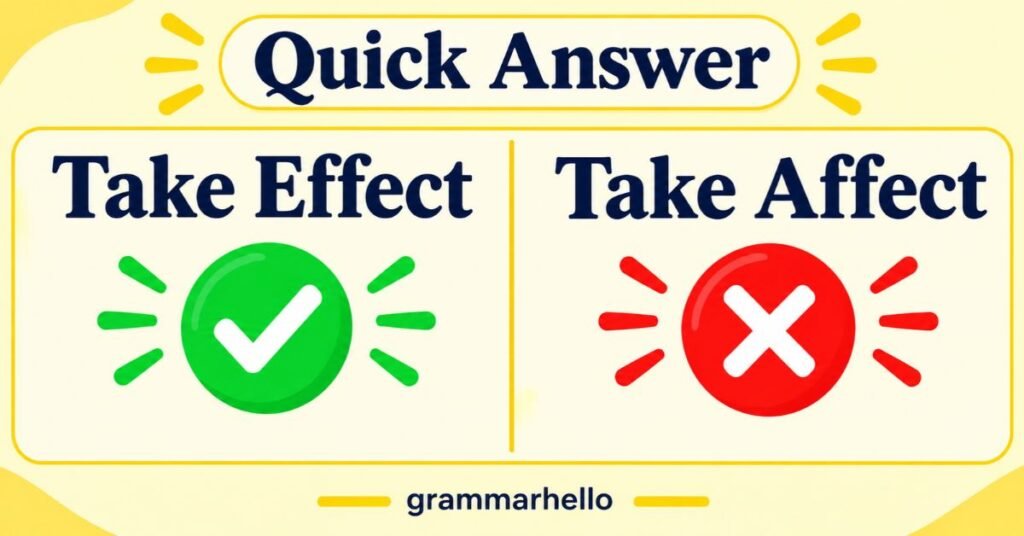
“Take effect” is correct. “Take affect” is a mistake.
Take effect means to begin to work, to become active, or to start producing results. You use it for laws, rules, medicines, updates, and changes of all kinds.
Here is the rule in one line: after take, English needs a noun, and effect is the noun. Affect is mainly a verb, so it does not fit in that spot.
- Correct: The new rule takes effect on Monday.
- Incorrect: The new rule takes affect on Monday.
If you only remember one thing from this article, remember that sentence pair.
Why People Confuse Them
The mix-up is understandable. Several things push writers toward the wrong spelling.
The words are homophones, or close to it
In normal speech, affect and effect sound almost the same. Most speakers say the first syllable as a quick “uh” sound for both, so listening does not help. You cannot hear the difference, which means you must remember it.
They share a similar meaning
Both words deal with change. Something that affects a situation causes an effect. Because the ideas are so close, the spellings blur together in the mind.
Spellcheck often misses it
Both words are real, correctly spelled English words. A spell checker sees nothing wrong with “take affect” because affect is a valid word. Grammar tools sometimes catch it, but not always, so the error slips into emails, news posts, and even printed notices.
The phrase is an idiom
Take effect is a fixed expression, and idioms do not always follow logic you can reason out on the spot. You simply learn that this is how English says it, much like you learn “make sense” instead of “do sense.”
Key Differences At A Glance

The table below compares the two phrases directly.
| Feature | Take Effect | Take Affect |
| Correct in standard English? | Yes | No |
| Meaning | To begin to work or become active | No standard meaning |
| Grammar pattern | Verb + noun | Verb + verb (does not work) |
| Typical use | Laws, policies, medicine, updates | None; it is an error |
| Where you see it | News, legal text, health advice, business emails | Typos, rushed messages, social media |
| Formality | Neutral; works in any setting | Not appropriate anywhere |
| Fix | Keep as is | Change affect to effect |
Quick takeaway: these two are not an equal pair. One is a real phrase and the other is a common slip.
Meaning and Usage Difference
To see why only one phrase works, it helps to look at each word on its own.
What “effect” means
Effect is most often a noun. It means a result or outcome. When something causes a change, that change is the effect.
- The effect of the storm was a week without power.
- The medicine had a calming effect.
- Sleep has a big effect on mood.
Effect can also be a verb, though less often and in more formal writing. As a verb it means to bring about or cause something to happen.
- The new manager hopes to effect real change.
What “affect” means
Affect is most often a verb. It means to influence or change something.
- The weather will affect our travel plans.
- Stress can affect your sleep.
- The news did not affect her decision.
Affect is also a noun in psychology and related fields. There it describes how a person’s emotions show on the outside, as in “a flat affect.” This use is specialized and rare in daily conversation.
Affect has one more meaning as a verb: to pretend or put on a show of something.
- He affected a British accent at the party.
How “take effect” works
In take effect, the verb is take and the noun is effect. Literally, a thing “takes” its effect when it starts producing one. In everyday use, the phrase means:
- To become active or operative
- To start working
- To begin applying, as with a rule or law
You can use it with a wide range of subjects:
- A law takes effect on a certain date.
- A medicine takes effect after a few minutes.
- A price change takes effect at midnight.
- A software update takes effect after a restart.
- A ceasefire takes effect at dawn.
Why “take affect” does not work
Remember the pattern: take + noun. If you replace effect with affect, you get take + verb, and the sentence falls apart. “Take affect” has no recognized meaning in standard English.
There is one tiny wrinkle. In psychology, affect is a noun, so a sentence like “She took the news with a flat affect” is grammatically possible. But that is a different structure, and it does not mean the same thing as the idiom take effect. For ordinary writing, treat “take affect” as an error.
British English vs. American English Spelling

Good news: this is one area with no confusion at all.
Take effect is the correct phrase in both British and American English. There is no regional version where “take affect” is accepted. Unlike pairs such as color and colour, this is not a spelling difference between countries.
The only small regional habit involves related phrasing. Come into effect is often preferred in British and Commonwealth legal writing, while go into effect is common in American English. Take effect works everywhere, so it is the safest choice for an international audience. Side effect and special effects also use effect in every variety.
Tone, Context, and Formality
Take effect is a neutral phrase. It fits almost any setting, from a quick text to a legal document. Because of this, you rarely need to worry about tone. What matters more is accuracy, since using the wrong word can make your writing look careless.
In formal writing
Legal, academic, and official documents use take effect all the time. These settings value precision, so an error stands out.
- “This regulation shall take effect on the first day of the next fiscal year.”
- “The amendment takes effect upon approval.”
In business communication
Emails, memos, and announcements often use the phrase to give clear timing.
- “Our updated pricing will take effect on June 1.”
- “The new schedule takes effect next week.”
A typo here can reduce trust in the message. A policy notice with “take affect” may make readers wonder how carefully the rest was checked.
In health and everyday life
People use it to describe how long it takes for something to start working.
- “The painkiller should take effect within half an hour.”
- “It takes a few days for the new routine to take effect.”
A note on credibility
Style guides, teachers, and editors consistently treat “take affect” as an error. If your goal is to look professional, get this one right. It is a small detail that signals care and attention.
How to Pronounce Take Effect and Take Affect

Pronunciation is where the confusion begins, because the two words sound nearly identical in casual speech.
Take effect
- Phonetic spelling: /teɪk ɪˈfɛkt/
- Say it like: “tayk ih-FEKT”
- The stress falls on the second syllable of effect.
Affect (the verb)
- Phonetic spelling: /əˈfɛkt/
- Say it like: “uh-FEKT”
- The stress is also on the second syllable.
Affect (the psychology noun)
- Phonetic spelling: /ˈæfɛkt/
- Say it like: “AF-ekt”
- The stress moves to the first syllable in this specialized use.
Why you cannot rely on your ears
In fast speech, ih-FEKT and uh-FEKT blur together. Many people pronounce both words the same way, which is why the difference is learned through spelling and grammar instead of sound.
Some speakers do keep a slightly different first vowel, and in careful speech you can hear a small gap. Still, it is too subtle to be a reliable guide when you write.
A simple tip
When you say the phrase out loud and are not sure how to write it, run a quick grammar test in your head. Ask yourself: “Is there a noun after take?” If yes, you want effect.
Which One Should You Use?
Here is the clear answer: always use “take effect.”
There is no situation in everyday writing where “take affect” is the better choice. Use this short decision path.
- Are you describing something that starts working or becomes active?
- Is the phrase “take ___” followed by the word you need?
- If the answer to both is yes, write take effect.
Use “take effect” when you mean:
- A rule, law, or policy begins to apply
- A medicine starts to work
- A change becomes active
- A decision or update comes into force
Use “affect” when you mean:
- To influence something (verb): “The delay will affect our schedule.”
- To show emotion in a clinical sense (noun): “The patient’s affect was calm.”
- To pretend (verb): “She affected surprise.”
Quick substitution test
Try swapping in a similar phrase. If “become active” or “start working” fits, then take effect is right.
- “The law will become active on Monday.” Works. So write take effect.
- “The law will influence on Monday.” Does not work. So affect is wrong.
Everyday Examples
Seeing the phrase in real sentences makes it easier to remember. Here are examples from several settings.
Laws and policies
- The new tax rules take effect at the start of the year.
- The ban will take effect on July 1.
- Once the amendment takes effect, drivers must follow the updated limits.
- The agreement took effect after both sides signed.
Medicine and health
- The medication should take effect within an hour.
- I can feel the allergy tablet taking effect already.
- It may take a few weeks for the treatment to take effect.
Work and business
- The new work-from-home schedule takes effect next Monday.
- Price changes take effect at midnight.
- The promotion takes effect on the first of the month.
- Your new benefits will take effect once HR approves the form.
Everyday life
- The caffeine finally took effect, and I felt awake.
- Her advice did not take effect until weeks later.
- When the new rules take effect, the café will close earlier.
Side by side: right and wrong
| Incorrect | Correct |
| The law will take affect in May. | The law will take effect in May. |
| The pill took affect quickly. | The pill took effect quickly. |
| Changes take affect right away. | Changes take effect right away. |
| When does the policy take affect? | When does the policy take effect? |
| It has not taken affect yet. | It has not taken effect yet. |
When One Choice Sounds Wrong
Sometimes you will feel unsure about which word to use. Here is how to spot when “take affect” sneaks in and when it does not belong.
When “take affect” looks right but is wrong
The most common trap is writing quickly. Your fingers type the word that feels familiar, and your brain does not catch the slip. This happens most often in:
- Emails written in a hurry
- Social media posts
- Text messages and chats
- Notes and meeting minutes
When “affect” belongs in the sentence
Affect is not wrong in general. It is just wrong after take in this phrase. Look at these correct uses, where the verb affect does its own job:
- “The new rule will affect everyone in the office.”
- “Cold weather can affect battery life.”
- “Does the change affect my schedule?”
You can even use both words together in one sentence:
- “When the new rule takes effect, it will affect every department.”
That sentence shows the roles clearly. Takes effect is the timing. Affect is the influence.
When the phrase “in effect” appears
In effect is another fixed expression that always uses effect. It can mean “currently active” or “essentially.”
- “The curfew is still in effect.”
- “He is, in effect, the leader of the team.”
When “to that effect” appears
Likewise, “to that effect” means “with that general meaning.” It always uses effect.
- “She said she would help, or something to that effect.”
A helpful gut check
If a sentence is about timing, starting, or becoming active, the correct word is almost certainly effect. If it is about influencing or changing something, the word is almost certainly affect.
Common Mistakes (and Quick Fixes)

Here are the errors people make most often with these words, along with simple fixes.
| Mistake | Why it is wrong | Quick fix |
| “Take affect” | Affect is a verb; the phrase needs a noun | Use take effect |
| “Taking affect” | Same problem in the continuous form | Use taking effect |
| “Took affect” | Same problem in the past tense | Use took effect |
| “Side affects” | Side effects are results, so the noun is needed | Use side effects |
| “In affect” for “in force” | The idiom is fixed | Use in effect |
| “To that affect” | The idiom is fixed | Use to that effect |
| “Effected” when you mean “influenced” | Effected means “caused” | Use affected |
| “The weather will effect us” | A verb meaning “influence” is needed | Use affect |
Mistake 1: Mixing up the verb forms
The past tense forms are affected and effected, and they mean different things.
- Affected means “influenced”: “The delay affected our plans.”
- Effected means “brought about”: “The team effected a major change.”
In most daily writing, you will want affected.
Mistake 2: Trusting spellcheck
Because both words are spelled correctly, a basic spell checker will not flag “take affect.” Always reread phrases that include these words before sending.
Easy Ways to Remember the Difference
Also Read This:Immediate vs. Extended Family: Meanings & Examples
Memory tricks work because they give your brain a shortcut. Pick the one that clicks for you.
Trick 1: A for Action, E for End result
- Affect is an Action. It is a verb.
- Effect is the End result. It is a noun.
When something takes effect, it reaches its end result. That is why the phrase uses E.
Trick 2: The RAVEN rule
RAVEN stands for: Remember Affect Verb, Effect Noun.
The idea is simple. Affect is a verb. Effect is a noun. Since take needs a noun after it, you pick effect.
Trick 3: The “the” test
Try putting the or an before the word. Nouns can follow those words, and verbs cannot.
- “The effect was clear.” Works.
- “The affect was clear.” Sounds odd unless you are discussing psychology.
If the effect sounds natural, effect is the noun you need.
Trick 5: Memorize the phrase as a block
Instead of breaking down the grammar each time, treat take effect as one chunk, like make sense or catch a cold. Say it out loud a few times. After that, “take affect” will start to sound wrong to you.
Dictionary-Style Word Details
If you prefer reference-style notes, here is a breakdown of the key terms.
Entry: take effect
- Part of speech: Verb phrase (idiom)
- Pronunciation: /teɪk ɪˈfɛkt/
- Meaning: To become operative or start producing results
- Register: Neutral; works in formal and informal writing
- Example: “The new rule takes effect tomorrow.”
- Related phrases: come into effect, go into effect, put into effect, be in effect
Entry: effect
- Part of speech: Noun (common); verb (formal, less common)
- Pronunciation: /ɪˈfɛkt/
- Noun meaning: A result or outcome of an action
- Verb meaning: To cause or bring about
- Example (noun): “The effect was immediate.”
- Example (verb): “They hope to effect change.”
- Related forms: effects, effective, effectively, effectiveness
Entry: affect
- Part of speech: Verb (common); noun (specialized)
- Pronunciation: /əˈfɛkt/ (verb); /ˈæfɛkt/ (noun)
- Verb meaning: To influence or produce a change in something; also, to pretend or adopt
- Noun meaning: In psychology, the outward expression of emotion
- Example (verb): “The delay affected our plans.”
- Example (noun): “The patient showed a flat affect.”
- Related forms: affects, affected, affecting, affection (a different word)
Synonyms for “take effect”
- Come into force
- Become active
- Start working
- Kick in
- Become operative
- Begin to apply
Related phrases using “effect”
| Phrase | Meaning |
| In effect | Currently active; essentially |
| To that effect | With that general meaning |
| Side effect | An additional, often unintended result |
| Special effects | Visual or audio tricks in film and media |
| Put into effect | To make something active |
| Cause and effect | The relationship between an action and its result |
| Take effect | To start working or become active |
Conclusion
The correct phrase is take effect, which means to begin working or become active. “Take affect” is a common mistake, because affect is mainly a verb and the phrase needs a noun. The spelling is the same in British and American English.
To avoid the slip, remember the RAVEN rule: Affect is a Verb, Effect is a Noun. Treat take effect as one fixed chunk, and use affect only when you mean “to influence.” Do that, and your writing will stay clear and professional.