
You are typing a quick message. You want to say that something took place, and your fingers write “happend.”
Something looks off, but you can’t say why. Is a letter missing? Is the ending different?
This confusion is very common, and the fix is simple. “Happened” is the correct spelling. “Happend” is a misspelling.
There is no situation where “happend” is right.
In this guide, you will learn what “happened” means and why the shorter version fails. You will also see where the word comes from and how to use it.
You will get a comparison table, real sentences, email samples, and memory tricks you can use right away.
Happened or Happend: The Quick Answer
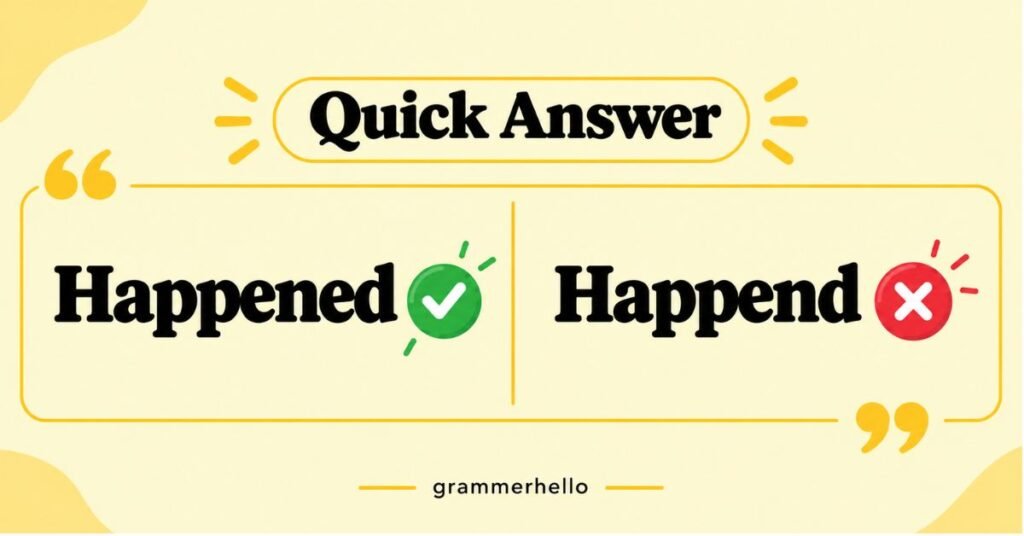
Happened is the only correct spelling. It is the past tense and past participle of the verb happen.
Happend is a typo. No standard dictionary lists it, and no style guide accepts it.
Here is the shortest way to remember it:
Happen + ed = happened.
The base verb ends in “n.” The past-tense ending is “-ed.”
Put them together without dropping anything, and you get the right word.
Correct: The accident happened on Monday morning.
Incorrect: The accident happend on Monday morning.
What Does “Happened” Actually Mean?
“Happened” describes something that took place in the past. It can refer to an event, a situation, or a change.
It often answers the question, “What occurred?”
Dictionaries usually give a few core senses for the verb happen:
- To occur or take place. The meeting happened last week.
- To occur by chance. We happened to meet at the airport.
- To befall someone or something. Nothing bad happened to her.
Because it is a regular verb, “happened” works as both the simple past and the past participle.
You can use it on its own or after a helping verb.
- Simple past: The storm happened overnight.
- Present perfect: Something strange has happened.
- Past perfect: I had no idea what had happened.
Is “Happened” Ever Used as an Adjective?
Rarely. In most cases it stays a verb.
You will see it in questions like “What happened?” or in phrases like “whatever happened to.”
Why Is “Happend” Wrong?
“Happend” breaks the basic rule for forming the regular past tense. Regular verbs add -ed.
The word happen already ends in “n,” so you simply attach “ed.” Nothing is removed.
When you write “happend,” you drop the “e” from the ending. The result looks like a word, but it follows no pattern in English.
There are three common reasons people make this mistake:
- Speech habits. In normal speech, the “e” in “-ed” is barely heard. The ear hears a soft ending, so the hand skips a letter.
- Fast typing. The “e” and “d” are neighbors on the keyboard. Skipping or swapping them is easy.
- Mixed-up doubling rules. Learners remember that some verbs double the last letter, like planned. Then they confuse which rule fits which word.
The Doubling Rule and Why It Doesn’t Apply Here
English doubles a final consonant before “-ed” when the stressed syllable comes last. Think of begin and beginning, or occur and occurred.
Happen is different. The stress falls on the first syllable: HAP-pen.
The last syllable is weak, so the “n” does not double. That is why the right form is happened and not happenned.
And “happend” fails too, because it removes a letter instead of adding one.
What Spell Checkers Do
Most spell checkers flag “happend” with a red underline right away.
If your tool misses it, check the word by hand. It is a quick fix that makes your writing look more careful.
Click Here To Read More Grammar
Want more help with commonly confused words and tricky spellings?
Browse the other grammar guides on this site to sharpen your writing, one word at a time.
Where Did the Word “Happened” Come From?
Knowing a word’s history can make its spelling easier to remember.
The verb happen comes from the Middle English word happenen, which developed in the 14th century. It grew out of the older noun hap, meaning luck, chance, or fortune.
That noun has roots in Old Norse, the language of the Vikings. They left many everyday words in English.
You can still see “hap” in other words:
- Haphazard: left to chance
- Mishap: an unlucky event
- Perhaps: by chance
- Hapless: unlucky
- Happy: originally meant “lucky” or “fortunate”
So the verb happen once meant “to come about by chance.”
Over time, it broadened to mean any event that takes place, planned or not.
The “-en” ending was a common verb marker in Middle English. Later, “-ed” became the standard past-tense ending for regular verbs, and happen took it on.
Why this matters for spelling: The word has a “hap” root, an “-en” ending, and an “-ed” ending. Each piece keeps its letters.
How to Pronounce and Spell “Happened” Correctly
Spelling and sound don’t always match in English. “Happened” is a good example.
Breaking the Word Into Parts
Here is a simple way to see all the letters:
| Part | Letters | Role |
|---|---|---|
| Root | hap | Old word for luck or chance |
| Verb ending | pen | Completes the base verb happen |
| Past-tense ending | ed | Marks the past |
Spell it out slowly: H-A-P-P-E-N-E-D.
That is eight letters, with two “p”s and two “e”s.
The Double P and the Double E
Two spots trip people up.
- Double P: The base verb happen has two “p”s. They stay in the past tense.
- Double E: One “e” comes from happen, and one comes from “-ed.” Both stay.
If your version has only seven letters, you have probably dropped one.
A Quick Spelling Routine
- Write the base verb: happen.
- Add the ending without changing anything: -ed.
- Read it back: happened.
Happened or Happend: Quick Comparison Table
| Feature | Happened | Happend |
|---|---|---|
| Correct spelling? | Yes | No |
| Found in dictionaries? | Yes | No |
| Part of speech | Verb (past tense and past participle) | Not a recognized word |
| Letters | 8 | 7 |
| Follows the “-ed” rule? | Yes | No |
| Safe for school, work, and publishing? | Yes | No |
| Example | The event happened yesterday. | The event happend yesterday. (wrong) |
Bottom line: Always choose happened.
How to Use “Happened” in a Sentence
The word fits into many sentence patterns. Here are the most useful ones.
As a Simple Past Verb
Use it to describe a finished event.
- The power cut happened around midnight.
- It all happened so fast.
- Nothing like that has happened before.
In Questions
Questions with “happened” are everywhere in daily talk.
- What happened to your phone?
- When did it happen? (After “did,” the verb stays in its base form.)
- Do you know what happened at the meeting?
With “To” for Chance
Use “happened to” for things that occurred by luck.
- I happened to be near the station when the train arrived.
- She happened to know the answer.
With Perfect Tenses
- Something unexpected has happened.
- I wondered what had happened to the report.
In Common Phrases and Idioms
- Whatever happened to…? Asks what became of a person or thing.
- It happened that… A formal way to introduce an event.
- Stranger things have happened. Something unlikely is still possible.
- Accidents happen. Mistakes are normal.
A helpful tip: after “did,” “does,” or “do,” always use the base form happen.
- Correct: What did happen?
- Incorrect: What did happened?
How to Pronounce “Happened”
The standard pronunciation is HAP-und (/ˈhæpənd/). It has two syllables, and the stress falls on the first.
Here is how it breaks down:
- HAP: rhymes with cap or map
- -und: a soft, quick ending
In casual speech, many people shorten the second syllable even more, so it sounds like HAP-nd.
That is normal for speaking. It is also exactly why spelling slips happen.
Practice phrases:
- “What happened?”
- “It happened again.”
- “I’m not sure what happened.”
Say each one aloud a few times. Then write it down in full.
Real-Life Usage Examples
Seeing a word in different settings helps it stick. Here are examples from ordinary situations.
Everyday Conversation
- “You won’t believe what happened on my way to work.”
- “Did something happen? You look worried.”
- “That happened to me last year, too.”
Storytelling
- The strangest thing happened just before sunrise.
- No one could explain how it happened.
- Whatever happened that night stayed a mystery for years.
News and Reporting Style
- Officials are still investigating what happened at the site.
- The incident happened shortly after noon.
- Witnesses described what happened in the minutes before the alarm.
School and Study
- Explain what happened during the experiment.
- Write a paragraph about an event that happened in your town.
- The class discussed what happened after the treaty was signed.
Social Media Captions
- “Guess what happened today!”
- “Well, that happened.”
- “Remember when this happened? Good times.”
Email Writing Examples
In email, a small spelling error can make a message look rushed. These samples show “happened” used correctly in a professional tone.
Reporting a Problem
Subject: Update on the missed delivery
Hi Sarah,
I wanted to let you know what happened with yesterday’s shipment. The courier reported a delay at the depot.
I have asked for a new delivery date and will update you soon.
Best regards, Daniel
Following Up After a Meeting
Subject: Notes from today’s call
Hello team,
Thank you for joining. Below is a short summary of what happened during the meeting.
The next steps we agreed on are listed at the end.
Kind regards, Priya
Apologizing for a Mistake
Subject: Apology for the error
Dear Mr. Ahmed,
I am sorry for the mix-up in your invoice. Here is what happened: a figure was entered twice during processing.
It has now been corrected, and a revised copy is attached.
Sincerely, Maria
Asking for Information
Subject: Quick question about the report
Hi James,
Could you tell me what happened to the second chart in the draft? It seems to have been removed in the latest version.
Thanks, Olivia
Email tip: Before you hit send, scan your message for slips like “happend,” “recieve,” or “definately.”
A quick re-read takes seconds and protects your credibility.
Common Mistakes People Make With “Happened”
Spelling “happend” is not the only way writers go wrong. Watch for these errors, too.
| Mistake | Why It’s Wrong | Correct Version |
|---|---|---|
| happend | Drops the “e” in “-ed” | happened |
| hapened | Only one “p” | happened |
| happenned | Doubles the “n” unnecessarily | happened |
| happpened | Three “p”s | happened |
| happaned | Wrong vowel in the middle | happened |
| What did happened? | “Did” needs the base verb | What did happen? |
| It was happened yesterday. | “Happen” is not used in the passive | It happened yesterday. |
The Passive Voice Trap
“Happen” is an intransitive verb. It does not take a direct object.
Because of that, it cannot be turned into a passive sentence.
- Incorrect: The event was happened last week.
- Correct: The event happened last week.
Mixing Up the Tense After “Did”
When you use “did” to form a question or negative, the main verb goes back to its base form.
- Incorrect: It didn’t happened.
- Correct: It didn’t happen.
Happened vs Happening vs Happens: What Is the Difference?
All three words come from the same verb. They point to different times.
| Form | Tense or Role | Meaning | Example |
|---|---|---|---|
| happen | Base form | To occur | Accidents can happen to anyone. |
| happens | Third-person singular present | Occurs regularly or now | It happens every spring. |
| happened | Past tense / past participle | Occurred before now | It happened last night. |
| happening | Present participle / gerund | Occurring right now | Something odd is happening. |
How to Choose the Right Form
Ask yourself one question: When did it take place?
- Already done? Use happened.
- Going on right now? Use is happening or are happening.
- A habit or general truth? Use happens.
- After “to,” “can,” “will,” or “did”? Use happen.
Quick Side-by-Side Sentences
- Yesterday: The concert happened at the main hall.
- Right now: The concert is happening at the main hall.
- Every year: The concert happens at the main hall every June.
- Future: The concert will happen at the main hall next week.
“Happening” can also be an informal adjective meaning lively or fashionable, as in “a happening place.”
That usage is casual, so avoid it in formal writing.
Which One Should You Use?
Use happened. Every time.
There is no regional variation. There is no British or American split, and no style guide allows “happend.”
Here is a simple checklist:
- Is the event in the past? Use happened.
- Writing a formal document? Use happened.
- Texting a friend? Use happened.
- Worried it looks odd? Count the letters. If there are eight, you are right.
If you ever doubt yourself, remember the formula: happen + ed.
Related Words People Often Misspell Too
Also Read This:Fiend vs. Feen: Which Spelling Is Correct? Meaning and Examples (2026)
If you slip on “happened,” you may also stumble on other words with unstressed endings or tricky letters.
Here is a short list to review.
| Common Misspelling | Correct Spelling | Quick Note |
|---|---|---|
| occured | occurred | Stress is on the last syllable, so the “r” doubles |
| recieved | received | “I before E, except after C” |
| opend | opened | Same ending problem as “happend” |
| listend | listened | Keep the full “-ed” ending |
| begining | beginning | Stress on the last syllable, so the “n” doubles |
| definately | definitely | Look for “finite” inside the word |
| seperate | separate | Remember “a rat” in sep-a-rat-e |
| neccessary | necessary | One “c,” two “s”s |
| accomodate | accommodate | Two “c”s and two “m”s |
| embarass | embarrass | Two “r”s and two “s”s |
Notice the pattern. Many mistakes involve skipping a letter or doubling the wrong one.
Regular reading and proofreading help a lot.
Common Curiosities
Can “Happend” Ever Be a Name or Brand?
Someone might use it as a stylized brand or username. That does not make it a standard word.
In regular writing, treat it as an error.
Why Do So Many People Type It Wrong?
Mostly because of how we speak. The “-ed” ending is so light that many writers never “hear” the “e.”
Add fast typing on a phone, and the mistake spreads.
Is “Happened” Formal or Informal?
Neither. It is neutral.
You can use it in a legal report, a school essay, or a casual chat.
Does Autocorrect Always Catch It?
Not always. It may leave the word alone, or change it to a different word.
It is smart to re-read important messages.
What Is the Difference Between “Happened” and “Occurred”?
Both mean “took place.” Occurred sounds slightly more formal and is common in reports.
Happened is more natural in everyday speech. You can swap them in most sentences.
- Casual: What happened at the party?
- Formal: The error occurred during data entry.
Are There Other Words to Use Instead?
Yes. Depending on context, you can use took place, occurred, came about, transpired, or unfolded.
Be careful with transpired. Some writers prefer to keep it for the sense of “became known.”
Tips to Never Misspell “Happened” Again
Good spelling comes from habits. Try these steps.
- Learn the formula. Write “happen + ed” on a sticky note and keep it near your desk.
- Slow down on the ending. Pause for a moment on the last two letters.
- Say it in parts. Read it as hap-pen-ed while you type, even if you say it as hap-und out loud.
- Proofread important messages. Search your document for “happend” before you send it.
- Turn on spell check. Make sure it is active in your email, word processor, and phone.
- Read more. The more you see the word spelled correctly, the more natural it feels.
- Write it ten times. It is old-fashioned, but it builds muscle memory.
- Keep a personal list. Note the words you often misspell and review them weekly.
Memory Tricks
Short tricks can help the right spelling stay in your head.
Trick 1: The Two Pairs
Happened has a double “p” near the start and an “e” at both the middle and the end.
Picture it as a balanced word that is complete.
Trick 2: Count to Eight
Hap-pen-ed has eight letters. If your word has seven, it is missing something.
Trick 3: The “Pen” Inside
Look for the word pen hiding in the middle of “happened.”
Think: “I wrote what happened with a pen.” The pen reminds you that “e” and “n” belong in the word.
Trick 4: Say It the Old Way
Pronounce it slowly as hap-pen-ed, with a clear “e” in each part.
Do this only when spelling, not when talking. It is a spelling aid, not a speaking style.
Trick 5: Learn It in a Group
Words with the same pattern include opened, listened, widened, and threatened.
If you spell one correctly, you can spell them all.
Final Thoughts
The answer is simple: “happened” is the correct spelling, and “happend” is not a word. The verb happen takes the regular “-ed” ending for the past tense, and no letters are dropped. Just remember the formula happen + ed, and you will never go wrong.
Small spelling details shape how readers see your writing, whether it is an email, an assignment, or a social media post. With the tips and memory tricks above, you can now spell “happened” with confidence in 2026 and beyond.