

Introduction
You are describing a dirty kitchen, a rough city street, or a hip-hop beat, and you stop mid-sentence. Does “grimy” have an “e” in it?
It is a fair question. English has plenty of inconsistent spellings, and this one trips up even confident writers. This guide settles the debate, explains the meaning and history of the word, and gives you examples, synonyms, and memory tricks you can use right away.
Grimey or Grimy: Quick Answer
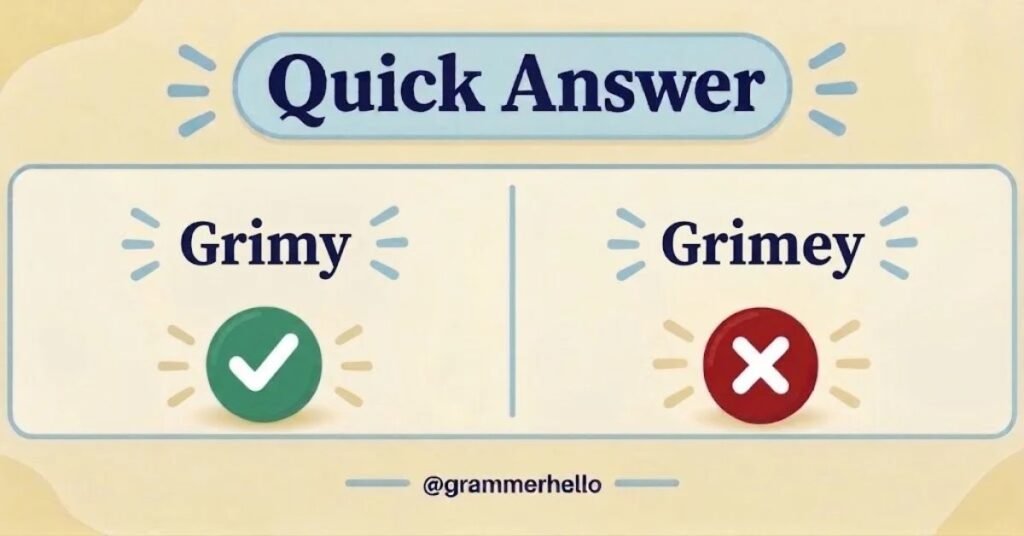
Grimy is the correct spelling. Grimey is a common misspelling.
The word comes from the noun grime plus the ending -y. When you add -y to a word that ends in a silent “e,” you usually drop the “e.” That is why grime becomes grimy, just like slime becomes slimy and shine becomes shiny.
| Spelling | Status | Example |
| grimy | Correct, standard spelling | “The windows were grimy.” |
| grimey | Misspelling in standard writing | Avoid in formal and everyday writing |
Fast rule: if you can say “covered in grime,” write grimy.
What Does Grimy Mean?
Grimy is an adjective. It means covered with grime, which is dirt that has built up and stuck to a surface.
That detail matters. Grimy does not describe a light dusting or a fresh splash of mud. It suggests dirt that is ingrained, greasy, or sooty, the kind that takes real scrubbing to remove.
Main meanings
- Covered in built-up dirt. “The garage floor was grimy with oil.”
- Rough or run-down. “They walked through a grimy part of town.”
- Morally unpleasant. “It was a grimy deal that left everyone feeling uneasy.”
- Gritty in style. In music and slang, grimy can describe a raw, dark, edgy sound or look.
The first meaning is by far the most common. The others grow out of it.
How Do You Pronounce Grimy?
Grimy is pronounced GRY-mee. The phonetic spelling is /ˈɡraɪmi/.
| Part | Sound | Tip |
| gri- | “gry,” like try | Long “i” sound |
| -my | “mee” | Light and unstressed |
The stress falls on the first syllable. British and American speakers say it the same way. It rhymes with slimy and limey.
If you can hear the long “i” in the first syllable, you can feel why the spelling needs no extra “e.” The “i” already does the work, and the final “y” only adds the soft “ee.”
Why Do People Spell It “Grimey”?
Plenty of capable writers type “grimey.” There are good reasons for it.
- Spelling rules are inconsistent. English keeps the silent “e” in some -y words, such as pricey, dicey, and cagey. Writers see those and assume grimey might follow suit.
- The base word has an “e.” Because grime ends in “e,” the brain wants to keep it.
- Sound can mislead. The “ee” at the end feels like it might need a letter pair.
- Slang and music spellings spread online. Nicknames, shop names, and social media captions sometimes use a looser spelling for style.
- Famous mix-ups. When grimy was the answer in a popular word game in early 2023, many players complained online that it should have an “e.”
So the error is not random. It comes from real patterns in how English works.
Can “Grimy” Be Used to Describe a Person?
Yes, but be careful. Grimy can describe a person in three ways.
- Physically dirty. “The mechanic came home grimy and tired.” This is neutral, even sympathetic.
- Looking unkempt. “He looked grimy after three days on the trail.” Again, this is descriptive.
- Morally questionable. “She called the lobbyist a grimy opportunist.” This is an insult.
Because the last meaning can sting, think about your audience. Describing hands, faces, or clothes as grimy is normal. Calling someone’s character grimy is strong language.
Is “Grimey” a Real Word or Just a Mistake?
For standard English, “grimey” is a mistake. Major dictionaries list grimy as the headword. You will not see “grimey” as the preferred form in dictionaries, style guides, or professional publishing.
Some online and community dictionaries record “grimey” as an informal alternative, and you will see it in nicknames, brand names, and slang. That does not make it correct in an essay, email, or article.
| Context | Which to use |
| Academic writing | grimy |
| News and business writing | grimy |
| Everyday emails and texts | grimy |
| Official brand or stage names | Match the owner’s spelling |
If you are quoting a name that uses “grimey,” copy it exactly. Otherwise, choose grimy.
What Is the Origin and History of the Word “Grimy”?

The history of grimy is simple and tidy.
Built from grime
Grimy is formed from grime plus the suffix -y, which means “full of” or “like.” So grimy literally means “full of grime.” Etymology references trace it to the early 1600s and note that it was not much used in literary writing during the 1700s.
Where grime comes from
Grime means ingrained dirt. Dictionary sources link it to an older Germanic root related to smearing. That fits how grime behaves: it smears and sticks.
The -y ending
The suffix -y has been attaching to nouns for centuries. We see it in words like dusty, smoky, muddy, greasy, and sooty. Most keep the root’s meaning and add the sense of “covered with.”
Grimy vs. Dirty vs. Filthy vs. Grubby
These words overlap, but they are not identical. Each carries a different level of dirt and a different tone.
| Word | Core meaning | Intensity | Typical use |
| Dirty | Not clean | Mild to medium | General, all-purpose |
| Grimy | Covered in built-up dirt | Medium to strong | Surfaces, hands, city streets |
| Filthy | Extremely dirty | Very strong | Disgusting messes |
| Grubby | Slightly dirty, shabby | Mild | Informal, hands and clothes |
Quick examples
- Dirty: “Put the dirty plates in the sink.”
- Grimy: “The oven door was grimy with baked-on grease.”
- Filthy: “The abandoned house was filthy.”
- Grubby: “He wiped his grubby hands on his jeans.”
How to choose
- Pick dirty when you want a neutral word.
- Pick grimy when the dirt is thick, sticky, or ingrained.
- Pick filthy when you want to stress that something is extremely dirty.
- Pick grubby for a lighter, casual, often British-flavored tone.
How to Use “Grimy” in a Sentence
Grimy usually sits before a noun or after a linking verb.
Before a noun
- “She wiped the grimy window with a cloth.”
- “A grimy film covered the old tiles.”
After a verb
- “His hands were grimy from the garden.”
- “The kitchen got grimy after the party.”
Figurative use
- “The scandal left a grimy stain on the company’s reputation.”
- “It was a grimy business from start to finish.”
Slang and music use
- “The producer built a grimy, bass-heavy beat.”
Sentence patterns to remember
| Pattern | Example |
| grimy + noun | grimy hands |
| be + grimy | The floor is grimy. |
| get/become + grimy | The walls got grimy. |
| grimy with + noun | grimy with soot |
When Did “Grimy” First Appear in English?
Etymology records place grimy in the 1610s. It was built from grime, which was already in use.
A note from a major historical dictionary says the word was apparently not in literary use during the 18th century. That does not mean people stopped saying it. It means writers of formal literature seemed to favor other words for a time.
In the 1800s and after, as cities industrialized, the word fits naturally. Factories, coal smoke, and crowded streets created plenty of things to call grimy. Today it is common in everyday English, journalism, and fiction.
Common Mistakes with Grimy

| Mistake | Problem | Fix |
| “grimey” | Extra “e” | Write grimy |
| “grimmy” | Double “m” | Write grimy |
| “grime” as an adjective | Noun used as adjective | Write grimy |
| “grimier” spelled “grimeier” | Wrong form | Write grimier |
| Using “grimy” for light dust | Too strong | Use dusty |
| Using “grimy” for fresh mud | Not ingrained | Use muddy |
Other tips
- Do not confuse grim and grimy. Grim means serious, bleak, or stern. “The news was grim.” Grimy means dirty.
- Mind the tone. Grimy is stronger than dirty. Do not use it if you only mean slightly messy.
- Do not mix up grime the noun and grime the music. Grime is also a genre of electronic music from London. Context makes it clear.
What Types of Things Can Be Described as Grimy?
Almost anything that collects dirt, grease, soot, or residue.
In the home
- Kitchen counters and stovetops
- Bathroom tiles and grout
- Windows and window frames
- Light switches and doorknobs
- Ovens and extractor fans
Outdoors and in public
- City streets and alleyways
- Subway stations
- Old bus windows
- Industrial areas
- Public restrooms
Tools and vehicles
- Engine parts
- Work gloves
- Car interiors
- Bike chains
People and clothing
- Hands, faces, and fingernails
- Work uniforms
- Sports kits after a muddy match
Ideas and situations
- A grimy deal
- A grimy campaign
- A grimy reputation
Is There a British or American Spelling Difference?
Also Read This:Channel vs. Chanel: Meaning, Difference, and Correct Usage Explained (2026)
No. Grimy is spelled the same way in American, British, Canadian, and Australian English.
| Variety | Spelling | Pronunciation |
| American English | grimy | GRY-mee |
| British English | grimy | GRY-mee |
| Australian and Canadian English | grimy | GRY-mee |
Some English words change by region, such as color and colour. Grimy is not one of them. If you see “grimey,” it is not a regional variant. It is just a misspelling or a stylized spelling.
Easy Memory Trick for “Grimy”
Try one of these.
- Swap the “e” for the “y.” Grime loses its “e,” and y takes its place. Think: “The e goes, the y grows.”
- Match it with slimy. You would never write “slimey.” Say “grimy, slimy” together.
- Spot the base word. Write grime, cross out the “e,” add y.
- Picture the word. Imagine the “y” as a tiny brush wiping away the “e.”
- Use a rhyme. “Grimy and slimy, no extra e.”
Grimy Synonyms
Choose the synonym that fits your tone and meaning.
| Synonym | Tone | Best for |
| Dirty | Neutral | General use |
| Filthy | Strong | Very dirty things |
| Grubby | Casual | Hands, clothes |
| Sooty | Specific | Soot or smoke |
| Greasy | Specific | Oil or fat |
| Grungy | Informal | Messy, worn places |
| Soiled | Formal | Stained fabrics |
| Mucky | Informal, British | Mud and mess |
| Squalid | Strong | Poor, run-down conditions |
| Unclean | Formal | Official or clinical writing |
Antonyms
- Clean
- Spotless
- Pristine
- Sparkling
- Immaculate
Grimy: Related Word Forms
Knowing the whole word family helps you write with confidence.
| Form | Part of speech | Example |
| grime | Noun | “Wipe off the grime.” |
| grime | Verb | “Soot grimed the walls.” |
| grimed | Verb (past) | “The tools were grimed with oil.” |
| griming | Verb (-ing form) | “Smoke is griming the ceiling.” |
| grimy | Adjective | “A grimy window” |
| grimier | Comparative | “This floor is grimier than that one.” |
| grimiest | Superlative | “That was the grimiest stove I have seen.” |
| grimily | Adverb | “He wiped his face grimily.” |
| griminess | Noun | “The griminess of the station was striking.” |
| begrimed | Adjective, literary | “A begrimed miner emerged.” |
Notice that the “e” is dropped in grimy, grimier, and grimiest, and also in griming. It only appears in grime and grimed.
Conclusion
The correct spelling is grimy, not “grimey.” It comes from grime plus -y, and the silent “e” drops out, just as it does in slimy and shiny.
Use grimy for thick, built-up dirt, for run-down places, and for things that feel morally unpleasant. Choose dirty, filthy, or grubby when you need a different level of intensity.