

You see them everywhere. A pre-game show. A post-game interview. A pre-order bonus. A post-op checkup.
Two tiny word beginnings, pre and post, quietly tell you when something happens. Yet many people mix them up, wonder when to add a hyphen, or ask whether a word like “post-existing” is even real.
This guide clears all of that up. You will learn what each prefix means, how it changes a word, how to say each one, and how to use them in school, work, health, film, and everyday writing. You will also get comparison tables, example sentences, a list of common mistakes, and memory tricks that actually stick.
Quick Answer: Pre vs Post
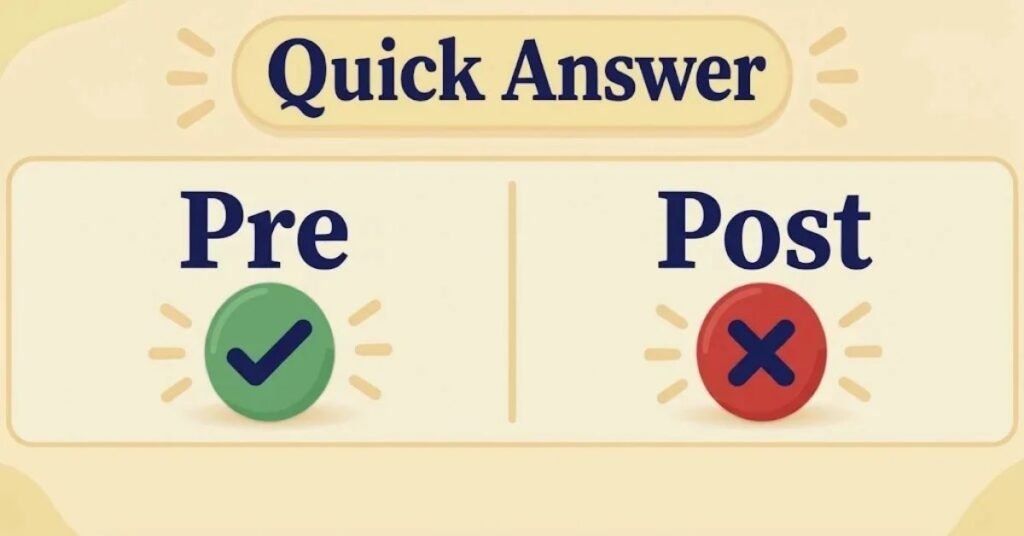
Pre means before. Post means after.
| Prefix | Meaning | Latin root | Example |
| Pre- | Before, earlier than, in advance | prae (before) | Preheat the oven |
| Post- | After, later than, following | post (after, behind) | Postgame interview |
Simple rule: Pre comes first. Post comes later. Think of a timeline: pre → event → post.
Featured Snippet Answer
What is the difference between pre and post?
Pre and post are opposite prefixes that describe timing. Pre- means before something happens, as in pre-test or preschool. Post- means after something happens, as in post-test or postwar. Added to the front of a word, each one shows whether an event, state, or action comes earlier or later.
What Is the Difference Between Pre and Post?
Both are prefixes. A prefix is a short group of letters added to the front of a word to change its meaning. The word prefix even contains pre, which tells you it goes before the main word.
The difference comes down to time order:
- Pre- points backward in time to what comes first.
- Post- points forward in time to what comes next.
A Simple Timeline
PRE —————— EVENT —————— POST
(before) (after)
Take the word operative, which relates to surgery:
- Pre-operative: the period before surgery
- Post-operative: the period after surgery
Same root, opposite timing.
Where the Two Prefixes Came From
Both come from Latin:
- Pre- from prae, meaning “before” in time, place, or order. It reached English mostly through French.
- Post- from post, meaning “behind” or “after.”
Because they are old and very productive, English keeps using them to build new words, from pre-boarding to post-pandemic.
A Quick Warning About “Post”
Post is trickier than pre. On its own, “post” is also a noun and a verb with unrelated meanings:
- A fence post (a pole)
- A social media post (a message)
- To post a letter (to mail it)
- A military post (a station)
- A job post (a position)
Only the prefix post- means “after.” The standalone word usually has nothing to do with time.
How to Pronounce Pre and Post
| Prefix | Sound | Rhymes with | Notes |
| Pre- | /priː/ or /prɪ/ | “tree” or “pit” start | The vowel can be long or short depending on the word |
| Post- | /poʊst/ | “toast,” “most” | Always a long “o” followed by “st” |
Examples
- Preview sounds like PREE-vyoo.
- Prepare often sounds like prih-PAIR, with a short vowel.
- Postpone sounds like pohst-POHN.
- Postscript sounds like POHST-skript.
Stress Patterns
In many compound words, the stress falls on the prefix when it is a clear “before” or “after” marker.
- PRE-game
- POST-game
- PRE-order
- POST-war
In longer words, stress may move. Check a dictionary when you are unsure.
Why Pre and Post Are Important in English
These two prefixes do a lot of work in very little space.
- They save words. Prewar replaces “before the war.”
- They add precision. Postoperative care tells you exactly when the care happens.
- They appear in specialized fields. Medicine, research, film, technology, finance, law, and education all rely on them.
- They help you decode new words. If you know the prefix, you can often guess the meaning of an unfamiliar word.
- They improve clarity. A reader instantly sees whether an event comes earlier or later.
Where You Will Meet Them
| Field | Examples |
| Medicine | pre-op, post-op, prenatal, postnatal, postpartum |
| Education | pre-test, post-test, preschool, postgraduate |
| Film and media | pre-production, post-production, pre-roll |
| Fitness | pre-workout, post-workout |
| Business | pre-order, prepaid, postpaid, pre-tax, post-tax |
| History and culture | prehistoric, post-war, post-modern |
| Technology | pre-release, post-launch, preconditions, postconditions |
How These Prefixes Change Word Meaning
A prefix does not stand alone. It attaches to a base word and changes the timing of its meaning.
The Formula
Prefix + base word = new meaning
| Prefix | Base word | New word | Meaning |
| Pre- | heat | Preheat | Heat beforehand |
| Pre- | view | Preview | See beforehand |
| Pre- | paid | Prepaid | Paid in advance |
| Post- | pone | Postpone | Put off until later |
| Post- | script | Postscript | Written after |
| Post- | war | Postwar | After a war |
Part of Speech Can Shift
Adding a prefix does not always keep the word type the same. Look at these:
- Pre + school (noun) → preschool (noun or adjective)
- Post + game (noun) → postgame (adjective: postgame interview)
- Pre + order (verb) → pre-order (verb or noun)
Hyphen Rules at a Glance
Style guides differ, but these habits work well in most writing:
- Usually no hyphen with common words: preschool, postwar, prepay, postgraduate.
- Use a hyphen before a capital letter: pre-Columbian, post-Victorian.
- Use a hyphen before a number: pre-1990, post-2020.
- Use a hyphen when it prevents confusion or an awkward double letter: pre-eminent in some styles, post-traumatic in others.
- Use a hyphen for newer or less common combinations: pre-dinner, post-lunch.
- Be consistent. Pick one style and keep it across your document.
Some dictionaries write preexisting as one word. Others keep the hyphen. When in doubt, follow your style guide or a current dictionary.
Pre vs Post Comparison Table
| Feature | Pre- | Post- |
| Core meaning | Before | After |
| Timeline position | Earlier | Later |
| Latin origin | prae | post |
| Common sense | Preparation, advance, first stage | Aftermath, follow-up, later stage |
| Used alone as a word? | No, only as a prefix (or short for “pre-” terms) | Yes, but with other meanings |
| Medical example | Pre-operative | Post-operative |
| Education example | Pre-test | Post-test |
| Film example | Pre-production | Post-production |
| Fitness example | Pre-workout | Post-workout |
| Opposite | Post- | Pre- |
Common Words Using Pre
Here are widely used words with pre-, grouped by theme.
Everyday Words
| Word | Meaning |
| Preheat | Heat before use |
| Preview | View beforehand |
| Prepay | Pay in advance |
| Prepare | Get ready beforehand |
| Precaution | Step taken in advance |
| Prefix | Letters placed before a word |
| Preface | Introduction before the main text |
| Prevent | Stop something before it happens |
Education and Life Stages
| Word | Meaning |
| Preschool | School before formal education |
| Pre-K | The year before kindergarten |
| Pre-teen | Before the teenage years |
| Prerequisite | Required beforehand |
| Pre-med | Study before medical school |
| Pre-law | Study before law school |
Health
| Word | Meaning |
| Prenatal | Before birth |
| Pre-op | Before surgery |
| Preventive | Aimed at stopping problems before they start |
| Pre-diabetes | A stage before diabetes |
Business and Technology
| Word | Meaning |
| Pre-order | Order before release |
| Pre-tax | Before taxes are taken out |
| Pre-sale | Sale before the official launch |
| Pre-release | Before public release |
| Preload | Load before use |
History and Time
| Word | Meaning |
| Prehistoric | Before recorded history |
| Prewar | Before a war |
| Pre-industrial | Before industrial development |
Not Every “Pre” Word Is a Prefix Word
Some words start with pre but are not built from the prefix. In these, “pre” is just part of the base word:
- Prey: an animal hunted by another
- Pretty: attractive
- Press: to push down
- Present: here, or a gift
Quick test: remove “pre.” If what remains is not a meaningful word, it is probably not the prefix.
Common Words Using Post
Everyday Words
| Word | Meaning |
| Postpone | Delay until later |
| Postscript (P.S.) | Note added after the main letter |
| Postwar | After a war |
| Postdate | Give a later date than the actual one |
| Postgame | After a game |
| Post-meal | After eating |
Education and Work
| Word | Meaning |
| Postgraduate | After a first degree |
| Postdoctoral | After a doctorate |
| Post-test | Test given after instruction |
| Post-secondary | After high school |
| Post-training | After a training session |
Health
| Word | Meaning |
| Postnatal | After birth |
| Postpartum | After childbirth |
| Post-op | After surgery |
| Postmortem | After death (an examination or review) |
| Post-traumatic | After a traumatic event |
Business and Technology
| Word | Meaning |
| Postpaid | Paid for after use |
| Post-tax | After taxes are taken out |
| Post-launch | After a launch |
| Post-purchase | After buying |
| Post-production | Work done after filming |
Culture and History
| Word | Meaning |
| Postmodern | After the modern era |
| Post-industrial | After industrial dominance |
| Post-pandemic | After a pandemic |
| Post-Soviet | After the Soviet era |
Words Starting With “Post” That Are Different
Some post words use the noun or verb meaning instead of “after”:
- Postman, postbox, postcard: these relate to mail.
- Poster: a printed notice.
- Posture: a way of holding the body (unrelated to the prefix).
Pre vs Post Examples in Sentences

Seeing the words in context is the best way to learn them.
Sentences With Pre
- Please preheat the oven to 180 degrees.
- We watched a preview of the film.
- The airline offers pre-boarding for families.
- He completed a pre-trip safety check.
- Students attended a pre-semester orientation.
- She booked a pre-dinner meeting with the client.
Sentences With Post
- The coach gave a short postgame speech.
- They had to postpone the picnic because of rain.
- The nurse explained the post-operative instructions.
- Many families struggled in the post-war years.
- He added a joke in the postscript.
- The company expects growth in the post-pandemic market.
Pre and Post in the Same Sentence
- **Pre-**game nerves faded, and **post-**game joy took over.
- The study compared **pre-**intervention and **post-**intervention results.
- Her mood was better **post-**vacation than **pre-**vacation.
- Sales were flat **pre-**launch but jumped **post-**launch.
Pre-Test vs Post-Test Explained
These terms are common in education, training, and research.
Pre-Test
A pre-test is given before teaching or training begins. It shows what learners already know.
Post-Test
A post-test is given after the lesson or program ends. It shows what learners gained.
| Feature | Pre-test | Post-test |
| Timing | Before instruction | After instruction |
| Purpose | Measure starting knowledge | Measure learning outcome |
| Use for teachers | Plan lessons, spot gaps | Check progress, evaluate teaching |
| Use for researchers | Baseline measurement | Compare change from baseline |
Why Compare Them?
Comparing pre-test and post-test scores gives a simple picture of change. If scores rise, the lesson may have helped. Researchers often use a pretest-posttest design, and many add a control group to check that the change came from the lesson and not from something else.
Example
Before the unit, the class averaged 52 percent on the pre-test. After the unit, the average rose to 81 percent on the post-test.
Pre-Workout vs Post-Workout Explained
In fitness, the same logic applies.
- Pre-workout means anything done before exercise, such as warming up, eating a light snack, or drinking a pre-workout drink.
- Post-workout means anything done after exercise, such as stretching, rehydrating, or eating a recovery meal.
| Feature | Pre-workout | Post-workout |
| Timing | Before training | After training |
| Common goal | Prepare the body, boost energy | Aid recovery, restore fluids and fuel |
| Typical habits | Dynamic warm-up, light snack, water | Cool-down, stretching, protein and carbs, water |
| Product examples | Pre-workout powder or drink | Post-workout shake or recovery drink |
A Helpful Note
Pre-workout and post-workout products vary a lot in ingredients. Some contain high amounts of caffeine. Check labels, follow instructions, and talk to a doctor or registered dietitian if you have health conditions, take medication, or are pregnant. This article explains language, not medical advice.
Pre-Existing vs Post-Existing: Understanding the Difference
Pre-existing (also written preexisting) is a real and common word. It means already existing before something else happened or began.
- Insurance companies often ask about pre-existing conditions.
- The new design built on a pre-existing framework.
Post-existing, on the other hand, is not a standard word. You will rarely find it in dictionaries, and most writers avoid it.
What to Use Instead of “Post-Existing”
| If you mean | Better choice |
| Exists after something | Subsequent, later, following |
| Newly created after an event | Newly formed, post-event (with a clear noun) |
| Arising after a date | Post-2020, post-launch |
| Emerging later | Emerging, later-developing |
Quick Comparison
| Word | Status | Meaning |
| Pre-existing | Standard | Existing before |
| Post-existing | Not standard | Avoid; choose a clearer phrase |
| Co-existing | Standard | Existing at the same time |
The lesson: not every pre- word has a matching post- word. Always check that the word is real before you use it.
Pre-Production vs Post-Production Explained
These terms come from film, television, video, music, and podcasting.
The Three Main Stages
| Stage | Timing | Typical tasks |
| Pre-production | Before filming or recording | Writing scripts, budgeting, casting, scouting locations, storyboarding, scheduling |
| Production | During filming or recording | Shooting scenes, capturing audio, directing actors |
| Post-production | After filming or recording | Editing, sound mixing, color correction, visual effects, music, final export |
Why the Split Matters
- Pre-production saves time and money by planning ahead.
- Post-production shapes raw footage into a finished product.
Example
The team spent six weeks in pre-production, ten days shooting, and three months in post-production.
The same pattern works in other industries. Manufacturing, software, and events all have planning steps before the work and wrap-up steps after it.
Pre-Order vs Post-Order Explained
Pre-Order
A pre-order is a request to buy a product before its official release. The buyer usually pays or reserves in advance and receives the item once it launches.
- I pre-ordered the new headphones last month.
- Pre-order customers get a free case.
Post-Order
Post-order is less common in everyday shopping, and its meaning depends on context.
- In commerce: It can describe things that happen after an order is placed, such as post-order emails, post-order support, or post-order surveys.
- In computer science: Post-order is a way of visiting nodes in a tree, where the program visits child nodes first and the parent node last.
| Term | Everyday meaning | Technical meaning |
| Pre-order | Order before release | Traversal that visits the parent first |
| Post-order | After an order is placed | Traversal that visits the parent last |
If you write for a general audience, use a plain phrase like “after you place your order” so no one is confused.
Preconditions and Postconditions in Everyday Contexts
These two words come from logic, law, and programming, but they work in daily life too.
- A precondition is something that must be true before an action can happen.
- A postcondition is something that should be true after the action finishes.
| Situation | Precondition | Postcondition |
| Baking a cake | Oven is preheated, ingredients ready | Cake is baked and cooled |
| Boarding a flight | Passenger has a valid ticket and ID | Passenger is seated on the plane |
| Signing a contract | Both parties agree on terms | Contract is in force |
| Withdrawing cash | Account has enough funds | Balance is reduced by the amount |
| Online order | Items are in stock, payment is approved | Order is confirmed |
Why This Idea Helps
Thinking in preconditions and postconditions makes plans clearer. You see what must be ready first and what success should look like at the end. Programmers use the same idea to test code, but you can use it for projects, checklists, and meetings.
Common Mistakes When Using Pre and Post
Even confident writers slip here. Watch for these.
1. Mixing Up the Two
Wrong: The post-test shows what students know before the lesson. Right: The pre-test shows what students know before the lesson.
2. Using Post to Mean “Before”
Because “post” sounds like “posting,” some people think it means something sent earlier. It does not. Post- means after.
3. Splitting the Prefix From the Word
Wrong: pre school, post war Right: preschool, postwar
4. Overusing Hyphens
Wrong: pre-school, post-war (in styles that close them up) Right: preschool, postwar
Hyphens are still right in cases like pre-1990 and post-Victorian.
5. Forgetting a Hyphen Where It Is Needed
Wrong: pre1990, postCovid Right: pre-1990, post-COVID
6. Creating Words That Do Not Exist
Not every pre- word has a post- partner. Post-existing and postview (outside a technical meaning) can confuse readers.
7. Confusing Prefix “Post-” With the Noun “Post”
Post a message is about sharing. Post-message would be about timing. Keep the roles separate.
8. Writing “Pre” or “Post” as Standalone Words
In casual speech, people say “pre” or “post” alone, such as “pre and post surveys.” That works informally, but in formal writing, use the full term: pre-survey and post-survey.
9. Inconsistent Style
Weak: We used preschool, pre-K, and pre kindergarten in the same report. Better: Pick one pattern and stay with it.
Quick Fix Table
| Mistake | Fix |
| pre school | preschool |
| post war | postwar |
| pre1990 | pre-1990 |
| postCovid | post-COVID |
| post-test before the lesson | pre-test before the lesson |
| post-existing | later, subsequent |
Easy Memory Tricks for Pre vs Post
Pick the trick that fits your brain.
Trick 1: Look at the Letters
- PRE and PRIOR both start with PR.
- POST and PAST both start with P and end with a “t” sound: post- is the one you reach after something is past.
Trick 2: Think of Familiar Words
- Preview is the trailer you watch before the movie.
- Postscript is the note written after the letter.
If you can picture a word, you can remember its prefix.
Trick 3: The Mail Clue
A postman delivers after you send a letter. Mail arrives after. That is a fun anchor for post = after, even if the noun is a different word.
Trick 4: Preschool and Postgraduate
- Preschool: before school.
- Postgraduate: after graduation.
These two words alone cover the whole idea.
Trick 5: The Timeline Sketch
Draw a line. Mark an event in the middle. Write pre on the left and post on the right. Keep this picture in mind.
Trick 6: “Pre = Prepare, Post = Prolong the Aftermath”
A cheesy phrase, but it works: prepare first, then deal with the aftermath.
Pro Tips for Using Pre and Post Correctly
- Check the timing. Ask: does this happen before or after the main event?
- Use a dictionary for hyphens. Spelling styles change over time and across regions.
- Be consistent. If you hyphenate one similar word in a document, hyphenate the others.
- Define technical terms. In specialized writing, a short explanation helps non-experts.
- Avoid made-up words. If a term is not in a dictionary, ask whether a plain phrase is clearer.
- Do not stack too many prefixes. Pre-post-event survey is hard to read. Say surveys before and after the event.
- Match your audience. Casual posts can say “pre-game”; formal reports may prefer “before the game.”
- Use numbers and dates with hyphens. Pre-2000 and post-1945 are easy to read.
- Keep sentences short. The prefix already adds a layer of meaning.
- Read it aloud. If it sounds awkward, rewrite it.
Pre and Post in Academic and Professional Writing
Also Read This:Homemade vs. Home Made: Which Is Correct? Meaning, Difference, and Usage Examples (2026)
Precision matters in formal settings. Here is how the two prefixes show up and how to handle them.
Academic Writing
| Context | Example |
| Research design | Pre-intervention and post-intervention scores were compared. |
| Education studies | The pre-test established baseline knowledge. |
| History | Post-war reconstruction changed the economy. |
| Literature | Postmodern fiction often questions fixed meaning. |
Tips for academic writing:
- Follow the style guide required by your institution, such as APA, MLA, or Chicago.
- Define terms like post-test the first time you use them.
- Report the timing clearly, such as “four weeks post-intervention.”
Professional Writing
| Setting | Example |
| Healthcare | Post-operative instructions were given before discharge. |
| Project management | A post-project review captured lessons learned. |
| Marketing | Pre-launch buzz drove early sign-ups. |
| Finance | Post-tax profit rose by 8 percent. |
| Human resources | A pre-employment check is required. |
Tips for professional writing:
- Spell out unfamiliar terms once.
- Avoid jargon when a simple word works.
- Use before and after in plain-language documents for general readers.
- Keep forms and policy documents consistent in how they use hyphens.
Style Guide Note
Different guides give different advice. For example, one may close up postgraduate while another prefers a hyphen in certain cases. Check the guide you are required to follow and apply it throughout.
Common Words With Pre and Post
Many pairs show how the same base word flips with a different prefix. Use this as a quick reference.
| Pre- word | Post- word | Base idea |
| Pre-test | Post-test | Testing before and after learning |
| Pre-op | Post-op | Surgery |
| Prenatal | Postnatal | Birth |
| Pre-game | Post-game | A match or event |
| Pre-workout | Post-workout | Exercise |
| Pre-production | Post-production | Film or media making |
| Pre-launch | Post-launch | A product release |
| Prewar | Postwar | Conflict |
| Pre-tax | Post-tax | Taxes |
| Prepaid | Postpaid | Billing |
| Pre-sale | Post-sale | A sale |
| Pre-meal | Post-meal | Eating |
| Pre-industrial | Post-industrial | Industry |
| Pre-modern | Post-modern | A cultural era |
| Pre-pandemic | Post-pandemic | A health crisis |
Words Without a Natural Partner
| Word | Why it has no direct partner |
| Preface | Postface exists but is rare |
| Prevent | No common “post” version |
| Prejudice | No “post” version, different meaning |
| Postpone | No “prepone” in most standard use, though some regions use it informally |
Conclusion
Pre means before and post means after. Learn that pair, picture a simple timeline, and you can read or build hundreds of words, from preschool and pre-test to postwar and post-production.
Check hyphen rules in a current dictionary or style guide, stay consistent, and avoid inventing words like post-existing. When a plain phrase is clearer, write “before” or “after” and keep your reader on track.