

Autumn arrives, and the yard fills up. You want to write a caption about “the red ___ on the lawn.” Then you stop. Is it leafs or leaves?
The question is fair. Most English plurals just add an “s,” so leafs looks perfectly logical. Yet you have probably also seen Toronto Maple Leafs, which makes the whole thing even more confusing.
This guide sorts it out. You will learn the correct plural, why the word changes shape, which other words follow the same pattern, and the few cases where leafs is actually right. Tables, examples, common mistakes, and memory tricks are included to make the rule easy to keep.
Quick Answer: Is It Leafs or Leaves?
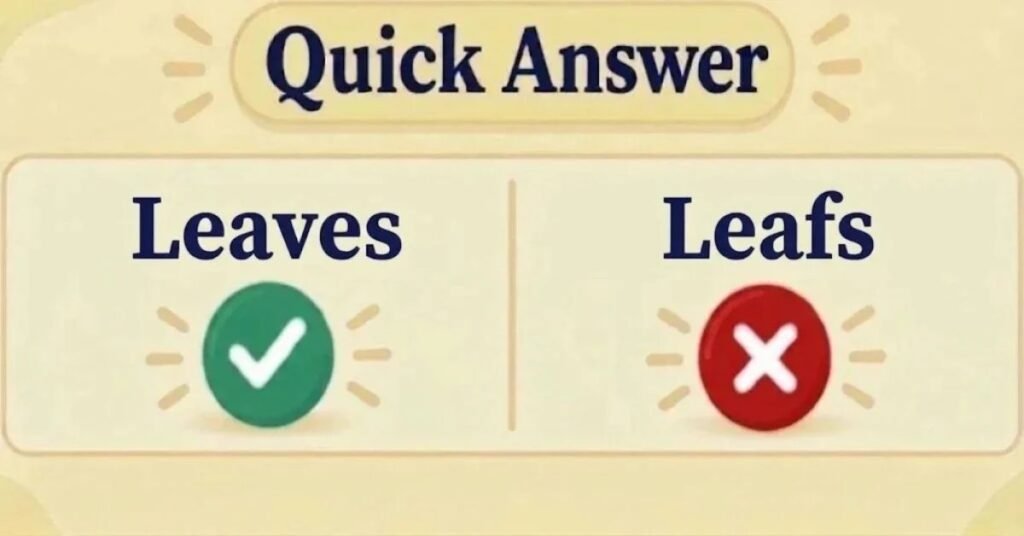
Leaves is the correct plural of the noun leaf.
Leafs is correct only in a few special cases: as the verb form (he leafs through a book) and in proper names such as the Toronto Maple Leafs.
| Word | Use it for | Example |
| Leaves | More than one leaf of a plant, a book, or a table | The leaves turned gold. |
| Leafs | Verb: turns pages or pushes out foliage. Proper noun: sports team name | She leafs through the report. |
Featured snippet answer: The plural of leaf is leaves. English changes the final “f” to “ves” in many nouns, such as knife → knives and wolf → wolves. Leafs is used only as a verb (she leafs through a magazine) or in proper names like the Toronto Maple Leafs.
What Is the Plural of Leaf?
The plural of leaf is leaves.
The word leaf has several meanings, and all of them use the same plural:
- Part of a plant. Oak leaves are lobed.
- A sheet of paper in a book. The old book had torn leaves. (One leaf has two pages: a front and a back.)
- A hinged or removable part of a table. We added two leaves to the dining table.
- A very thin sheet of material. The artist used leaves of gold.
Is “Leaf” Countable?
Yes. You can say one leaf, two leaves, many leaves. The phrase gold leaf is different. There, leaf refers to the material in general and is usually treated as a mass noun.
Leaf as a Verb
Leaf is also a verb, and that is where leafs appears.
| Form | Spelling | Example |
| Base | leaf | I like to leaf through old albums. |
| Third person singular | leafs | He leafs through the catalog. |
| Past | leafed | She leafed through the pages. |
| -ing form | leafing | They are leafing through magazines. |
You will often see it as the phrasal verb leaf through, which means to turn pages quickly. Trees can also leaf out, which means to grow new leaves in spring.
Leafs vs Leaves: What’s the Difference?
The difference is part of speech and context.
| Feature | Leaves | Leafs |
| Part of speech | Plural noun | Verb (third person), or proper noun plural |
| Standard plural of leaf? | Yes | No |
| Meaning | More than one leaf | Turns pages; or members of a group named “Leaf” |
| Typical example | Leaves covered the path. | He leafs through the file. |
| Appears in | Everyday English, science, books | Verb use, names, sports |
| Risk if misused | Low | Looks like a spelling error in most contexts |
Key Differences in Plain Words
- Leaves is the default. If you mean more than one leaf, use leaves.
- Leafs needs a reason. Use it only if it is a verb or part of a name.
- Leaves can also be a verb. He leaves at noon is from leave, not leaf. Do not mix them up.
- Leafs the verb is about pages or foliage. It is not a plural noun.
Why Does Leaf Become Leaves?
The change from f to v is a quirk that comes from the history of English.
The Sound Change Behind It
Old English had a sound habit: the f sound between vowels often became a voiced v sound. Over time, plural forms with a vowel ending developed the v sound, and spelling later followed. So the plural of leaf became leves, then leaves.
The singular form kept its original f, because the “f” sat at the end of the word and stayed unvoiced. This is why we say leaf with an f, but leaves with a v.
A Short Timeline
| Stage | What happened |
| Old English | Related forms were spelled differently, and the “f” sound changed with its neighbors |
| Middle English | Plural forms with the “v” sound became common (leves) |
| Early modern English | Spelling settled as leaves |
| Today | Leaves is standard everywhere; leaf keeps the “f” |
Why Not Just Add S?
Some words in English kept older patterns while most nouns moved to a simple “s” ending. Leaf is one of the survivors. English is full of such leftovers, like child → children and mouse → mice.
Is This Rule Still Alive?
Mostly no. New words almost always take a regular -s. The “f to ves” pattern is limited to a group of older, common words.
Other Words That Follow the Same Rule
Many everyday nouns that end in -f or -fe change to -ves in the plural.
| Singular | Plural |
| leaf | leaves |
| knife | knives |
| wife | wives |
| life | lives |
| wolf | wolves |
| shelf | shelves |
| half | halves |
| calf | calves |
| loaf | loaves |
| thief | thieves |
| elf | elves |
| self | selves |
Words With Two Accepted Plurals
A few words allow both forms.
| Singular | Plural options |
| scarf | scarves, scarfs |
| dwarf | dwarfs, dwarves |
| hoof | hooves, hoofs |
| wharf | wharves, wharfs |
| turf | turfs, turves |
| staff | staffs, staves (different senses) |
A Handy Rule of Thumb
If the word is short, old, and very common, the plural is likely -ves. If it is newer or less common, it likely takes plain -s.
Words That Do Not Follow the F to Ves Rule
Not every word ending in f changes. Many take a plain -s.
| Singular | Plural |
| roof | roofs |
| chief | chiefs |
| belief | beliefs |
| cliff | cliffs |
| proof | proofs |
| safe | safes |
| chef | chefs |
| giraffe | giraffes |
| reef | reefs |
| brief | briefs |
| gulf | gulfs |
| cuff | cuffs |
| puff | puffs |
Patterns That Help
- Words ending in -ff take a plain -s: cliffs, cuffs, stuffs.
- Words ending in -ief often take -s: chiefs, beliefs, briefs. The main exception is thief → thieves.
- Words ending in -oof usually take -s: roofs, proofs. Hoof is the exception that allows both forms.
- Newer or borrowed words almost always take -s: chefs, safes.
An Odd Case: Still Life
The phrase still life (the art form) has the plural still lifes, not “still lives.” That is because it works as a name for an artwork type and does not follow the usual pattern. It is a good reminder that English plural rules have exceptions.
Why Memorizing Lists Helps
There is no single rule that covers every word. The best approach is to learn the common group (leaf, knife, wife, life, wolf, shelf, half, calf, loaf, thief) and treat the rest as regular.
British vs American English Usage
Good news: there is no difference. British and American English both use leaves as the plural of leaf.
| American English | British English | |
| Plural of leaf | leaves | leaves |
| Verb forms | leafs, leafed, leafing | leafs, leafed, leafing |
| Phrasal verb | leaf through | leaf through |
| Hockey team | Maple Leafs | Maple Leafs |
Small Regional Notes
- In Canada, people see Maple Leafs often, so leafs shows up in casual speech and sports talk more than elsewhere.
- In British English, leaf through a book is just as common as in American English.
- In Australian and New Zealand English, the rules match the standard forms.
The only real variation is in the sports and brand names, which keep their own spellings anywhere in the world.
When Is Leafs Actually Correct?
There are three solid cases.
1. As a Verb (Third Person Singular)
When leaf is a verb meaning “to turn pages,” the third person form is leafs.
- She leafs through the brochure while she waits.
- He leafs through his notes before every meeting.
- The old oak finally leafs out in late April.
2. As a Proper Noun: The Toronto Maple Leafs
The best-known example is the Toronto hockey team. The club took the name in 1927 after a new owner chose the maple leaf as a symbol. The maple leaf was a proud national emblem and appeared on Canadian military badges in the First World War.
Because Maple Leaf is treated as a proper name, its plural keeps the name’s spelling and simply adds s. So each player is a Maple Leaf, and the group is the Maple Leafs. The name does not refer to tree foliage, which is why the usual rule does not apply.
3. Other Names and Surnames
The same logic applies to other proper names:
- A family named Leaf becomes the Leafs, not “the Leaves.”
- A product or car model called Leaf may be pluralized informally as Leafs when people mean several of that model. Style guides may still prefer to rephrase, such as “several Leaf cars.”
A Note on Dictionaries
A few reference sites mention leafs as a rare variant in certain senses, but standard usage for the plant part, the book page, and the table piece is leaves. If you are unsure, use leaves.
Quick Decision Table
| Situation | Choose |
| More than one leaf on a tree | leaves |
| More than one page of a book | leaves |
| Table extensions | leaves |
| He turns pages (verb) | leafs |
| The hockey team | Leafs |
| A family named Leaf | the Leafs |
How to Pronounce Leaf, Leaves, and Leafs
| Word | Pronunciation | Rhymes with |
| Leaf | /liːf/ | beef, brief, grief |
| Leaves | /liːvz/ | eaves, sleeves, believes |
| Leafs | /liːfs/ | beliefs, chiefs, briefs |
| Leafed | /liːft/ | briefed |
| Leafing | /ˈliːfɪŋ/ | beefing |
Sound Tips
- Leaf ends with a crisp, unvoiced “f.” Your teeth touch your lower lip, and air passes without a buzz.
- Leaves ends with a voiced “vz.” Your lip and teeth are in the same spot, but your voice buzzes.
- Leafs ends with “fs.” It sounds like beliefs.
A Word About the Verb “Leaves”
The word leaves can also come from the verb leave, as in She leaves at six. It is pronounced the same as the plural noun, so context shows which one you mean.
Examples of Leaves in Sentences
Plant Examples
- The leaves on the maple turn red in October.
- She pressed several leaves between the pages of a book.
- Rain made the leaves shine.
- Dry leaves crunched under our boots.
Book and Paper Examples
- The manuscript has twenty leaves, which means forty pages.
- A few leaves were missing from the old atlas.
- Each leaf is numbered on the front side.
Furniture Examples
- The table has two extra leaves for large dinners.
- We stored the leaves in the hall closet.
Material Examples
- The craftsman covered the dome with thin leaves of gold.
- The tea is made from dried leaves of the plant.
Everyday and Figurative Examples
- The leaves of the book had yellowed with age.
- Spring brings fresh green leaves and warmer days.
- Please rake the leaves before the rain comes.
Examples of Leafs in Sentences
Verb Examples
- He leafs through the newspaper every morning.
- She leafs through the album and smiles at old photos.
- The professor leafs through each draft before grading.
- The cherry tree leafs out early after a mild winter.
Sports and Name Examples
- The Maple Leafs are playing at home tonight.
- The Leafs have a loyal fan base.
- Several Leafs players signed autographs after practice.
Surname Example
- The Leafs next door have lived on this street for years.
Related Verb Forms
- She leafed through the contract before signing.
- He was leafing through a travel guide when the bus arrived.
Common Mistakes and How to Avoid Them
1. Writing “Leafs” for Plant Leaves
Wrong: The leafs fell from the tree. Right: The leaves fell from the tree.
2. Writing “Leaves” for the Hockey Team
Wrong: The Toronto Maple Leaves won last night. Right: The Toronto Maple Leafs won last night.
Team names keep the spelling the club chose.
3. Confusing Noun “Leaves” With Verb “Leaves”
| Sentence | Which “leaves”? |
| The leaves are green. | Plural noun of leaf |
| She leaves at noon. | Verb from leave |
4. Using the Wrong Verb Form
Wrong: He leaves through the book. Right: He leafs through the book.
Leaves through would be a different, confusing phrase.
5. Adding an Apostrophe
Wrong: The tree’s leaf’s turned red. Right: The tree’s leaves turned red.
Use an apostrophe only for possession, such as the leaf’s color.
6. Misspelling the Plural
Wrong: leafes, leavs, leaves’ Right: leaves
7. Applying the Rule to the Wrong Words
Wrong: rooves, cliffes, chieves Right: roofs, cliffs, chiefs
Do not assume every “f” changes to “ves.”
8. Mixing Singular and Plural
Wrong: One leaves fell. Right: One leaf fell.
Quick Fix Table
| Mistake | Correction |
| The leafs are red | The leaves are red |
| Maple Leaves (team) | Maple Leafs |
| He leaves through the book | He leafs through the book |
| leafes | leaves |
| roofes | roofs |
How to Remember the Difference
Also Read This:Village vs. Subdivision: What’s the Difference? Meaning, Examples & Usage (2026)
Choose the trick that suits you.
Trick 1: Count the Foliage
If you can picture many green things on a tree, the word is leaves. The extra “ves” sounds like a bunch of them rustling.
Trick 2: The Knife Test
Say knife → knives. Leaf follows the same pattern: leaf → leaves.
Trick 3: Verb Equals Pages
If the word means turning pages, use leafs. Picture a person flipping pages with a quiet “fff” sound.
Trick 4: Team Name Equals Leafs
If it is a team or a name, use Leafs. You are pluralizing a title, not a tree part.
Trick 5: Group by Family
Keep a mental list: leaf, knife, wife, life, wolf, shelf, half, calf, loaf, thief. All of them change to -ves.
Trick 6: Say It Out Loud
Say “leaves” and feel the buzz on the v. If the plural does not buzz, you probably should not spell it with a v.
Pro Tips for Using Leaves Correctly
- Default to leaves. For anything about plants, pages, or tables, leaves is almost always right.
- Check the part of speech. If the word acts as a verb, think about leafs or leafed.
- Respect names. Keep official spellings of teams, brands, and families.
- Be careful with “leaves” as a verb. Make sure your sentence is clear about which word you mean.
- Use “leaf through” for pages. It is natural, standard, and easy to understand.
- Use “leaf out” for trees. It is common in gardening and nature writing.
- Avoid mixing “leafs” and “leaves” in one sentence. It can look like a typo.
- Proofread captions and headlines. Short text often hides spelling errors.
- Use a dictionary for unusual plurals. Words like scarf, dwarf, and hoof allow two forms.
- Keep an apostrophe out of plurals. Only possession needs one.
Quick Reference Table
| Question | Answer |
| Plural of the plant part | leaves |
| Plural of a book page (leaf) | leaves |
| Table extensions | leaves |
| Verb “to turn pages,” he/she/it | leafs |
| Past tense of the verb | leafed |
| Hockey team | Maple Leafs |
| A family named Leaf | the Leafs |
| Standard plural in all English | leaves |
| Dictionary-safe choice | leaves |
Final Verdict: Leafs or Leaves?
Leaves is the correct plural of leaf for trees, book pages, tables, and thin sheets. Leafs is only right as a verb (she leafs through a book) or in proper names such as the Toronto Maple Leafs.
When you are not sure, choose leaves. Keep the f-to-ves pattern in mind, like knife and knives, and you will get it right almost every time.
[…] See also Leafs or Leaves: Which Is the Correct Plural of Leaf? Meaning & Examples (2026) […]