

You are writing about a farm, a fitness plan, or a wildlife documentary, and you need the plural of calf. Your fingers hover. Is it “five calves” or “five calfs”? Both look believable, and spellcheck does not always rescue you.
This guide gives you the answer first, then walks through the grammar rule, the pronunciation, the rare exception, and the mistakes people make most often. By the end, you will know which plural to use and, more importantly, why.
Quick Answer
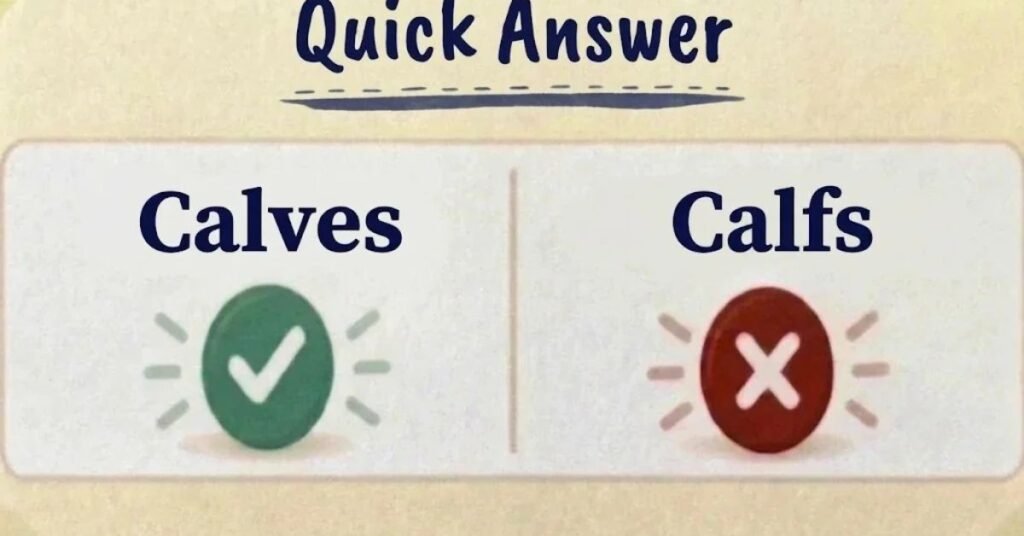
The correct plural of “calf” is “calves.”
That is true for every meaning of the word: baby cows, young elephants and whales, and the muscle at the back of your lower leg.
“Calfs” is not the standard plural. The only place it appears in some dictionaries is as a plural of calfskin, meaning leather hides. Outside the leather trade, treat it as an error.
| Sentence | Verdict |
| The calves are grazing near the barn. | Correct |
| Squats build strong calves. | Correct |
| The farmer has three calfs. | Incorrect |
| The shop sells wallets made from fine calfs. | Rare, trade use only |
If you only have five seconds, write calves and move on.
What Is Correct?
Let us break the answer into its three working parts.
1. Singular: calf
2. Plural: calves
3. Possessives: calf’s (one calf), calves’ (many calves)
Examples in context:
- “The calf stayed close to its mother.” (singular)
- “The calves stayed close to their mothers.” (plural)
- “The calf’s coat was wet.” (one calf owns the coat)
- “The calves’ pen needs cleaning.” (many calves share the pen)
Here is the part that trips people up: the word has two unrelated meanings, but they share one plural.
| Meaning | Singular | Plural |
| Young cow, or the young of some large mammals | calf | calves |
| Fleshy back part of the lower leg | calf | calves |
Some writers wrongly assume the animal gets one plural and the muscle gets another. They do not. The word is calves in both cases, and a quick look at the sentence makes the meaning clear.
The Core Grammar Rule
Most English nouns form the plural by adding -s: dog → dogs, table → tables, river → rivers. Writers lean on this rule so often that adding -s to calf feels automatic.
But a group of nouns ending in -f or -fe follow a different path. They change the final f to v and add -es.
The pattern in action
| Singular | Plural |
| calf | calves |
| half | halves |
| wolf | wolves |
| knife | knives |
| wife | wives |
| leaf | leaves |
| shelf | shelves |
| loaf | loaves |
| thief | thieves |
| life | lives |
| self | selves |
| elf | elves |
Calf belongs to this group. So the plural is calves, in the same way that half becomes halves and wolf becomes wolves.
Why does English do this?
The habit goes back to Old English. In that early stage of the language, a final f sound turned into a v sound when a vowel followed it, such as the plural ending. Over the centuries, the spelling caught up with the sound. Modern calves is a leftover from that old pattern. It is not a random exception someone invented to make students miserable.
The word itself comes from Old English cealf, a term for a young cow, according to Merriam-Webster’s etymology note. The leg meaning came into English separately, from an Old Norse word, which is why the two meanings are unrelated even though they look identical.
But not every -f word follows the pattern
Here is the frustrating part. There is no clean rule for which -f nouns change and which do not. You simply have to learn them.
| Singular | Plural | Pattern |
| roof | roofs | adds -s |
| chief | chiefs | adds -s |
| cliff | cliffs | adds -s |
| gulf | gulfs | adds -s |
| belief | beliefs | adds -s |
| proof | proofs | adds -s |
| safe | safes | adds -s |
| scarf | scarves or scarfs | both accepted |
| hoof | hooves or hoofs | both accepted |
| dwarf | dwarfs or dwarves | both accepted |
Grammar Monster makes this same point: you cannot predict which words change, so you memorize them. Gulf becomes gulfs, but calf becomes calves.
The key takeaway
If you are unsure, the safest bet for calf is simple. It always takes the -ves ending in everyday English.
When Each Form Is Correct
Now let us look at when each spelling is acceptable. The honest answer is that one is nearly universal and the other is a narrow exception.
When “calves” is correct
Use calves in all of these situations:
- Young cattle: “The ranch raised forty calves this spring.”
- Young of other large animals: “Elephant calves stay close to the herd.” The same applies to whales, giraffes, hippos, bison, moose, seals, and dolphins.
- Leg muscles: “She stretched her calves after the run.”
- Medical and fitness writing: “Tight calves can lead to ankle problems.”
- Verb form (third-person singular): “The cow calves in early spring.” More on this below.
When “calfs” appears
According to Merriam-Webster, calfs is listed as a plural when the word refers to the hide of a young cow, especially calfskin. Grammarly also notes that this entry exists, though it describes calves as the plural most dictionaries give.
You may run into calfs in:
- leather goods catalogs, such as “fine calfs for shoe making”
- tanning and shoe trade writing
- some word games, where the word is accepted
Even in those settings, many writers choose calfskins, which sidesteps the question entirely. For ordinary writing, you will almost never need calfs.
A quick decision guide
| If you mean… | Use |
| More than one baby cow or large young mammal | calves |
| More than one leg muscle area | calves |
| Several hides in the leather trade | calfskins (or calfs in trade usage) |
| Not sure | calves |
How to Pronounce “Calves” Correctly

Pronunciation helps lock in the spelling, so let us cover it.
The letter “l” is silent. You do not say “kal-ves.” You say it with no “l” sound at all.
| Word | American English | British English |
| calf | /kæf/ | /kɑːf/ |
| calves | /kævz/ | /kɑːvz/ |
A simple way to remember it:
- calf sounds like “kaf” (US) or “kahf” (UK)
- calves sounds like “kavz” (US) or “kahvz” (UK)
Dictionary.com lists both “kavz” and “kahvz” as accepted ways of saying it, so neither is wrong. Which one you use depends mostly on your accent.
Words with a silent L
Calves is part of a small family of words where the “l” sits quietly in the spelling:
- calf, calves
- half, halves
- salmon
- folk
- walk, talk, chalk
- palm, calm, balm
Noticing the family helps. When you say calves out loud, the v sound is clear and strong. That sound is your clue that the written form carries a v.
Why pronunciation causes spelling mistakes
People say “kafs” in their head, and that sounds close to “calfs.” But the plural sound is actually “kavz,” with a z sound at the end, and that matches calves better. If you hear a v, write a v.
When It Is Incorrect or Less Natural
Let us look at where each form can cause problems.
When “calfs” is incorrect
Calfs is wrong in almost every common setting:
- School essays and exams
- Business writing
- Agriculture, farming, and veterinary content
- Sports, fitness, and medical articles
- News reports and online guides
Example of the error: “The vet checked all the calfs.” This will look like a spelling mistake to nearly any reader, because the standard plural is calves.
Writing Explained points to book data and says that calfs appears so rarely in English-language books since 1800 that it barely registers. That tells you how little support the form has in real usage.
When “calves” can feel wrong
Sometimes the correct form looks odd, and that is just a quirk of staring at a word too long. It can also look odd when you expect a regular -s. If you doubt it, think of halves and wolves. They look right, and calves belongs in the same family.
The mix-up with the verb “calve”
Calves can also be a verb. To calve means to give birth to a calf, and for glaciers, it means to break off a chunk of ice.
- “The cow calves every spring.” (verb)
- “The glacier calves into the sea.” (verb)
- “The calves are healthy.” (noun)
If a sentence has a subject that is doing something, check whether calves is a verb. Otherwise, it is the plural noun.
British vs. American English Spelling

Good news: there is no spelling difference between British and American English for this word. Both varieties use calf for the singular and calves for the plural.
| Feature | American English | British English |
| Singular | calf | calf |
| Plural | calves | calves |
| Verb | calve, calves, calved | calve, calves, calved |
| Typical pronunciation of calf | kaf | kahf |
| Leather plural variant | calfs (rare) | calfs (rare) |
The only real difference between the two is pronunciation. Americans typically use a short “a” sound as in cat, while many British speakers use the longer “ah” sound as in father.
Other English-speaking regions, including Canada, Australia, and New Zealand, follow the same spelling. So whether you write for a US blog, a UK magazine, or a global audience, the answer stays the same: calves.
Meaning, Structure, or Emphasis Differences
Because calves has a few jobs, it helps to know how structure and context shape the meaning.
Context tells you which meaning
You rarely need extra clues, but here are some:
| Sentence | Meaning |
| The calves were born in March. | baby animals |
| My calves ache after hiking. | leg muscles |
| The cow calves in spring. | gives birth (verb) |
| The glacier calves icebergs into the bay. | breaks off ice (verb) |
Singular vs. plural agreement
Subject and verb must match in number.
- “The calf is healthy.” (singular)
- “The calves are healthy.” (plural)
A common slip is writing “The calves is…” after getting the plural right but forgetting the verb.
Possessive structure
| Form | Meaning | Example |
| calf’s | belonging to one | The calf’s mother was nearby. |
| calves’ | belonging to many | The calves’ feed arrived. |
Notice that the plural possessive adds only an apostrophe, because the plural already ends in s.
Compound and related words
Calf shows up inside several other words and phrases:
- calfskin: leather from a young cow
- calving: the act of giving birth to a calf
- calving season: the time of year when cows give birth
- calf muscle: the muscle group at the back of the lower leg
- cow-calf operation: a farm that keeps cows to raise calves
- veal: meat from a calf
- calf-length: a clothing length that ends at the calf
- calf raise: a common gym exercise
Writing these correctly helps your content read as natural and informed.
Real-World Examples
Seeing the word in context makes it stick. Here are examples across different settings.
Farming and ranching
- The herd produced sixty healthy calves this season.
- We separate the calves from the cows at weaning time.
- A good rancher watches the calves closely during the first week.
- The calves’ pen was cleaned and refilled with fresh straw.
Wildlife and nature
- Elephant calves can stand within an hour of birth.
- Humpback whale calves travel close beside their mothers.
- Giraffe calves can walk within hours of birth.
- Bison calves are born in spring and stay close to the herd.
Fitness and health
- Calf raises are a simple way to strengthen your calves.
- Runners often feel tightness in their calves after long distances.
- Stretching your calves can reduce the risk of cramps.
- Some compression sleeves are designed to support the calves.
Fashion
- She wore boots that stopped just below her calves.
- Calf-length skirts have been popular for several seasons.
Everyday writing
- My calves hurt after the hike.
- The children laughed at the newborn calves.
- Both calves needed medical attention after the storm.
Side-by-side: correct and incorrect
| Incorrect | Correct |
| The farm has twelve calfs. | The farm has twelve calves. |
| My calfs are sore. | My calves are sore. |
| The baby elephants, or calfs, were playing. | The baby elephants, or calves, were playing. |
| The calfs’ food was late. | The calves’ food was late. |
Common Mistakes (and Quick Fixes)
Here are the errors that come up most often, along with repairs.
| Mistake | Why it happens | Fix |
| Writing “calfs” | Adding -s to every noun | Use “calves” |
| Writing “calfes” | Mixing the rule with the -es ending | Use “calves” |
| Writing “calve” for more than one animal | Confusing the verb with the noun | Use “calves” for the plural noun |
| Writing “calves'” when you mean one | Mixing plural possessive with singular | Use “calf’s” |
| Writing “calf’s” when you mean many | Mixing singular possessive with plural | Use “calves'” |
| Pronouncing the “l” | Reading the letters literally | Say “kavz” |
| Using “calfs” for muscles but “calves” for animals | Thinking each meaning has its own plural | Use “calves” for both |
Five quick habits that prevent mistakes
- Default to “calves.” It is correct nearly every time.
- Check for the V sound. If you say “kavz,” write a v.
- Search before you publish. Use your editor’s find tool to scan for “calfs.”
- Check the apostrophe. Ask whether you mean one calf or several.
- Confirm the verb. If a sentence has “calves” and it is the action, you may mean the verb.
A note on spellcheck
Many spellcheckers accept calfs, since it is a real dictionary entry in some references. So a clean spellcheck report does not prove the word is the best choice. Trust the rule, not the red underline.
Grammar Rule Details
Also Read This:Shaky or Shakey: Which Spelling Is Correct? Meaning, Usage & Examples (2026)
If you like seeing the full picture, this section collects the technical points in one place.
The rule for nouns ending in -f and -fe
Many nouns ending in -f or -fe drop the f and take -ves in the plural.
Common nouns that follow the rule:
- calf → calves
- half → halves
- knife → knives
- leaf → leaves
- life → lives
- loaf → loaves
- self → selves
- shelf → shelves
- thief → thieves
- wife → wives
- wolf → wolves
- elf → elves
Common nouns that do not follow the rule:
- roof → roofs
- cliff → cliffs
- chief → chiefs
- belief → beliefs
- proof → proofs
- gulf → gulfs
- safe → safes
- chef → chefs
- reef → reefs
Nouns with two accepted plurals:
- scarf → scarves, scarfs
- hoof → hooves, hoofs
- dwarf → dwarfs, dwarves
- wharf → wharves, wharfs
Parts of speech for “calf” and “calves”
| Word | Part of speech | Example |
| calf | noun (singular) | The calf was born at dawn. |
| calves | noun (plural) | The calves were born at dawn. |
| calve | verb (base form) | Cows usually calve in spring. |
| calves | verb (third-person singular) | The cow calves in spring. |
| calved | verb (past tense) | The cow calved last night. |
| calving | verb (present participle) | The herd is calving now. |
Quick dictionary-style entry
- Word: calf
- Pronunciation: US kaf, UK kahf
- Plural: calves (standard); calfs (leather sense, rare)
- Meanings:
- the young of a domestic cow or of other large animals such as elephants and whales
- the fleshy back part of the leg below the knee
- leather made from the hide of a young cow (calfskin)
- Origin: Old English cealf for the animal sense
- Related words: calve (verb), calving, calfskin, veal
Related terms worth knowing
If you write about this topic often, a few related terms will help your content sound natural:
- bovine: relating to cattle
- heifer: a young female cow that has not yet had a calf
- steer: a young male cow raised for meat
- bull calf: a male calf
- heifer calf: a female calf
- weaning: the stage when calves stop drinking milk
- gastrocnemius and soleus: the two main muscles that form the calf of the leg
Tips To Remember The Differences
A good memory trick should be quick and easy to repeat. Here are some that work.
Trick 1: V for victory
Think of the v in calves as standing for victory. Choose calves and you win. Choose calfs and you lose a point. Writing Explained and Microsoft’s writing tips both use a version of this idea, and it is simple enough to recall under pressure.
Trick 2: Match the family
Say these three words in a row: halves, wolves, calves. They all share the same ending sound and the same spelling pattern. If you are sure about the first two, the third follows.
Trick 3: Listen for the V
When you say the plural out loud, you hear a v sound, not an f sound. Your ear gives you the spelling.
Trick 4: One meaning, one plural
Remind yourself that the animal and the muscle both use calves. There is no separate form for each, so you only have to remember one word.
Trick 5: The rhyme
Here is a mini rhyme to try:
One calf, two calves, drop the f, add the v.
Trick 6: The leather exception
If you ever see calfs, ask yourself: “Is this about leather?” If not, it is probably a mistake.
A short self-check
Before you hit publish, run this three-step check:
- Did I mean more than one? Use calves.
- Did I mean ownership? Choose calf’s or calves’.
- Did I mean the action of giving birth? Use calve or calves as a verb.
Conclusion
The plural of calf is calves, whether you mean baby cows, young elephants and whales, or the muscles in your lower legs. The form calfs appears only as a rare leather-trade plural, so it should stay out of everyday writing.
Remember the pattern shared with halves and wolves, listen for the v sound, and think of victory when you spell it. With those habits, you will never second-guess this plural again.