
You are typing a message, a product description, or maybe a baby name. You reach the word and pause. Is it “sapphire” or “saphire”? The word looks right both ways, and that is exactly why it trips so many people up.
Here is the short version: “sapphire” is the only correct spelling. “Saphire” is a misspelling. This guide explains why, where the word comes from, how to say it, and how to lock the spelling in your memory for good.
Sapphire or Saphire: The Quick Answer
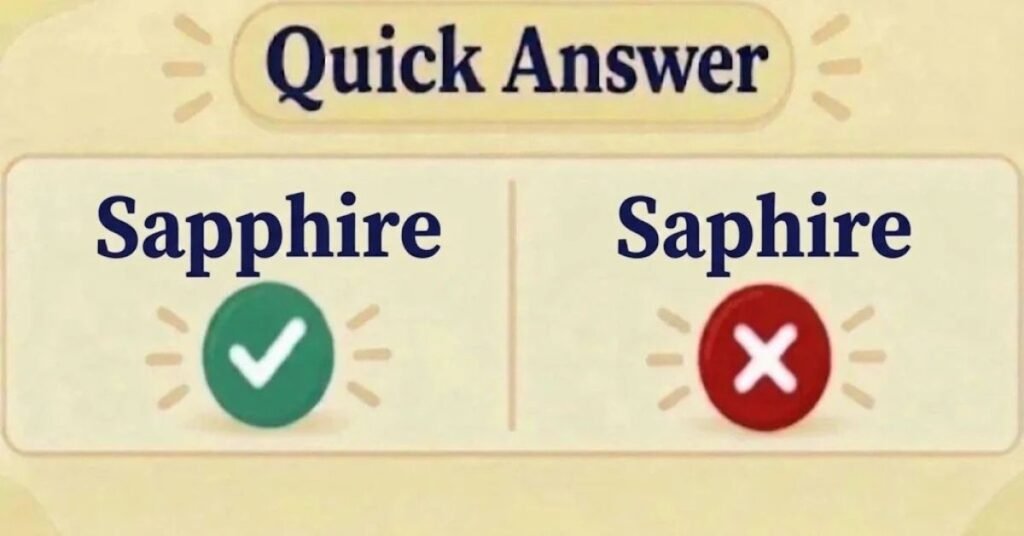
Sapphire is correct. It has two P’s, a silent-looking “ph,” and ends in “-ire.”
Saphire is wrong. It drops one P and is not accepted in any major dictionary, in British English or American English.
| Spelling | Correct? | Notes |
| Sapphire | Yes | Standard in US, UK, Canada, Australia |
| Saphire | No | Common typo and misspelling |
| Sapphir | No | Missing final “e” |
| Sapheer | No | Phonetic guess |
If you remember only one thing, remember this: two P’s, then “hire.” Sapphire.
What Does Sapphire Mean?
The word “sapphire” has several meanings. They are all connected, so once you know the main one, the rest make sense.
The gemstone
A sapphire is a precious gemstone, best known for its deep blue colour. It is a form of the mineral corundum, which is made of aluminium oxide. Corundum is one of the hardest natural substances on Earth. It scores 9 on the Mohs scale, just below diamond at 10.
That hardness is why sapphires are popular in engagement rings and daily-wear jewellery. They resist scratches well and hold their shine for decades.
The colour
“Sapphire” is also a colour name. It describes a rich, deep blue, slightly darker than royal blue. You will see it in fashion, interior design, and car paint. A “sapphire blue dress” or “sapphire sky” is a common phrase.
Other uses
- Sapphire glass: Synthetic sapphire crystal is used for premium watch faces and smartphone camera lenses because it is extremely scratch resistant.
- Anniversaries: The sapphire is the traditional gift for a 45th wedding anniversary.
- Birthstone: It is the birthstone for September.
- Names: Sapphire is used as a given name and as a brand name for everything from hotels to graphics cards.
In every one of these uses, the spelling stays the same: sapphire.
Sapphire vs Saphire: What’s the Difference?
There is no difference in meaning. “Saphire” is not a different word, a variant, or a regional form. It is simply a sapphire spelled incorrectly.
Think of it like this:
- Sapphire = the real word, found in every dictionary.
- Saphire = a typo that happens when the double P gets lost.
Here is a side-by-side look.
| Feature | Sapphire | Saphire |
| Accepted in dictionaries | Yes | No |
| Number of P’s | Two | One |
| Used in formal writing | Yes | Never |
| Refers to the gemstone | Yes | Only by mistake |
| Spellcheck result | Passes | Flagged |
| Safe for names and branding | Yes | Looks like an error |
The practical takeaway is simple. If you write “saphire” in a résumé, a product listing, or an essay, readers will notice. In jewellery sales especially, a misspelled gemstone name can quickly cost you credibility.
Why Is Sapphire Spelled With Two P’s?
This is the question that causes the most confusion, and the answer sits in the word’s history.
English borrowed “sapphire” from Old French saphir, which came from Latin sapphirus. The Latin word was taken from Greek sappheiros. In that Greek form, the double P is already there. It was carried through Latin and French, and English kept the double consonant when the word settled into its modern shape.
A few points help explain it:
- The double P is inherited. It comes from the ancient Greek and Latin forms and was never dropped in standard English.
- The “ph” is also inherited. Greek used the letter phi, which Latin wrote as “ph.” English kept that pattern in many words, such as “pharmacy” and “philosophy.”
- Double consonants often signal a short vowel. The double P keeps the first “a” short, as in “sap” and “cap.” With a single P, many readers would be tempted to say “SAY-fire,” like “safe.”
So the two P’s are not random. They keep the pronunciation steady and reflect the word’s long journey into English.
Different Types and Colours of Sapphire
Many people picture sapphire as only blue. In reality, sapphires come in almost every colour of the rainbow. Gemologists call the non-blue ones fancy sapphires.
Blue sapphire
This is the classic. Its colour comes from tiny traces of iron and titanium inside the crystal. Blue sapphires range from pale sky blue to inky, near-black navy. The most prized shades are a vivid, medium-dark blue with strong saturation.
Fancy sapphires
| Type | Colour | Quick note |
| Pink sapphire | Light pink to hot pink | Very popular in modern jewellery |
| Yellow sapphire | Pale lemon to golden | Traditionally valued in some cultures |
| Green sapphire | Soft green to deep forest | Often has a slight blue or yellow tint |
| White (colourless) sapphire | Clear | Sometimes used as a diamond alternative |
| Purple sapphire | Lilac to violet | Rarer than blue |
| Orange sapphire | Bright orange | Less common |
| Padparadscha | Pinkish-orange | Among the rarest and most valuable |
| Star sapphire | Various | Shows a six-rayed star when cut as a cabochon |
Sapphire and ruby
Here is a fun fact. A ruby is also corundum. The only real difference is colour: red corundum is called ruby, and corundum of every other colour is called sapphire. This surprises many people, but it is how gemologists classify them.
Famous sources
Sapphires are mined in several countries. Kashmir, Burma (Myanmar), Sri Lanka (once called Ceylon), Madagascar, Thailand, Australia, and Montana in the United States are among the best known. Kashmir and Burmese stones are often considered the gold standard, though quality varies widely within any origin.
How Do You Spell Sapphire?
Break it into small pieces and it becomes easy.
S – A – P – P – H – I – R – E
Eight letters. Say them out loud once or twice. Then use this simple breakdown:
- Sap (like tree sap)
- phire (sounds like “fire”)
Put them together: Sap + phire = Sapphire.
A quick step-by-step method
- Start with “S-A.”
- Add two P’s (P-P).
- Add “H.”
- Finish with “I-R-E.”
Spelling checklist
- Does it start with “Sa”? Yes.
- Does it have two P’s? Yes.
- Does the “ph” come right after them? Yes.
- Does it end in “ire,” not “ier” or “ir”? Yes.
If you can say yes to all four, you have it.
How Is Sapphire Pronounced?
The standard pronunciation is SAF-eye-er (sometimes said as two syllables, SAF-ire).
| Region | Common pronunciation | Phonetic |
| American English | SAF-ire (two syllables) or SAF-eye-er | /ˈsæfaɪər/ |
| British English | SAF-ire | /ˈsæfaɪə/ |
Both are fine. The key points are:
- The first syllable is SAF, with a short “a” as in “cat.”
- The “ph” makes an “f” sound, not a “p” sound.
- The ending sounds like “fire.”
Common pronunciation slips
- “SAY-fire”: wrong, because the first vowel is short.
- “SAP-hire”: wrong, because the “ph” is an “f” sound.
- “Sa-FEER”: wrong, because the ending is not “eer.”
Listening to a short audio clip on any major online dictionary can help, but the rhyme is easy: sapphire rhymes with “wire” and “fire.” It does not rhyme with “chair.”
Why Do People Spell Sapphire as “Saphire”?
Misspellings are rarely random. They usually have a logical cause. Here are the main reasons people write “saphire.”
1. The sound only hints at one P
When you say the word, you hear one “p” sound. English does not pronounce double consonants twice, so your ear gives you no clue that there are two P’s.
2. Phonetic spelling instinct
Many writers spell words the way they sound. “Saf-ire” sounds like it could be “saphire,” and that is the version many people write.
3. The “ph” pattern feels complete already
When people see “ph,” they often treat that as the whole job. Adding another P before it feels like one P too many.
4. Autocorrect and fast typing
On phones especially, a skipped letter slips through easily. A missed double letter is one of the most common typing errors.
5. Name variations
Names such as Saffire, Safire, and Sapphira appear in real life. Seeing them can blur the correct spelling of the gemstone in your mind.
6. Limited exposure in print
Most people hear “sapphire” more than they read it. Words learned by ear often get misspelled in writing.
None of this means you are careless. It means the word is genuinely tricky, and a spelling slip here is very understandable.
Sapphire in Example Sentences
Seeing a word in context is one of the best ways to remember its spelling. Here are examples grouped by use.
As a gemstone
- She wore a sapphire pendant that belonged to her grandmother.
- The jeweller held the sapphire up to the light to check its clarity.
- A heated blue sapphire is more common than an untreated one.
- He proposed with a sapphire ring surrounded by small diamonds.
- The museum displays a 100-carat star sapphire in a glass case.
As a colour
- The ocean looked a deep sapphire blue in the evening light.
- She chose sapphire curtains to match the velvet sofa.
- Her eyes were a startling sapphire.
- The brand’s logo is printed in sapphire and silver.
As technology
- The watch has a scratch-resistant sapphire crystal.
- Many camera lenses on phones are covered with sapphire glass.
In celebration and tradition
- They celebrated their 45th anniversary, the sapphire anniversary, with a small family dinner.
- September babies have the sapphire as their birthstone.
As a name
- Sapphire was the first name her parents considered.
- The restaurant on the corner is called The Sapphire Room.
Wrong vs right
| Incorrect | Correct |
| She wore a saphire necklace. | She wore a sapphire necklace. |
| The saphire blue dress looked stunning. | The sapphire blue dress looked stunning. |
| He bought a saphire ring. | He bought a sapphire ring. |
| The saphire anniversary is the 45th. | The sapphire anniversary is the 45th. |
British vs American English: Is the Spelling Different?

No. This is good news, because you do not have to remember two versions.
Sapphire is spelled the same way in British, American, Canadian, Australian, and Indian English.
Many words do change between regions. Think of “colour” and “color,” or “jewellery” and “jewelry.” Sapphire is not one of them.
| Word | British English | American English |
| Sapphire | Sapphire | Sapphire |
| Colour | Colour | Color |
| Jewellery | Jewellery | Jewelry |
| Aluminium | Aluminium | Aluminum |
Notice that other words in a sentence about sapphires may change by region, such as “colour” and “jewellery” above. The gemstone’s name itself does not.
So if you ever see “saphire” and think it might be a British spelling, it is not. It is an error in every variety of English.
The Origin and History of the Word Sapphire

The story of “sapphire” stretches back thousands of years.
Greek and Latin roots
The word came into English through Old French saphir, from Latin sapphirus, which came from Greek sappheiros. The Greeks likely borrowed it from an older Semitic source, and Hebrew sappir is often mentioned as a possible relative. Scholars are not completely certain about the earliest origin, which is common with very old words for gems.
A surprising twist
In ancient times, the word did not always mean what it does today. The Roman writer Pliny the Elder described a stone called sappirus that was blue with golden flecks. Many historians believe this was actually lapis lazuli, not the sapphire we know now. Over time, the name shifted to the modern blue corundum gem.
Sapphire in history and culture
- Ancient and medieval periods: Sapphires were linked with royalty, wisdom, and heaven. Clergy and kings often wore them.
- Religion: Blue stones appear in religious writing and were believed to protect the wearer.
- Royal jewels: Famous sapphires have long been part of royal collections, including engagement rings and crowns in European royal families.
- Modern era: Lab-grown sapphires, first made in the early 1900s, opened the door to industrial uses such as watch crystals and electronics.
Arrival in English
The word appears in English by the Middle Ages. Spellings varied in early texts, but the double P and the “ph” settled into the standard form as English spelling became more fixed.
Knowing this history gives you a handy memory anchor. The word is old, it carries its double letter from Greek, and it has been “sapphire” for a very long time.
Common Misspellings of Sapphire
Here are the errors you are most likely to see, with the fix for each.
| Misspelling | What went wrong | Correct form |
| Saphire | Missing second P | Sapphire |
| Sapphir | Missing final “e” | Sapphire |
| Sapphyre | Wrong vowel before the ending | Sapphire |
| Sapphier | Letters swapped at the end | Sapphire |
| Saffire | Used “ff” for the “f” sound | Sapphire |
| Safire | Dropped the P’s and used one “f” | Sapphire |
| Sapheer | Pure phonetic guess | Sapphire |
| Sappire | Missing the “h” | Sapphire |
| Sapfire | Replaced “ph” with “f” | Sapphire |
Why these matter
If you write online, misspellings affect more than pride:
- Search visibility: People search for the correct spelling, so a wrong one can hide your content.
- Trust: A jewellery shop with a misspelled gemstone looks less reliable.
- Professionalism: Résumés, emails, and reports are judged on small details.
A note on names
Names are different from the gemstone. “Safire” and “Saffire” are real surnames or brand names in some cases. If someone’s name or a business is spelled that way, follow their spelling. For the gemstone and the colour, always use sapphire.
Sapphire Spelling: An Easy Way to Remember It
Also Read This:Lessee vs. Leasee: How to Spell It Right Every Time
Memory tricks work because they turn an abstract rule into something you can picture. Try one or two of these.
1. The “two P’s” picture
Picture two P’s standing side by side like a pair of pillars: sa-PP-hire. The pillars hold the word up. Lose one and the word wobbles.
2. The “sap + hire” split
Say it as two small words:
- Sap (the sticky stuff in trees)
- hire (to employ someone)
Sap + hire. The first P is the end of “sap,” the second P starts the “ph.” It is a silly trick, and silly tricks stick.
3. The sentence trick
Some artists paint pale hues in rich evening light.
The first letters spell S-A-P-P-H-I-R-E. If you want, make up your own sentence. A personal one is even easier to remember.
4. The “pretty pair” rule
A sapphire is a precious pair of things in one: a pair of P’s in a beautiful stone. Tie the double letter to the idea of something valuable and doubled.
5. Write it three times
It sounds old-fashioned, but it works. Write “sapphire” by hand three times, slowly, thinking about each letter. Muscle memory helps.
6. Use it in your own sentence
Write one sentence about a sapphire you have seen, a ring, a colour, or a gift. Personal connections make spelling stick.
Quick recap
- Two P’s.
- “ph” makes the “f” sound.
- Ends in “ire” like “fire.”
Common Questions About Sapphire Spelling
These are the points people raise most often when they are unsure.
Is “saphire” ever acceptable? Not as the gemstone or colour. It does not appear in standard dictionaries. The only exception is a person’s name or brand that is intentionally spelled that way.
Does the spelling change for the colour? No. “Sapphire blue” and “sapphire” as a colour use the same spelling as the gem.
Is it capitalised? Only at the start of a sentence, in titles, or when it is a person’s name or brand. In ordinary use, it is lowercase: “a sapphire ring.”
What is the plural? Add “s”: sapphires. “She owns three sapphires.”
Is there an adjective form? The noun is often used as a modifier: “sapphire necklace,” “sapphire blue.” There is also “sapphirine,” a rarer word that means “of or like sapphire,” used mainly in scientific or poetic writing.
Does spellcheck catch it? Most tools flag “saphire” and offer “sapphire” as the fix. Do not rely on it fully, though, especially in names and product titles.
Does the double P change the pronunciation? Not audibly. It helps keep the first vowel short and signals the spelling to the reader.
Is there a hyphen in “sapphire-blue”? When used before a noun as a compound modifier, a hyphen is common: “a sapphire-blue gown.” After the noun, it is usually written without one: “the gown was sapphire blue.” Style guides differ, so follow the guide you are using.
Conclusion
“Sapphire” is the correct spelling, and “saphire” is a mistake. The word keeps its two P’s from Greek and Latin, and it is spelled the same in British and American English.
To remember it, think of two P’s and a “ph” that sounds like “f,” so it rhymes with “fire.” Split it into “sap” and “hire,” and you won’t need to pause next time.
[…] Also Read This:Sapphire vs. Saphire: Which Is Correct? Meaning, Spelling & Examples (2026) […]
[…] Also Read This:Sapphire vs. Saphire: Which Is Correct? Meaning, Spelling & Examples (2026) […]