

You are closing an envelope, writing about a deal, or maybe describing a sleepy marine animal. The word sounds like “seel.” But how do you spell it?
Here is the good news: you almost certainly want seal. Yet seel is a real word too. It is just very rare, and it has nothing to do with envelopes, deals, or the animal.
This guide explains both. You will learn what each word means, why people mix them up, how they sound, and when each one belongs in a sentence. You will also find comparison tables, real examples, common phrases, and a few memory tricks to keep the spelling straight.
Seal vs Seel: The Quick Answer
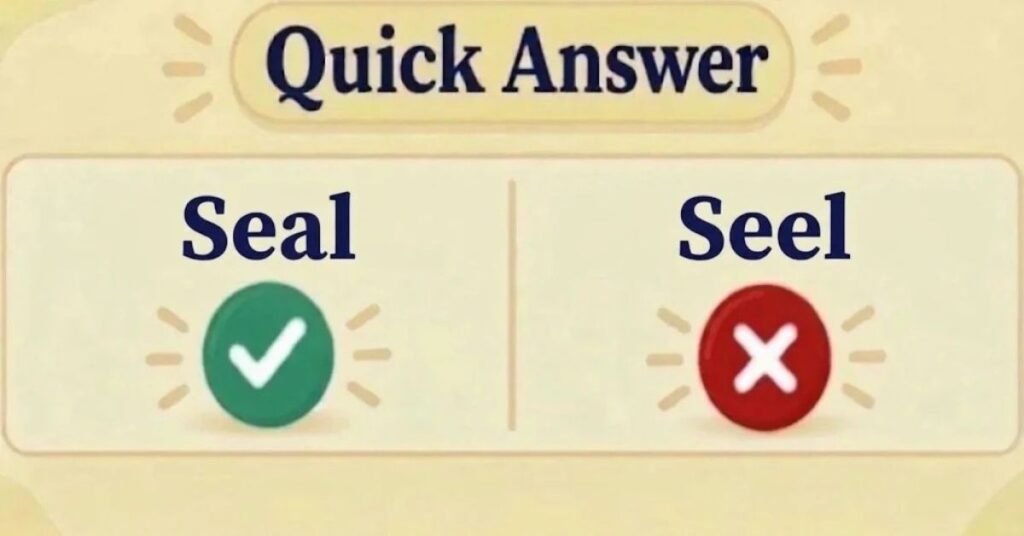
Seal is the correct spelling for nearly every situation in modern English. It is the word for closing something tightly, for a stamp or emblem, and for the marine mammal.
Seel is a rare, mostly archaic verb. It means to sew shut the eyelids of a hawk or falcon, a practice from traditional falconry. It can also mean, in a poetic or old-fashioned sense, to close or blind the eyes.
| Word | Part of speech | Main meaning | Common today? |
| Seal | Noun and verb | To close tightly; a stamp or closure; a sea mammal | Yes, very common |
| Seel | Verb | To sew a falcon’s eyelids shut; to blind (archaic) | No, very rare |
Quick rule: If you are not writing about falconry or quoting old literature, use seal.
Featured snippet answer: Seal is the everyday word for closing something securely, for an official stamp, and for the sea animal. Seel is a rare, mainly archaic verb that means to sew shut a hawk’s eyelids in falconry. The two are homophones, so they sound alike, but their meanings are completely different.
What Does “Seal” Mean?
Seal is a flexible word with several meanings. It works as both a noun and a verb.
Seal as a Verb
As a verb, seal means to close or fasten something so that nothing can get in or out, or to make something official or final.
- To close tightly. Please seal the envelope before mailing it.
- To make airtight or watertight. He sealed the window with caulk.
- To stamp or mark with an official emblem. The notary sealed the document.
- To settle or confirm. They shook hands to seal the deal.
- To block off an area. Police sealed the street after the accident.
Seal as a Noun
As a noun, seal has three main senses.
- A closure or barrier. The jar has a rubber seal around the lid.
- An official stamp, mark, or emblem. The letter carried the royal seal.
- A marine mammal. A seal slid off the rock into the water.
Where the Word Comes From
The meanings come from different roots, even though they share one spelling.
- The stamp and closure senses go back to the Latin sigillum, meaning a small image or sign, which reached English through Old French.
- The animal sense comes from an Old English word for the creature, seolh.
That is why the same spelling covers things that seem unrelated.
Word Forms
| Form | Spelling | Example |
| Base | seal | Seal the box. |
| Third person singular | seals | She seals every package. |
| Past tense | sealed | He sealed the letter. |
| -ing form | sealing | They are sealing the cracks. |
| Plural noun | seals | We saw three seals on the beach. |
What Does “Seel” Mean?
Seel is a verb, and it is far less common than seal. Dictionaries describe it as a term from falconry.
The Falconry Meaning
In traditional falconry, to seel a hawk or falcon meant to sew its eyelids shut, usually for a short period during training. The idea was to keep the young bird calm and manageable while it got used to people.
Dictionaries also list a second, older meaning marked as archaic or obsolete: to close the eyes or, by extension, to blind.
Word Forms of Seel
| Form | Spelling | Example |
| Base | seel | Falconers used to seel young hawks. |
| Third person singular | seels | He seels the bird’s eyes during training. |
| Past tense | seeled | The falcon was seeled before the journey. |
| -ing form | seeling | Seeling is rarely practiced today. |
The Origin of Seel
The word entered English in the Middle Ages. It came from Old French ciller, which came from the Latin word for an eyelid, cilium. The idea was very literal: it was about the eyelids.
You can see a related root in the English word eyelash and in the medical word cilia, which refer to tiny hair-like structures.
Seel in Literature
The best-known use is in Shakespeare’s Macbeth. In one scene, Macbeth calls on the night to “come, seeling night,” asking darkness to cover the eyes of day like a falconer sewing up a bird’s eyelids. Many readers meet the word there for the first time.
Other Old Senses
Older dictionaries record a few more meanings that have faded out of use. One described the rolling motion of a ship in rough water. Another meant good fortune, and appears in old poetry. You are unlikely to meet these today, and most modern dictionaries no longer treat them as current.
Is Seel Still Used?
Rarely. The word is mainly found in:
- Writing about falconry history
- Literary study, especially Shakespeare
- Poetry that wants an old-fashioned flavor
- Word games, puzzles, and vocabulary lists
For everyday writing, readers will not expect it, and most will assume it is a typo.
British English vs. American English Spelling of Seal and Seel

There is no difference between British and American English for either word.
| American English | British English | |
| Spelling of the closing word | seal | seal |
| Spelling of the falconry verb | seel | seel |
| Pronunciation | /siːl/ | /siːl/ |
| Past tense | sealed / seeled | sealed / seeled |
What This Means for You
- You do not need to adjust your spelling for a US or UK audience.
- Dictionary entries in both traditions list the same forms.
- The confusion between the two words is the same everywhere English is spoken.
Some English spelling pairs differ by region, such as color and colour. Seal and seel are not one of those pairs. They are two separate words that happen to sound the same.
Seal vs Seel: What’s the Difference?
The two words are homophones. That means they sound the same but differ in spelling and meaning.
| Feature | Seal | Seel |
| Part of speech | Noun and verb | Verb |
| Core idea | Close, secure, stamp, or the animal | Sew a hawk’s eyelids shut; blind |
| Frequency in modern English | Very high | Very low |
| Typical setting | Daily life, business, law, nature | Falconry, literature, history |
| Used for envelopes and deals? | Yes | No |
| Used for the sea mammal? | Yes | No |
| Looks correct to most readers? | Yes | Often looks like a typo |
| Example | She sealed the jar. | They seeled the falcon. |
Is It “Seal” or “Seel” in Modern English?
In modern English, seal is the standard choice. It is in every ordinary dictionary and appears in everyday speech, news, and business writing. Seel is a real word, but it is a specialist term and an archaic one. Treat it as a niche word that needs a specific reason to appear.
The Key Difference in One Line
Seal closes things. Seel closes a bird’s eyes.
A Third Homophone: Ceil
The same sound appears in another rare word, ceil. It means to cover the top of a room with a ceiling or lining. It shares its sound with seal and seel, and it is related to the word ceiling. This is why seeling night in Macbeth sounds just like ceiling night.
| Word | Pronunciation | Meaning |
| seal | /siːl/ | Close tightly; stamp; marine mammal |
| seel | /siːl/ | Sew falcon’s eyelids; blind |
| ceil | /siːl/ | To put a ceiling on a room (rare) |
Seal vs Seel Pronunciation
Both words are pronounced the same way.
seal = seel = /siːl/
How to Say It
- The first sound is a soft s, as in sun.
- The vowel is the long ee sound, as in feel.
- The ending is a clear l.
It rhymes with feel, heal, meal, real, steel, and wheel.
Related Forms
| Word | Pronunciation |
| Seals | /siːlz/ |
| Sealed | /siːld/ |
| Sealing | /ˈsiːlɪŋ/ |
| Seeled | /siːld/ |
| Seeling | /ˈsiːlɪŋ/ |
Why the Sound Causes Problems
Because the words sound identical, you cannot tell them apart in speech. Only the spelling and the context show which one you mean. Listeners understand from the sentence, so there is almost never confusion out loud. The risk appears in writing.
Seal vs Seel Examples in Sentences
Examples With Seal
Closing and securing:
- Make sure you seal the container before you store the food.
- The technician sealed the pipe with special tape.
- A tight seal keeps the cold air inside the fridge.
Official and legal:
- The agreement carried the company seal.
- The judge placed the court records under seal.
- A wax seal closed the old letter.
Making things final:
- A handshake helped seal the partnership.
- That last goal sealed the win.
- His mistake sealed the team’s fate.
The animal:
- A seal basked on the ice.
- Harbor seals can often be spotted near the coast.
- The zoo has a feeding show for its seals.
Examples With Seel
Falconry:
- In medieval times, a falconer might seel a young hawk to tame it.
- The bird was seeled for a few days during early training.
- Seeling is rarely practiced in modern falconry.
Literary and poetic:
- Shakespeare’s Macbeth calls for “seeling night” to cover the eyes of day.
- The poet wrote that death would seel his tired eyes.
Explaining the word:
- The word seel comes from Old French and refers to eyelids.
- A rare verb, seel, appears in old falconry manuals.
Pairs That Show the Contrast
| Sentence with seal | Sentence with seel |
| She sealed the envelope. | The falconer seeled the hawk’s eyes. |
| The seal on the jar was tight. | Seeling was once common in falconry. |
| They sealed the deal. | Macbeth wants night to seel the day’s eye. |
When Should You Use “Seal” or “Seel”?
When to Use Seal
Use seal in almost every case. It is the right word when you mean:
- Closing something tightly. Seal the package.
- Making something airtight or leak-proof. Seal the roof.
- Stamping or authenticating. The notary will seal the form.
- Making a decision final. Let’s seal the agreement.
- The sea animal. A seal swam by the boat.
- An emblem or mark. The university seal appears on the diploma.
- A barrier or gasket. Replace the door seal.
When to Use Seel
Use seel only when:
- You are writing about falconry. For example, a history of hawking or a training guide.
- You are discussing or quoting Shakespeare. Macbeth‘s “seeling night” is the classic case.
- You are writing poetry or fiction and want an old-world sound.
- You are explaining the word itself, as in a vocabulary lesson.
A Quick Decision Table
| If you mean… | Use |
| Close an envelope | seal |
| Make a deal official | seal |
| A stamp on a document | seal |
| A marine mammal | seal |
| A tight closure on a jar or pipe | seal |
| Sew a hawk’s eyelids shut | seel |
| Quote Macbeth’s “seeling night” | seel |
| To blind (in poetic, archaic style) | seel |
A Helpful Test
Ask yourself: Is there a bird involved, or is this a Shakespeare quote? If not, choose seal.
Common Expressions and Phrases Using the Word “Seal”
Many English idioms use seal, and none of them use seel.
| Phrase | Meaning | Example |
| Seal the deal | Finalize an agreement | A smile helped seal the deal. |
| Seal of approval | Official sign that something is accepted | The film earned the critics’ seal of approval. |
| Sealed with a kiss | Ended or confirmed with a kiss | The letter ended: “Sealed with a kiss.” |
| My lips are sealed | I will keep the secret | Don’t worry, my lips are sealed. |
| Seal one’s fate | Make an outcome certain | That decision sealed his fate. |
| Signed, sealed, delivered | Completed and handed over | The contract is signed, sealed, delivered. |
| Break the seal | Open something that was closed | Break the seal to open the bottle. |
| Sealed bid | A private bid placed in a closed envelope | Companies submitted sealed bids. |
| Seal off | Block access to an area | Guards sealed off the building. |
| Great Seal | An official government emblem | The Great Seal marks formal documents. |
| Hermetically sealed | Completely airtight | The sample was hermetically sealed. |
| Seal the cracks | Fix gaps to stop leaks | Seal the cracks before winter. |
Seal as a Name or Brand
Seal also appears in names. The Navy SEALs are a US special forces group, and the name comes from the words Sea, Air, and Land. Some brands and products also use the word. These are names, so they follow their own spelling.
Common Mistakes With Seal and Seel
1. Writing “Seel” for Everyday Closing
Wrong: Please seel the envelope. Right: Please seal the envelope.
2. Writing “Seel” for the Animal
Wrong: We saw a seel on the rocks. Right: We saw a seal on the rocks.
3. Using “Seal” in a Falconry Context
If you are writing about the old practice of sewing a bird’s eyelids shut, seel is the specialist term. Many modern writers would use seal in a looser sense, but a falconry text should use seel.
Specialist: The falconer seeled the hawk. Looser modern wording: The falconer stitched the hawk’s eyelids shut.
4. Mixing Up Seeling, Sealing, and Ceiling
| Word | Meaning |
| Sealing | Closing or stamping |
| Seeling | Sewing a bird’s eyelids (falconry) |
| Ceiling | The top surface of a room |
5. Misspelling the Verb Forms
Wrong: sealled, seeld, seelled Right: sealed (for seal), seeled (for seel)
6. Using the Wrong Plural
Wrong: The seels swam in the bay. Right: The seals swam in the bay.
7. Adding an Apostrophe by Mistake
Wrong: The seal’s were playing. Right: The seals were playing.
Use an apostrophe only for possession, as in the seal’s flipper.
8. Over-Correcting to “Seel”
Some writers read that seel is a real word and start using it everywhere. It is not a variant spelling of seal. Do not replace seal with seel in modern writing.
Quick Fix Table
| Mistake | Correction |
| seel the package | seal the package |
| seel of approval | seal of approval |
| a seel on the ice | a seal on the ice |
| seeling the envelope | sealing the envelope |
| seals’ deal | seal the deal |
| seal the hawk’s eyes (falconry text) | seel the hawk’s eyes |
How to Remember Seal vs Seel
Also Read This:Leafs or Leaves: Which Is the Correct Plural of Leaf? Meaning & Examples (2026)
Use any of these tricks.
Trick 1: Seal Has an “A” for “Animal” and “All-Purpose”
Seal has an a. Think A for animal, A for airtight, and A for all-purpose. It is the word you will use most.
Trick 2: Seel Has Two E’s for Two Eyes
Seel has two e’s. Picture two eyes being closed. Eyes are the only thing this word is about.
Trick 3: Picture the Scene
- A seal in the water or a wax seal on a letter.
- A falcon with a tiny stitch over each eye: that is seel.
Trick 4: Think “Everyday vs Specialist”
If you would say it at breakfast, it is seal. If you would only read it in a falconry book or a Shakespeare play, it is seel.
Trick 5: Use the Rule of Three
Ask three quick questions:
- Am I closing, stamping, or finalizing something? Seal.
- Am I talking about the animal? Seal.
- Am I writing about a hawk’s eyelids or quoting Macbeth? Seel.
Trick 6: When in Doubt, Pick Seal
Because seal covers nearly all uses, you will be right almost every time.
Final Takeaway
Seal is the correct word for closing, stamping, finalizing, and for the marine mammal. Seel is a real but rare verb that belongs to falconry and old literature, where it means to sew a hawk’s eyelids shut or to blind.
Both are pronounced /siːl/, so only the spelling and context tell them apart. When you are not writing about falconry or quoting Shakespeare, choose seal and you will almost always be right.