

You are typing a message, you reach the word that means “I’m not sure,” and your fingers hesitate. Is it dought? Dout? Doubt? The word sounds like “dowt,” so the spelling feels like a guess.
Here is the short version: doubt is the spelling you want. The “b” is silent, but it is part of the word and cannot be dropped. Dought does exist in dictionaries, but only as a rare dialect and archaic term. It has nothing to do with uncertainty.
This guide explains what each word means, how doubt is pronounced, why that stubborn silent “b” is there, and how to stop mixing the two up. You will also find example sentences, a mistakes table, memory tricks, and a short practice set with answers.
Quick Answer: Dought vs Doubt
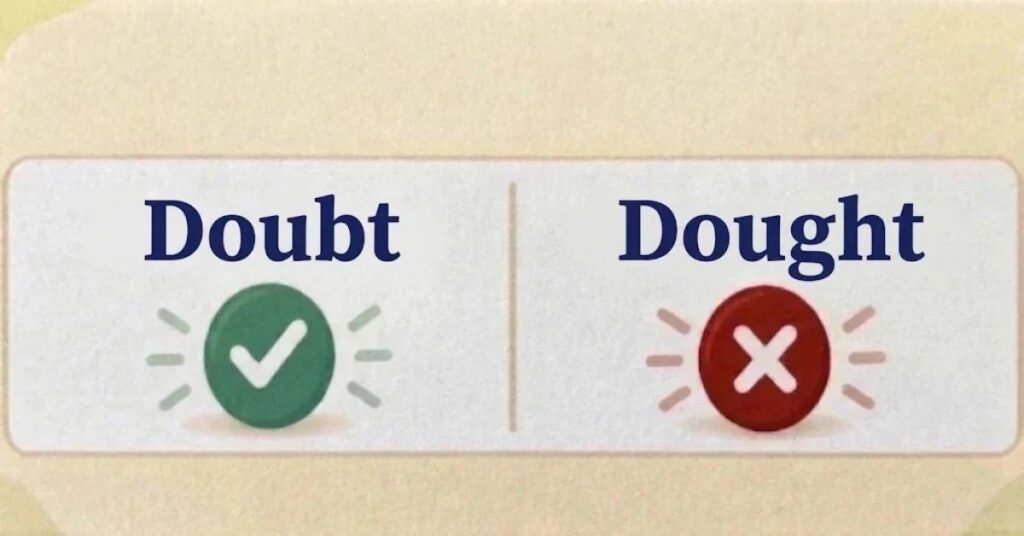
Doubt is the correct spelling for the everyday word meaning uncertainty or a lack of belief. Dought is a rare, dialectal word (a past form of the old verb dow, and a Northern English and Scots noun for strength or ability). It is not a misspelling that dictionaries accept for doubt.
| Doubt | Dought | |
| Common in modern English? | Yes, very | No, very rare |
| Part of speech | Noun and verb | Dialect noun, dialect verb form |
| Core meaning | Uncertainty, disbelief, to question | Power or ability; past tense of dow |
| Pronunciation | /daʊt/ | Listed as /daʊt/ in open dictionaries |
| Safe to use in an email, essay, or exam? | Always | Almost never |
Rule of thumb: if you mean “I’m not sure,” write doubt. If you are quoting an old Scots poem, you might meet dought. Otherwise, you won’t.
What Does “Doubt” Mean?
Doubt describes the state of not being sure. It can be a feeling, an action, or a gap between what you are told and what you believe.
Major dictionaries treat it as both a noun and a verb, and the two uses are easy to separate.
Doubt as a Noun
As a noun, doubt means uncertainty about whether something is true, real, or possible. It can also mean a lack of conviction.
- She felt a flicker of doubt before opening the results.
- There is no doubt that the bridge will reopen next month.
- The report raises doubts about the current method.
You can have one doubt or several doubts. It is countable in many contexts and uncountable in others (“a moment of doubt,” “beyond doubt”).
Doubt as a Verb
As a verb, doubt means to be unsure about something, to consider it unlikely, or to hesitate to believe it.
- I doubt the store is open on Sunday.
- Nobody doubted her ability to lead.
- He is doubting his decision to quit.
Verb forms: doubt, doubts, doubted, doubting.
Words Built From Doubt
The word spawns a useful family. Notice that the “b” stays in every one of them.
| Word | Part of speech | Example |
| doubter | noun | Every doubter in the room changed their mind. |
| doubtful | adjective | It is doubtful that the train will arrive on time. |
| doubtfully | adverb | She smiled doubtfully. |
| doubtless | adjective/adverb | Doubtless, you have heard the news. |
| undoubtedly | adverb | This is undoubtedly her best work. |
| undoubted | adjective | His undoubted talent opened doors. |
Close Synonyms
Uncertainty, skepticism, suspicion, mistrust, hesitation, disbelief, misgiving. Merriam-Webster’s thesaurus notes that mistrust suggests a doubt rooted in suspicion, so the words overlap but are not always interchangeable.
Is “Dought” a Real Word?
Yes, but not in the way most people hope when they type it. If you were hoping dought is a variant of doubt, it is not.
Wiktionary and the dictionaries built on it list dought with a few narrow meanings:
- A dialect past tense of “dow.” Dow is an old verb meaning to be of use, to avail, or to be able. It comes from Old English dugan, and dought descends from Old English dohte.
- A noun for power, strength, or ability. It is flagged as Northern English and Scots and is usually uncountable. Some entries describe it as a back-formation from doughty.
- A Middle English form. There it is a shortened version of doughty.
The Doughty Connection
Doughty is the surviving cousin. It means brave, bold, or steadfast, and you still meet it in phrases like “a doughty defender” or “a doughty opponent.” Old English dohtig meant capable or strong, which is the same root that gave dought its sense of ability.
So the family tree looks like this:
- Dought / doughty / dow → ability, strength, courage (Germanic roots)
- Doubt / dubious / dubitable → hesitation, being “of two minds” (Latin roots)
Two unrelated families that happen to sound similar. That, more than anything, is why the confusion keeps going.
Should You Ever Use “Dought”?
Rarely. You might see it when:
- reading dialect poetry or older Scottish and Northern English texts,
- studying Middle English, or
- playing word games that accept obscure entries.
In everyday writing, using dought when you mean doubt reads as a typo. A spell checker will often flag it, and an editor certainly will.
How Is Doubt Pronounced in English?
Doubt is a single syllable pronounced /daʊt/, which rhymes with out, shout, and about.
- Say “d.” Same sound as in dog.
- Glide through “ow.” The same vowel as in how.
- End with a crisp “t.” Do not add a “b” sound.
American and British dictionaries list the same pronunciation. Canadian speakers often tweak the vowel slightly (Wiktionary shows /dʌʊt/ for Canada), but the “b” stays silent everywhere.
Plural and Verb Forms
Doubts is pronounced /daʊts/. Doubted adds a syllable: /ˈdaʊtɪd/. Doubting is /ˈdaʊtɪŋ/. In every one of them, you pronounce no “b.”
A Small Pronunciation Trap
Because dought is listed with the same /daʊt/ sound, the two words are effectively homophones in open dictionaries. If you only ever hear doubt spoken aloud, nothing tells you the spelling. That is exactly why you have to learn the letters.
Key Differences Between Dought and Doubt
| Feature | Doubt | Dought |
| Spelling | d-o-u-b-t | d-o-u-g-h-t |
| Silent letters | “b” | “gh” |
| Origin | Latin dubitare via Old French douter | Old English dohte / Germanic root of doughty |
| Typical meaning | Uncertainty, to question | Strength, ability; dialect past of dow |
| Register | Standard, all contexts | Dialect, archaic, literary |
| Appears in exams and dictionaries as standard? | Yes | No |
| Related words | dubious, doubtful, undoubtedly | doughty, dow |
The one-line takeaway: doubt has a silent b and a Latin past; dought has a silent gh and a Germanic past. Different spelling, different history, different job.
The Silent B: Where It Came From
The “b” in doubt is not a mistake. It is a deliberate addition with a paper trail.
- Latin. The verb dubitare meant to waver or hesitate. It comes from dubius, “uncertain,” and is tied to the idea of being in two minds.
- Old French. French speakers dropped the “b” sound and the letter. The word became douter (verb) and doute (noun).
- Middle English. English borrowed the French form in the 13th century, spelled doute. It matched the pronunciation perfectly.
- The “b” returns. In the 1400s, and increasingly after, scribes and scholars who knew Latin put the “b” back so the English word visibly matched its Latin root. Dictionary.com places the first appearance of the “b” around 1420 to 1430, while other sources describe the habit spreading through the 1500s. Either way, the sound never came back, only the letter.
This is also why doubt sits beside dubious and indubitable, where the “b” is pronounced. And one language writer explains that doubt and double share a common ancestor in the same Latin family, which is a neat way to remember the “b.”
Not the Only Word This Happened To
Renaissance spelling reformers did the same to other words:
- debt (Latin debitum)
- receipt (Latin receptum)
- salmon (an “l” added)
Subtle has a silent “b” too, though its history differs slightly. Learners often group doubt, debt, and subtle together as “silent b before t.”
Common Expressions and Phrases Using the Word “Doubt”
Idioms are where doubt shows up most. Notice how often it appears in fixed phrases.
| Phrase | Meaning | Example |
| no doubt | certainly, probably | No doubt you’ve heard the news. |
| without a doubt | unquestionably | She is without a doubt the best candidate. |
| beyond a shadow of a doubt | with complete certainty | He proved it beyond a shadow of a doubt. |
| beyond reasonable doubt | the legal standard of proof | The jury must be convinced beyond reasonable doubt. |
| in doubt | uncertain | The outcome is still in doubt. |
| cast doubt on | make something seem less believable | The new data cast doubt on the theory. |
| give someone the benefit of the doubt | trust them despite uncertainty | I’ll give her the benefit of the doubt. |
| when in doubt | if you can’t decide | When in doubt, ask. |
| have no doubt | be fully confident | I have no doubt that you’ll succeed. |
| doubting Thomas | a skeptic who needs proof | Don’t be such a doubting Thomas. |
Short Guidance on Phrase Choices
- Say “have no doubt,” never “have not doubt.”
- “Putting something in doubt” and “throwing something into doubt” are both natural. They mean making it uncertain.
- “I doubt it” is the quick conversational way to say “I don’t think so.”
Why People Confuse Dought and Doubt
The mix-up has a few clear causes.
1. The Silent Letter Problem
English spells many words with letters you do not hear. Because the “b” in doubt makes no sound, spellers fill the gap with whatever looks familiar.
2. The “-ought” Pattern
Words such as thought, bought, ought, fought, and brought all end in -ought. So dought feels like it belongs in the family, even though it does not. The same family makes people write thought where they mean though, a confusion that also shows up on writing sites.
3. Typing and Autocorrect
On a phone, “doubt” and “dought” are only a letter apart. Fast thumbs plus an autocorrect that learned your habits can leave a wrong word looking fine.
4. Phonetic Spelling
If you spell by sound, you get dout. Some people then “fix” it by adding letters that feel English, and land on dought.
5. Learners Who Spell by Ear
Teachers point out that sounding words out gets many learners most of the way to a spelling but misses the silent letter. Checking a word’s history, as with doubt and its Latin root, makes the spelling easier to hold.
British English vs American English: Is the Spelling Different?

No. Doubt is spelled the same in American, British, Canadian, and Australian English. There is no “doubt/dout” split like color/colour or center/centre.
| Feature | American English | British English |
| Spelling | doubt | doubt |
| Pronunciation | /daʊt/ | /daʊt/ |
| Meaning | same | same |
Usage Differences Worth Knowing
The difference is in phrasing, not spelling.
- “I have a doubt.” This is common in Indian and South Asian English, meaning “I have a question.” In standard American or British English, people usually say “I have a question” or “I’m unsure about this.” Using “I have a doubt” there can sound slightly odd, because doubt leans toward disbelief rather than a simple request for explanation.
- “Doubt that,” “doubt whether,” “doubt if.” All three appear. Usage guides note that whether was once preferred, that and if are now acceptable, and “doubt if” is a bit more casual. Do not use “doubt if” when you mean “doubt that.”
Correct Usage of “Doubt” (With Examples)
Here is how to use the word cleanly in different situations.
In Negative and Positive Sentences
- Positive statement: “I doubt he will come.” (I think he probably won’t.)
- Negative statement: “I don’t doubt that she meant well.” (I believe she did.)
Notice that the negative sentence flips the meaning. Be careful.
With Different Following Words
| Pattern | Example |
| doubt + that | I doubt that this will work. |
| doubt + whether | I doubt whether they will agree. |
| doubt + if | I doubt if it matters. (casual) |
| doubt + noun | He doubted her motives. |
| no doubt + clause | No doubt he is tired. |
In Formal Writing
- Prefer “There is no doubt that…” to a vague “Obviously…”
- Use “raise doubts about” and “cast doubt on” in news and academic writing.
- Avoid stacking them: “I doubt that it might possibly work” is wordy. “I doubt it will work” is enough.
In Everyday Conversation
- “Do you think it’ll rain?” “I doubt it.”
- “She’s late again.” “No doubt.”
- “Are you sure about this?” “Honestly, I have my doubts.”
Real-World Writing Tip
If a sentence feels awkward, replace doubt with be unsure or question and see if it still works. If it does, you have used the word correctly.
Common Dought vs Doubt Mistakes
Here are the errors that show up most often, with fixes.
| Wrong | Right | Why |
| dought | doubt | Dought is a rare dialect word, not a variant. |
| dout | doubt | The “b” is part of the spelling even though it is silent. |
| doub | doubt | The “t” is required. |
| doubtt | doubt | Typo, only one “t.” |
| doubtfull | doubtful | Only one “l” in the suffix -ful. |
| undoubtly | undoubtedly | Use undoubtedly or doubtless. |
| have not doubt | have no doubt | Fixed phrase. |
| I am in dought | I am in doubt | Same spelling fix. |
Memory Tricks to Lock In the Spelling
Pick one that sticks.
- Doubt has a “b” because of “dubious.” Both come from the same Latin root, so the “b” travels with them.
- Doubt and double. Both start with d-o-u-b and share a Latin ancestor. Think “two minds” when you doubt.
- Debt twin. Doubt and debt both hide a “b” before a “t.” Learn them as a pair.
- No “gh,” no doubt. Dought needs a “gh,” and doubt never does. If you see “gh,” you’ve drifted into thought or bought territory.
- Say it in pieces. Out loud: “dou-b-t.” Writing it with the “b” exaggerated trains your hand.
- Mini rhyme. “There’s no doubt about it: the ‘b’ is in.”
Practice Exercises
Also Read This:Quizes or Quizzes: Correct Spelling, Meaning, and Usage Explained
Try these before you read the answers.
Exercise 1: Choose the Correct Word
- I have no (dought / doubt) that you will pass.
- There is serious (dought / doubt) about the schedule.
- The result is still in (dought / doubt).
- I (dought / doubt) he will arrive on time.
- She gave him the benefit of the (dought / doubt).
Exercise 2: Fix the Mistake
- Without a dout, it was her best game.
- They felt doubtfull about the plan.
- This is undoubtly the right answer.
- I have not doubt about it.
Exercise 3: Which Word Fits?
- Which word means “bold or brave” and is related to dought? (doubtful / doughty)
- Which word shares a Latin root with doubt? (dubious / doughty)
Answers
- doubt
- doubt
- doubt
- doubt
- doubt
- doubt
- doubtful
- undoubtedly
- have no doubt
- doughty
- dubious
If you scored 10 or more, you have the spelling down. If you missed a few, reread the memory tricks and try again tomorrow. Spelling sticks through repetition.
Conclusion
Doubt is the correct spelling for the word that means uncertainty or disbelief. The “b” is silent because scribes restored it from the Latin dubitare, and it stays the same in American, British, and every other major variety of English.
Dought is a rare dialect and archaic term linked to dow and doughty, so it is not a variant of doubt. Link doubt to dubious and debt to remember the “b”, and keep dought for dialect reading only.