

You’re proofreading a report and one line stops you cold: “We are focussing on growth this quarter.” Is that a typo, or is it fine? Then you check your own draft and find “focusing” two lines up. Now you’re wondering whether one of them has to change.
This guide clears it up. You’ll learn which spelling to use, where the other one comes from, how the same question plays out with “focused” and “focuses,” and how to stay consistent from now on.
Focusing or Focussing: Quick Answer
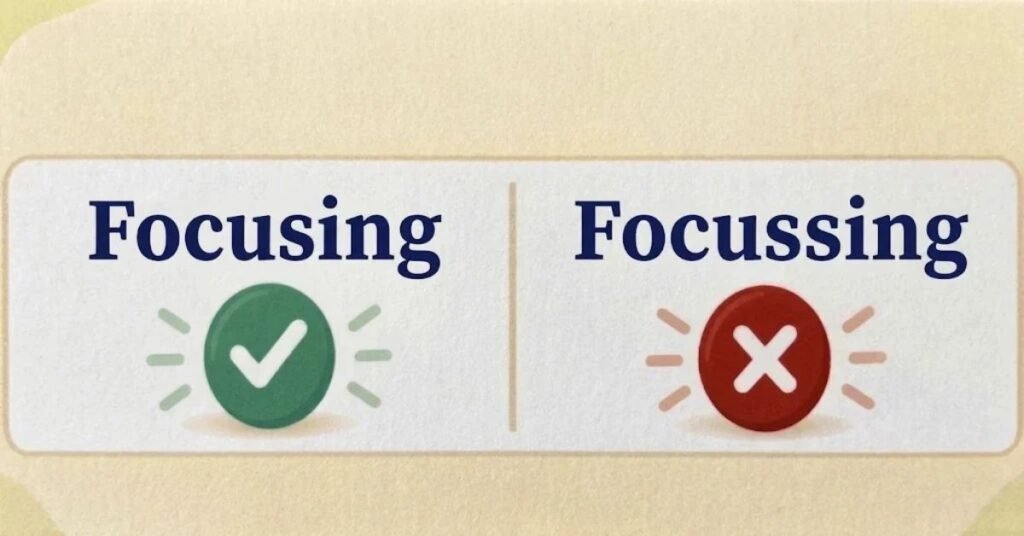
“Focusing” is the standard spelling in both American and British English. “Focussing” is a less common variant that some British writers still use.
- Focusing (one “s”) is correct everywhere and is the safe choice.
- Focussing (two “s”) is not wrong in the UK, but it is rarer and can look like a mistake to many readers.
Quick examples:
- ✅ She is focusing on her exam.
- ⚠️ She is focussing on her exam. (Accepted in some British writing, but uncommon.)
If you want one rule you can apply without thinking, write focusing, focused, and focuses. Nobody will ever mark that wrong.
Focusing vs Focussing: What’s the Difference?
There is no difference in meaning. Both spellings are forms of the verb “focus,” and both describe the act of directing attention, effort, or light toward one point.
The only difference is how the word is written. One version keeps a single “s” before the ending. The other doubles it.
Think of it like “grey” and “gray.” Same word, two spellings. But unlike that pair, one form of “focus” has clearly won out. Dictionaries, style guides, and everyday writing all lean toward the single “s.”
Here is what that means in practice:
- The meaning stays the same.
- The pronunciation stays the same.
- One spelling is far more widely used and accepted.
- The less common one is a spelling variant, not a separate word.
Focusing vs Focussing at a Glance
| Feature | Focusing | Focussing |
| Spelling | One “s” | Two “s” letters |
| Meaning | Directing attention or effort | Directing attention or effort |
| American English | Standard | Rare, usually treated as an error |
| British English | Standard and most common | Accepted variant, less common |
| Australian and Canadian English | Standard | Occasional variant |
| Related past form | Focused | Focussed |
| Related present form | Focuses | Focusses |
| Best for global audiences | Yes | No |
The takeaway is simple. If your readers live in more than one country, or you don’t know where they live, pick the single-“s” forms.
Is Focusing or Focussing More Common?
Focusing is far more common. This holds true in both the US and the UK.
You can see it in nearly every large body of published English: newspapers, academic papers, books, and websites. Writers in Britain, Australia, and Canada overwhelmingly choose the single “s” too. The double-“s” form turns up in smaller pockets, such as some UK schools, older printed material, and individual writers who learned it that way.
Why does this matter for you?
- Search and readability. Most readers recognize “focusing” instantly. “Focussing” makes some pause.
- Spell-checkers. Many tools flag “focussing” when set to American English, and some even flag it in British settings.
- Professional impression. In a resume, a business email, or a school essay, the common spelling avoids any doubt about your attention to detail.
A good rule: use the variant only when a specific style guide, publisher, or employer requires it.
Focusing and Focussing in British vs American English

Many people assume this is another US-versus-UK split, like “color” and “colour.” It isn’t, at least not cleanly.
Here is how it actually works.
American English
American writers use focusing, focused, and focuses. The doubled forms appear in some American dictionaries as variants, but they are rarely used in real writing and often get corrected.
British English
British writers also use focusing, focused, and focuses most of the time. The doubled forms (focussing, focussed, focusses) are listed as acceptable alternatives in major British dictionaries. That is why you may see them in UK newspapers, school materials, or older books.
Other Varieties
Australian, Canadian, Irish, and New Zealand English follow the same general pattern. The single-“s” spelling is the default, and the double-“s” spelling is a minor variant.
| Region | Preferred Spelling | Accepted Variant |
| United States | focusing | focussing (rare) |
| United Kingdom | focusing | focussing |
| Australia | focusing | focussing |
| Canada | focusing | focussing (rare) |
So this isn’t a true “color vs. colour” situation. It’s a matter of one dominant spelling and one fading alternative.
Why Is Focussing Spelled With Two S’s?
If “focusing” is standard, why does “focussing” exist at all? The answer comes down to a spelling rule that is easy to over-apply.
The Consonant-Doubling Rule
In English, a word that ends in a single vowel plus a single consonant often doubles the consonant before an ending that begins with a vowel. This happens when the stress falls on the last syllable.
- begin → beginning (stress on “gin”)
- refer → referred (stress on “fer”)
- stop → stopping (one syllable, stressed)
Why “Focus” Breaks the Pattern
“Focus” has two syllables, and the stress sits on the first one: FO-cus. The final syllable is unstressed. When the final syllable isn’t stressed, the consonant normally stays single.
- FO-cus → FO-cus-ing (not “focussing”)
- BEN-e-fit → BEN-e-fit-ed (not “benefitted,” in most guides)
- VIS-it → VIS-it-ing
That’s the textbook answer, and it points to “focusing.”
What Pushes People Toward Double S
Several things nudge writers toward “focussing”:
- British doubling habits. British English doubles many consonants that American English leaves single: “travelled,” “cancelled,” “labelled.” Writers assume the same applies here.
- Look-alike words. Words like “bus” and “gas” sometimes take a double “s” (“bussing,” “gassing”), so the pattern feels familiar.
- Visual balance. “Focussing” can look more “complete” to some readers, as if the “s” needs reinforcing.
- Older printing conventions. Variant spellings stuck around in some publishing traditions long after most writers moved on.
None of these reasons make “focussing” wrong. They just explain why it survives alongside the standard form.
Focusing Pronunciation
The spelling variant doesn’t change how you say the word. Both forms are pronounced the same way.
- Focusing: FOH-kuh-sing
- Focussing: FOH-kuh-sing (identical)
The stress lands on the first syllable. The “o” is a long sound, like the “o” in “go.” The middle syllable is soft and quick, and the word ends with “-sing.”
Regional Notes
- In American English, the first vowel glides as in “boat.”
- In British English, it sounds close to “foh” with a slightly different glide.
Because the two spellings sound identical, you can’t rely on your ear to pick the right one. That’s why spelling errors in this area are so common. You have to rely on the rule or on memory.
What Does Focusing Mean?
“Focusing” is the present participle of the verb “focus.” It describes an action that is happening right now, or one that continues over time.
Main Meanings
1. Giving attention to one thing. This is the everyday meaning. When you concentrate on a task and shut out distractions, you are focusing.
2. Adjusting a lens or optical device. Photographers, scientists, and anyone using binoculars or a microscope focus the instrument so an image looks sharp.
3. Concentrating effort or resources. Companies, teams, and governments focus their budgets or strategies on specific goals.
4. Making light or energy converge. In physics, a lens or mirror focuses rays to a single point.
Grammar Basics
“Focus” works as both a verb and a noun.
- Verb: “I need to focus.”
- Noun: “Her focus is on accuracy.”
“Focusing” is the -ing form. You use it after “be” verbs for ongoing action (“is focusing”), as a gerund (“Focusing takes practice”), or as a participle (“a team focusing on safety”).
Focusing and Focussing Examples
Seeing the word in context is the quickest way to make it stick. Each example below uses the standard spelling, with the variant shown where relevant.
Everyday Sentences
- I’m focusing on one task at a time this week.
- The students were focusing hard before the test.
- She kept focusing on her breathing to stay calm.
- They’re focusing their efforts on customer support.
Work and Business
- Our team is focusing on reducing delivery times.
- The manager spent the meeting focusing on priorities.
- We’re focusing this campaign on first-time buyers.
Photography and Science
- The photographer is focusing on the bird’s eye.
- The lens works by focusing light onto the sensor.
- Scientists are focusing the beam to a single point.
Using the Variant
These are correct in British writing, though uncommon:
- She was focussing on her revision. (Standard: focusing)
- The report is focussing on rural schools. (Standard: focusing)
If you’re unsure which to use, stick with the first spelling in each pair.
Focus, Focuses, Focused, and Focusing
The whole family of forms follows the same logic. Once you know the rule for one, you know it for all.
| Form | Standard Spelling | Variant Spelling | Example |
| Base verb | focus | focus | “Please focus.” |
| Third person (present) | focuses | focusses | “She focuses well.” |
| Past tense | focused | focussed | “He focused on the task.” |
| Past participle | focused | focussed | “I’ve focused my search.” |
| Present participle | focusing | focussing | “We’re focusing now.” |
| Noun (singular) | focus | focus | “Her focus was sharp.” |
| Noun (plural) | focuses or foci | focuses or foci | “The two foci of the ellipse.” |
A Note on the Noun Plural
For the noun, you have two choices. Focuses is common in everyday writing. Foci is the traditional Latin-style plural, and it shows up most in math, science, and formal writing. In geometry, an ellipse has two foci.
Both are correct. Use “foci” when the context is technical, and “focuses” when you want a more natural tone.
One Simple Memory Rule
If you never double the “s” in any form of “focus,” you’ll never go wrong. The word stays the same length in every form: focus, focuses, focused, focusing.
Common Expressions and Phrases Using Focusing
“Focus” has made its way into a long list of fixed phrases. Here are some you’ll hear often, along with the -ing forms in action.
Work and Study
- Focusing on the task at hand: giving full attention to what you’re doing now.
- Focusing on the big picture: thinking about overall goals instead of small details.
- Focusing on results: measuring success by outcomes.
- Focusing your efforts: narrowing your energy to one priority.
Everyday and Wellbeing
- Focusing your mind: calming and directing your thoughts.
- Focusing on the positive: choosing to notice what is going well.
- Losing focus: letting your attention drift.
- Staying focused: keeping your attention steady.
Related Terms
- Focus group: a small group asked to discuss a product or idea.
- In focus / out of focus: sharp or blurry, used for images and also for ideas.
- Focal point: the main center of attention.
- Focus on: the most common phrase pattern with this verb.
- Pull focus: a film term for shifting a camera’s focus during a shot.
- Soft focus: a deliberately blurred, dreamy photographic effect.
Focused or Focussed: Which Is Correct?
The same answer applies here. “Focused” is the standard spelling in American and British English. “Focussed” is an accepted variant you may spot in some British publications.
Examples
- ✅ He stayed focused during the whole presentation.
- ⚠️ He stayed focussed during the whole presentation. (Acceptable in some UK writing, but less common.)
Using “Focused” as an Adjective
“Focused” often works as an adjective that means “having a clear purpose” or “concentrated.”
- a focused study plan
- a focused approach
- a focused beam of light
- a highly focused employee
Using “Focused” as a Verb Form
It also works as the past tense.
- “She focused her attention on the problem.”
- “They focused on cost savings last year.”
Whichever role it plays, the single-“s” spelling is the safe pick.
Focuses or Focusses: Which Is Correct?
Again, the single-“s” form wins. “Focuses” is the standard spelling for the third-person singular verb and the common plural noun.
As a Verb
- “She focuses on one goal at a time.”
- “The course focuses on practical skills.”
As a Plural Noun
- “The two main focuses of the study are cost and speed.”
- In technical settings: “The ellipse has two foci.”
What About “Focusses”?
“Focusses” is a rare variant. You’ll rarely see it in modern writing. Most readers will assume it is a typo, so it’s best avoided unless a specific style guide asks for it.
Common Mistakes With Focusing and Focussing
Also Read This:Career or Carrer: Which Is Correct? Meaning, Spelling, Differences & Examples (2026)
A handful of slips come up again and again. Here’s how to spot and fix them.
1. Mixing Spellings in One Document
This is the biggest problem. Writing “focusing” in one paragraph and “focussed” in the next looks careless.
Fix: Choose one set of spellings and use it from start to finish.
2. Assuming It Is a US vs. UK Difference
Many writers believe “focussing” is simply the British spelling. In reality, British writers also use “focusing” most of the time.
Fix: Use the single “s” for all audiences unless told otherwise.
3. Over-Applying the Doubling Rule
Because “travelling” and “cancelling” are British standards, some writers double the “s” in “focus” without thinking.
Fix: Remember that the stress falls on the first syllable, so the consonant stays single.
4. Confusing “Focus” With Words That Do Double
“Bus” can become “busses,” and “gas” can become “gasses.” Writers see the pattern and stretch it to “focus.”
Fix: Treat “focus” as its own case. It stays single in every form.
5. Trusting the Spell-Checker Blindly
Settings matter. A checker set to American English may flag “focussing,” while one set to British English may let it pass. Neither setting tells you which is more widely accepted.
Fix: Pick the standard spelling yourself and double-check any flagged word.
6. Misusing “Foci” and “Focuses”
Some writers think “foci” is the only correct plural. Others think “focuses” is wrong. Both are accepted.
Fix: Use “foci” in technical writing and “focuses” in everyday writing.
Which Spelling Should You Use?
The best choice depends on who you’re writing for. Here’s a simple decision guide.
| Situation | Best Choice |
| Writing for a global or unknown audience | focusing |
| Writing for a US audience | focusing |
| Writing for a UK audience with no style guide | focusing |
| Following a UK publisher or school style that requires it | focussing |
| Resume, cover letter, business email | focusing |
| Academic papers and technical writing | focusing |
| SEO content and web writing | focusing |
Practical Tips
- Default to the single “s.” It’s correct everywhere.
- Check your style guide. If your employer, school, or publisher states a preference, follow it.
- Stay consistent. Whatever you choose, use it for every form of the word.
- Run a final search. Use find-and-replace to check for any stray double-“s” versions before you publish or send.
The goal isn’t to prove one spelling is the only valid one. It’s to make your writing clear and professional, and the single “s” does that best.
What Is the Origin of the Word “Focus”?
The word has a surprisingly warm beginning. “Focus” comes from a Latin word meaning “hearth” or “fireplace,” which sat at the center of a Roman home.
From Fireplace to Lens
In the early 1600s, the German astronomer Johannes Kepler borrowed the word for science. He used it for the point where a lens or curved mirror gathers rays of light. The idea fits well, because light concentrated at that spot can be hot enough to start a fire, much like a hearth.
From Optics to Attention
Over time, the meaning stretched.
- Early 1600s: a scientific term for the burning point of a lens.
- 1700s: a general word for a center of activity or interest, and the verb “to focus” appears.
- 1900s: the sense of mental concentration becomes dominant, especially in school and work settings.
Why Origin Matters for Spelling
The Latin root has nothing to do with a doubled “s.” The word comes from a single-“s” ending in Latin and entered English that way. That gives extra support to the standard spelling: nothing in its history calls for a second “s.”
Looking at the history also explains the noun plural. “Foci” is the original Latin plural, which is why it still lives in mathematics and science.
Focusing or Focussing: Quick Summary
Here’s everything in a short list you can screenshot or save.
- Correct spelling: focusing (one “s”).
- Variant: focussing, an accepted but less common British option.
- Meaning: identical for both.
- Pronunciation: identical for both: FOH-kuh-sing.
- Related forms: focus, focuses, focused, focusing.
- Why one “s”: the stress is on the first syllable, so the final consonant stays single.
- Region: the single “s” is standard in the US, UK, Canada, and Australia.
- Best practice: use one spelling consistently and default to the single “s.”
Final Answer
Use “focusing.” It is correct in American and British English, and the same goes for “focused” and “focuses.” The double-“s” forms are accepted variants, but they are rarer and often read as typos.
“Focus” is stressed on the first syllable, so its final consonant stays single, and its Latin root gives no reason for a second “s.” Pick the single “s,” stay consistent, and you can write with confidence.