
You are writing an email, a social media caption, or a school essay. You want to say that you will “get people involved.” The word comes to mind, but your fingers pause. Does it start with in- or en-?
That small doubt is common. The word sounds like “in-GAYJ,” so many people reach for the letter “i” at the start. But only one spelling is right in modern English.
This guide gives you the answer first, then goes deeper. You will see what engage means, why ingage shows up at all, where the word came from, and how to use it in real sentences. You will also find tables, phrase lists, common mistakes, and a memory trick you can use in seconds.
Quick Answer: Is It Ingage or Engage?
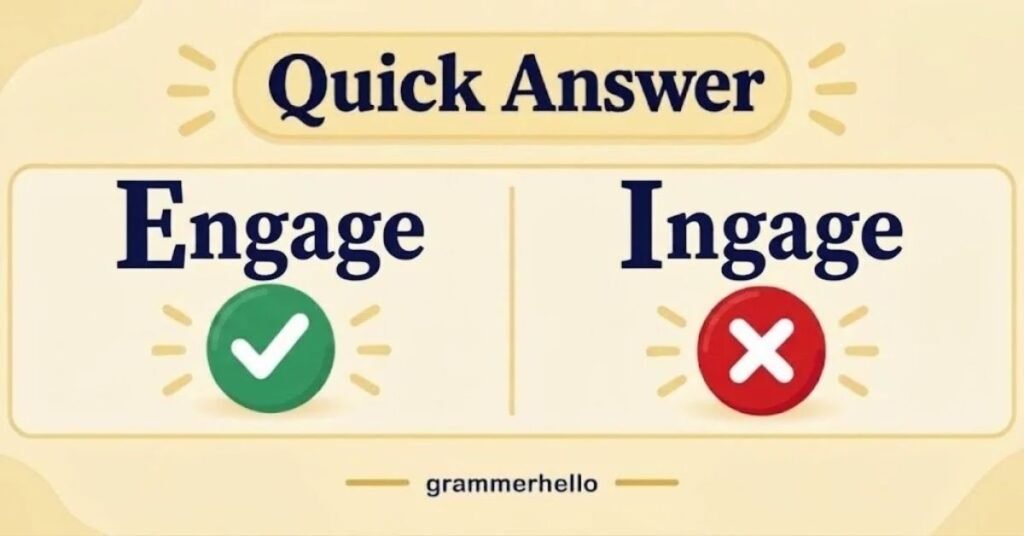
Engage is the correct spelling.
Ingage is not a word in modern English. It is a misspelling, and it appears in old books only as a historical spelling that has long since gone out of use.
| Spelling | Correct today? | Notes |
| Engage | Yes | Standard spelling in American, British, and all other English |
| Ingage | No | Obsolete spelling from older English, now treated as an error |
Remember: Start with E, as in Engage, Engaging, and Engagement.
Ingage vs Engage: What’s the Difference?
In meaning, there is no difference. Both spellings were meant to express the same verb. In correctness, the gap is huge.
| Feature | Engage | Ingage |
| Part of speech | Verb | None in modern usage |
| Accepted in dictionaries | Yes, as a main entry | Only as an old or obsolete form |
| Pronunciation | in-GAYJ | Same sound, wrong spelling |
| Spell-check result | Passes | Flagged as an error |
| Safe for school, work, publishing | Yes | No |
| Related forms | engaged, engaging, engagement, engager | ingaged, ingaging (all wrong) |
The two spellings sound exactly the same when you say them. That is why the problem exists only in writing. If you type “ingage,” your reader will understand you, but they may also quietly judge the spelling.
Origin and History of the Word “Engage”
To see why the spelling uses an “e,” it helps to look at where the word came from.
The Roots of Engage
Engage came into English from Old French engagier, which was built from two parts:
- en-, a prefix meaning “to put in” or “to bring into”
- gage, meaning a pledge or something offered as security
So the earliest sense was close to “to bind by a pledge” or “to put under an obligation.” If someone engaged to do something, they promised it. That idea still lives on in words like engagement (a promise to marry) and to be engaged to someone.
How the Meaning Grew
Over the centuries, the word spread into many areas of life:
| Period | Common sense of “engage” |
| Early use | To pledge, promise, or bind oneself |
| Later | To hire or employ someone, as in “engage a lawyer” |
| Military use | To enter into battle, as in “engage the enemy” |
| Mechanical use | To lock parts together, as in “engage the clutch” |
| Social use | To take part in conversation or activity |
| Modern business and media | To attract and hold attention, as in “engage customers” |
Where Did “Ingage” Come From?
Before spelling became fixed, English writers often spelled words as they heard them. Old texts show that ingage appeared as a variant spelling, especially in 17th and 18th century writing. Dictionaries list it today as an obsolete spelling of engage.
As printing, schooling, and dictionaries standardized English, the “en-” form became the only accepted one. “Ingage” faded away.
Is “Ingage” a Word?
No, not in modern English.
Here is the full picture:
- Historically: It appeared in older texts as a variant spelling.
- In current dictionaries: It is labeled obsolete, which means no longer in use.
- In spell checkers: It is flagged as incorrect.
- In professional writing: It is treated as a typo.
So if you see “ingage” in a modern headline, ad, or post, it is almost certainly a mistake, not a stylistic choice.
Can “Ingage” Ever Be Used?
There are only a few cases:
- You are quoting an old text that uses it.
- You are writing about the history of English spelling.
- A brand or product has deliberately chosen it as a name.
In every other case, use engage.
Why Do People Confuse “Ingage” and “Engage”?
This mix-up is easy to understand. Several things push writers toward the “i.”
1. The Sound
The first syllable of engage is often pronounced like “in.” So the ear hears “in-gage,” even though the spelling begins with “en.”
2. The “In-” Habit
English has many words that start with “in-,” such as inform, involve, include, and invest. The brain naturally guesses “in” for that sound.
3. Similar Pairs That Switch Between “In” and “En”
Some English words really do have both forms. That makes the guess feel reasonable.
| Pair | Notes |
| Inquire / Enquire | Both accepted, with regional preferences |
| Insure / Ensure | Different meanings |
| Inclose / Enclose | “Enclose” is now standard |
| Incase / Encase | “Encase” is standard |
Because these pairs exist, people assume engage might also have a twin. It does not.
4. Fast Typing and Texting
On phones and keyboards, people often type quickly and skip checking. A wrong vowel can slip through, especially in casual writing.
5. Weak Visual Memory
If a writer has not seen the word spelled out many times, they may rely on sound alone.
Synonyms and Related Words of “Engage”
Because engage has several meanings, its synonyms depend on the context. Here is a helpful breakdown.
Synonyms by Meaning
| Meaning | Synonyms |
| Take part in | participate, join, partake, get involved |
| Attract attention | captivate, absorb, grip, hold, interest, occupy |
| Hire | employ, recruit, appoint, retain, hire |
| Promise or commit | pledge, vow, undertake, contract, commit |
| Fight or battle | attack, confront, clash with, take on |
| Connect parts | lock, mesh, fasten, link, activate |
| Interact | converse, communicate, connect, interact with |
Word Forms in the Same Family
| Word | Part of speech | Example |
| Engage | Verb | They engage with their readers daily. |
| Engaged | Adjective or past tense | The audience looked engaged. |
| Engaging | Adjective or participle | She gave an engaging talk. |
| Engagement | Noun | The brand boosted engagement on social media. |
| Engager | Noun (rare) | The speaker is a skilled engager of crowds. |
| Disengage | Verb | He tried to disengage from the argument. |
| Re-engage | Verb | The team worked to re-engage lapsed customers. |
| Unengaged | Adjective | The students seemed unengaged. |
Opposites of Engage
- ignore
- disengage
- withdraw
- detach
- dismiss
- neglect
- abandon
What Does “Engage” Mean?
Engage is a verb with several related meanings. Here is a clear way to understand each one.
1. To Attract and Hold Someone’s Attention
This is the most common meaning in everyday and business writing.
- A good teacher knows how to engage students.
2. To Take Part in Something
Often used with the word in.
- They engage in volunteer work every weekend.
3. To Interact or Connect With Someone
Often used with the word with.
- Leaders should engage with their communities.
4. To Hire or Employ
More formal and common in professional settings.
- The firm decided to engage a consultant.
5. To Promise or Commit
An older meaning that still appears in formal language.
- He engaged to pay the debt in full.
6. To Begin Fighting
Common in military language.
- The troops engaged the enemy at dawn.
7. To Fit or Lock Together
Used for machines and mechanical parts.
- Press the pedal to engage the clutch.
Quick Dictionary-Style Definition
Engage (verb): to attract or hold attention; to take part or cause someone to take part in something; to hire; to pledge; or to lock together, depending on the context.
Pronunciation
in-GAYJ (/ɪnˈɡeɪdʒ/)
The stress falls on the second syllable. The first syllable is short and soft.
How to Use “Engage” Correctly
Using engage well depends on choosing the right preposition and the right sense.
Engage In
Use engage in when you mean take part in an activity.
- Children should engage in physical play every day.
- The two companies engaged in lengthy talks.
Engage With
Use engage with when you mean interact or connect with a person, idea, or group.
- Writers should engage with their audience.
- The students engaged with the text through discussion.
Engage As a Direct Verb
Use engage + object when you mean capture attention, hire, or activate.
- The story engaged the whole room.
- We engaged an electrician to fix the wiring.
Engage vs Engaged vs Engaging
| Form | Meaning | Example |
| Engage | Base verb | I want to engage my team. |
| Engages | Third-person singular | She engages everyone she meets. |
| Engaged | Past tense or adjective | The crowd was fully engaged. |
| Engaging | Present participle or adjective | His engaging style won everyone over. |
Quick Rules
- Add -s for he, she, or it: She engages.
- Add -d for the past: They engaged a lawyer.
- Use -ing for ongoing action: We are engaging with partners.
- Do not say “engage of” or “engage on” when you mean participation. Use in or with.
Engage in a Sentence: Examples

Seeing the word in context is the fastest way to learn it.
Everyday Examples
- The teacher tried to engage every student in the discussion.
- It is hard to engage a toddler with a long story.
- They engage in a friendly debate every Sunday.
- She was too tired to engage with the crowd.
Work and Business Examples
- The brand wants to engage customers through short videos.
- We engaged an agency to handle our marketing.
- Managers should engage their teams with clear goals.
- The company engaged in talks with two potential partners.
Education Examples
- Interactive lessons help engage reluctant readers.
- Students are more likely to engage when topics feel relevant.
- The professor used a quiz to engage the class.
Technical Examples
- Make sure the brake is fully engaged before leaving the car.
- Pull the lever to engage the lock.
- The gears engage when the handle turns.
Personal and Social Examples
- They got engaged last summer.
- He was engaged to be married in the spring.
- I am engaged in a book project right now.
Military and Formal Examples
- The unit engaged the enemy near the bridge.
- The two sides agreed to engage in peace talks.
Common Mistakes With “Engage”
Even skilled writers slip up with this word. Here are the most common errors.
1. Spelling It “Ingage”
Wrong: We need to ingage our readers. Right: We need to engage our readers.
2. Other Misspellings
Watch for these variations:
- engauge
- enguage
- engadge
- ingauge
- engige
The correct spelling is e-n-g-a-g-e.
3. Mixing Up Engage and Enrage
These two look similar but mean very different things.
| Word | Meaning | Example |
| Engage | Involve or take part | The speech engaged the crowd. |
| Enrage | Make very angry | The decision enraged the crowd. |
4. Confusing Engaged With Engine
A sound-alike mistake, but the words are unrelated.
5. Wrong Prepositions
Wrong: He engaged on the debate. Right: He engaged in the debate.
6. Using the Base Form Instead of the Past Form
Wrong: She is being engage in the project. Right: She is engaged in the project.
7. Forgetting the Third-Person “S”
Wrong: The app engage users every day. Right: The app engages users every day.
8. Overusing It as a Buzzword
In marketing, engage can become empty. Instead of writing “We engage our audience,” say how: We reply to every comment within an hour.
Engage vs Ingage: Correct Spelling Examples
This section shows the right and wrong versions side by side.
| Wrong (Ingage) | Correct (Engage) |
| Ingage with your customers. | Engage with your customers. |
| The speaker ingaged the audience. | The speaker engaged the audience. |
| An ingaging presentation | An engaging presentation |
| Employee ingagement is rising. | Employee engagement is rising. |
| They ingage in daily practice. | They engage in daily practice. |
| Please ingage the lock. | Please engage the lock. |
| She was ingaged to him. | She was engaged to him. |
| We hope to re-ingage old clients. | We hope to re-engage old clients. |
Notice the pattern: Every form of the word keeps the “en-“ at the start: engage, engaged, engaging, engagement, disengage, re-engage.
How to Remember the Correct Spelling
Also Read This :Investor vs. Investee: What’s the Difference? Meaning, Roles, and Examples Explained (2026)
Use whichever trick feels easiest.
Trick 1: The Gage Link
Look at the end of the word: gage. It comes from the idea of a pledge. The word begins with en-, meaning “to put into.” So en + gage is “to put into a pledge.”
Trick 2: Pair It With Enjoy and Enter
Think of friendly “en-” words:
- enjoy
- enter
- engage
- encourage
- enrich
All of these are active, positive words. Engage fits the group.
Trick 3: E for Everyone
Say it: “To Engage is to involve Everyone.” The “E” at the start reminds you of the correct letter.
Trick 4: The Engagement Ring
Picture an engagement ring. You would never write “ingagement ring.” The same spelling applies to the verb.
Trick 5: Use the Spell-Check Habit
If you are unsure, type the word in a dictionary or spell checker once. Seeing it with an “e” a few times builds visual memory fast.
Common Phrases and Expressions With “Engage”
Here are the most useful phrases, grouped by theme.
Everyday Phrases
| Phrase | Meaning |
| Engage in conversation | Start or take part in talking |
| Engage with others | Interact with people |
| Engage someone’s attention | Capture interest |
| Engage in small talk | Chat casually |
| Engage in debate | Join a discussion with opposing views |
| Engage in activity | Take part in something |
Work and Business Phrases
| Phrase | Meaning |
| Engage customers | Connect with buyers or users |
| Engage employees | Keep staff motivated and involved |
| Engage a consultant | Hire an expert |
| Engage stakeholders | Involve people with an interest in a project |
| Engage in negotiations | Take part in formal talks |
| Customer engagement | How strongly customers interact with a brand |
| Employee engagement | How committed workers feel |
| Audience engagement | How actively an audience responds |
Technical Phrases
| Phrase | Meaning |
| Engage the clutch | Connect the engine to the gearbox |
| Engage the brake | Apply the brake |
| Engage the gears | Lock gears together |
| Engage autopilot | Switch on automatic control |
| Engage the lock | Secure a mechanism |
Social and Military Phrases
| Phrase | Meaning |
| Get engaged | Agree to marry |
| Engaged to be married | Formally promised to marry |
| Engage the enemy | Begin fighting |
| Rules of engagement | Official rules for when and how force can be used |
| Engaged tone | A busy signal on a phone line (especially in British English) |
Related Idioms and Expressions
- “Engage brain before mouth.” A playful reminder to think before speaking.
- “Engage warp drive.” A science-fiction phrase often used jokingly to mean “go fast.”
- “Engaged in a battle of wits.” Competing through clever thinking.
Is “Engage” a Correct Word?
Yes, absolutely.
Engage is a standard, widely used English verb found in every major dictionary. It appears in:
- Everyday speech
- Business and marketing
- Education and training
- Law and contracts
- Engineering and machinery
- Military language
- News and journalism
It is accepted in both American and British English, and the spelling is the same in both. You do not need to worry about regional differences.
Quick Credibility Check
You can confirm the spelling in several ways:
- Look it up in a trusted dictionary such as Merriam-Webster, Oxford, or Cambridge.
- Check whether your spell checker accepts it.
- Search for the word in reputable news sites and note how it is spelled.
Every one of these will show engage, not “ingage.”
Ingage or Engage: Which One Should You Use?
Use engage. The advice does not change, no matter who you are writing for.
Here is why:
- It is the only standard spelling. Dictionaries, style guides, and teachers all agree.
- It protects your credibility. A typo in a resume, report, or ad can weaken trust.
- It supports your SEO. People search for “engage,” “engagement,” and “engaging,” so correct spelling helps your content get found.
- It prevents confusion. Readers may not recognize “ingage” at first glance.
- It matches related words. Engagement, engaging, and disengage all share the same spelling pattern.
Quick Decision Guide
| Situation | Which spelling? |
| Essay, report, or email | Engage |
| Social media post or ad | Engage |
| Resume or cover letter | Engage |
| Quoting an old text exactly | Ingage (only if the original uses it) |
| Writing about historical spelling | Ingage (as an example only) |
| Everything else | Engage |
Final Takeaway
Engage is the only correct spelling in modern English. Ingage is an obsolete form that survives only in old texts and is treated today as a simple spelling mistake.
Keep the “en-” at the start of every related word, such as engaged, engaging, and engagement. If you ever doubt it, picture an engagement ring and the spelling will come back to you right away.