

You are typing a quick email, a shipping form or a job application. You reach the word for where someone lives, and your fingers hesitate. One d or two? One s or two?
It is a small pause, but it happens to a lot of people. “Address” is one of the most used words in English, and it is also one of the most misspelled. Spell it wrong on a resume, a delivery form or a business website, and the mistake sits right where everyone can see it.
This guide settles the question. You will see which spelling is correct, where the word comes from, how it is pronounced, why so many people get it wrong, and how to lock the right spelling into memory for good.
Adress or Address – Quick Answer
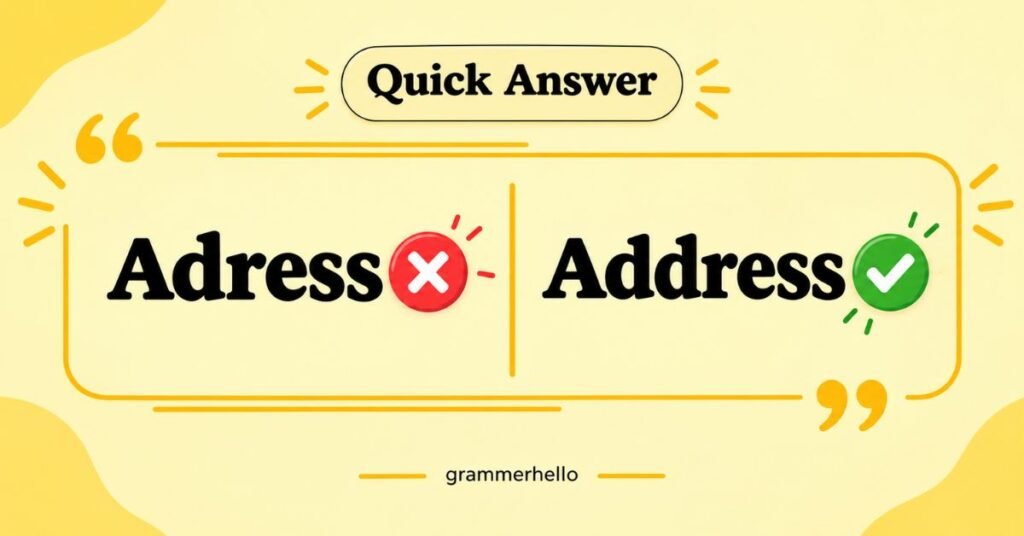
“Address” is the only correct spelling. It has two ds and two ses: a-d-d-r-e-s-s. “Adress” is not a word in standard English. It is not an accepted variant in British, American, Canadian or Australian English.
Here is the short version:
- Correct: address, addresses, addressed, addressing
- Incorrect: adress, adresses, adressed, adressing
- Seven letters: a-d-d-r-e-s-s
- Easy check: it is “ad” + “dress,” with the two ds meeting in the middle
The word works as both a noun and a verb. As a noun, it can mean the place where you live or work, a web or email location, or a formal speech. As a verb, it means to speak to someone, to write a destination on mail, or to deal with a problem.
The Origin of Address
Spelling makes more sense once you know the history, and this word has an interesting one.
“Address” came into English in the early 1300s. It came from Old French adrecier, which meant to go straight toward something, to straighten, to point or to direct. That French verb goes back further to a Vulgar Latin form meaning “to make straight,” built from the Latin prefix ad- (“to” or “toward”) and the Latin directus (“straight”).
So the original idea was pointing something in the right direction. That core meaning never really left. When you address an envelope, you direct it to a destination. When you address an audience, you direct your words at them. When you address a problem, you direct your effort at it.
The word is also a cousin of “dress.” Both come from the same Old French verb, and “dress” simply lost the prefix along the way. That is why “dress” sits inside “address,” and it becomes useful later when we talk about memory tricks.
A few milestones in the word’s life:
| Period | What happened |
| Early 14th century | “Address” enters English as a verb meaning to guide or direct |
| 15th century | French writers try to respell the word with add-. The change fails in French but survives in English |
| 1530s | The noun appears, first meaning a dutiful or courteous approach |
| 1751 | The sense of a formal speech to an audience is recorded, as in the Gettysburg Address |
That 15th-century detail matters. Scholars of the time liked to make spellings look more Latin. French eventually dropped the idea, and modern French spells the verb adresser with a single d. English kept the double d. So when someone writes “adress,” they are accidentally spelling it the French way.
Why “Adress” Is Incorrect in English
Dictionaries are the final judges of standard spelling, and none of the major ones list “adress” as a headword or an accepted variant. Spell checkers in word processors and browsers flag it right away, usually with a red underline.
There are three simple reasons it counts as an error:
- It breaks the established spelling. English spelling is not perfectly logical, but it is fixed by long convention. The convention for this word is addr- and -ess.
- It is treated as a mistake in testing. The misspelling is a favorite in English exams. Competitive tests often list “adress” among four options and ask which one is spelled wrong. Teachers use it for the same reason: it looks plausible, which is exactly why it catches people.
- It causes real problems in practice. Address-validation tools are built to catch typos in location data, and misspellings are one of their listed causes of failed validation. Software projects have also shipped with the “adress” typo in visible form labels, only to have it patched later. A small slip in a form field can mean undelivered mail or a failed checkout.
In short, there is no gray area. If you see “adress,” it is a typo.
British English vs American English Spelling (Address or Adress)
Many spelling questions in English come down to a British versus American split. Think of colour and color, or centre and center. So it is fair to ask whether “adress” might be an accepted regional form.
It is not. Both British and American English use “address.”
The word is one of the many that the two varieties agree on. The same goes for Canadian, Australian, Indian and Irish English. There is no regional “adress” to fall back on.
To see how this differs from words that really do split by region, compare:
| Word type | British spelling | American spelling |
| Real regional difference | colour | color |
| Real regional difference | centre | center |
| Real regional difference | organise | organize |
| Real regional difference | defence | defense |
| No difference | address | address |
| No difference | dress | dress |
The takeaway: if you are unsure about a spelling, first ask whether the word is one of the British/American pairs. For “address,” the answer is no, so you can use one spelling everywhere.
Which Spelling Should You Use?
Always use address. There is no situation in standard written English where “adress” is the better choice.
Here is how that plays out in common settings:
- Email and business writing: “Please confirm your email address.”
- Resumes and cover letters: “Home address” or “mailing address.”
- Legal and official forms: “Residential address,” “billing address,” “registered address.”
- Websites and apps: form labels, checkout pages and contact sections should all read “address.”
- Academic writing: “This paper addresses the problem of…”
- Public speaking: “The president delivered an address to the nation.”
One practical note for anyone who builds or manages websites: check your form fields, placeholder text, error messages and meta descriptions. A single “adress” on a contact page can make a business look careless, and it can quietly hurt trust.
Common Mistakes with Adress or Address
The single-d error is the headline, but people slip up with this word in several ways. These are the ones that show up most often.
| Wrong | Right | What went wrong |
| adress | address | One d missing |
| adres | address | Both a d and an s missing |
| addres | address | One s missing |
| adresss | address | Too many ses |
| adressed | addressed | One d missing in the past form |
| adressing | addressing | One d missing in the -ing form |
| adresses | addresses | One d missing in the plural |
| email adress | email address | Missing d in a very common phrase |
| IP adress | IP address | Same slip in a technical term |
One usage note: don’t mix up “address” and “addressee.” An addressee is the person a letter is sent to, while the address is the place.
Pronunciation of Address
The pronunciation does not help you with the spelling, and that is part of the problem. Say it aloud and you hear one d sound and one s sound. The doubled letters are silent. English has many doubled letters that have no effect on how a word sounds.
How to say it:
- Verb: uh-DRESS, with the stress on the second syllable. In IPA, /əˈdrɛs/.
- Noun, British English: usually the same, uh-DRESS.
- Noun, American English: often AD-dress (/ˈæˌdrɛs/), with the stress on the first syllable, although uh-DRESS is also common.
Both forms have two syllables. The second syllable rhymes with “dress,” “press” and “guess.”
The stress shift in the American noun is why some learners think the word has a hidden extra beat. It does not. There are only two syllables either way.
A helpful point for English learners: the first syllable, a- or ad-, is a weak sound called a schwa. Weak sounds are where many spelling mistakes begin, because the ear cannot tell the writer what letter to use.
Address in Everyday Examples
Seeing the word in real sentences is the fastest way to feel the right spelling. Here it is in its main roles.
As a noun meaning a location
- “Please write your home address on the form.”
- “The package was sent to the wrong address.”
- “She has lived at the same address for twenty years.”
- “He has no fixed address at the moment.”
As a noun for digital locations
- “What is your email address?”
- “Type the web address into the browser.”
- “Every device on the network has an IP address.”
- “The program stores data at a specific memory address.”
As a noun meaning a speech
- “The mayor gave a short address at the ceremony.”
- “The Gettysburg Address is one of the most famous speeches in American history.”
- “Her keynote address opened the conference.”
As a verb meaning to speak or write to
- “He addressed the crowd from the stage.”
- “Address the envelope clearly so it gets delivered.”
- “How should I address a judge?”
As a verb meaning to deal with something
- “The manager promised to address the complaints.”
- “We need to address this problem before it grows.”
- “The new law addresses data privacy.”
In golf, a lesser-known meaning
- “He took his time to address the ball before his swing.” This is actually the oldest English sense still in use: to get set and aim.
Why This Mistake Happens
If the right spelling is so common, why do people keep getting it wrong? There are several honest reasons, and none of them mean you are a poor speller.
- The sound hides the doubled letters. English does not pronounce a double d or double s any differently from a single one. Without a sound clue, your brain guesses.
- The word splits in a misleading way. Because “adress” sounds like “a” + “dress,” it feels natural to write it as two parts. One language-learning resource points out exactly this pattern: the misspelling mirrors how the word sounds when broken apart.
- Other languages spell it with one d. French writes adresse, German writes Adresse, and several other languages follow similar patterns. Anyone who speaks one of those languages may carry the single d across without noticing. As we saw, French even had a chance to change its spelling and chose not to.
- Typing is fast and autocorrect is unreliable. The d and s keys sit next to each other on a standard keyboard, so a skipped or swapped letter is easy. And if you rely on autocorrect, you may never notice the slip.
- We read words as shapes, not letters. Skilled readers recognize whole word shapes. “Adress” looks almost identical to “address” at a glance, so proofreading by eye misses it.
Knowing the cause makes the fix easier. You do not need a better ear. You need a better memory hook, which we cover below.
Adress or Address – Google Trends & Usage Data
Also Read This:
Search and usage data tell a consistent story: the standard spelling is overwhelmingly dominant, and the misspelling survives mainly as a typo.
Rather than quote numbers that go out of date, here is how you can check the pattern yourself:
| Tool | What it shows | How to use it |
| Google Trends | Relative search interest over time and by region | Enter “address” and “adress” as two terms and compare |
| Google Books Ngram Viewer | How often each spelling appears in published books | Compare both spellings across a chosen date range |
| Corpus tools (such as COCA or the BNC) | Frequency in real written and spoken English | Search both forms and look at the counts |
What you will typically see:
- “Address” appears constantly. It shows up in everyday searches, shopping, travel, technology and government services.
- “Adress” appears as an error. When people search for it, they are usually trying to spell the correct word or fixing a typo. Search engines tend to suggest the right spelling automatically.
- No sustained shift. Nothing in published usage suggests “adress” is becoming an accepted form.
For writers and site owners, the practical meaning is simple. Optimizing for “adress” has no real value, and using it in your own copy only signals a mistake.
Comparison Table: Adress vs Address

Here is the whole picture in one place.
| Feature | Address | Adress |
| Correct in standard English? | Yes | No |
| In major dictionaries? | Yes | No |
| Number of ds | Two | One |
| Number of ses | Two | One |
| Part of speech | Noun and verb | Not a word |
| Used in British English? | Yes | No |
| Used in American English? | Yes | No |
| Pronunciation | uh-DRESS or AD-dress | Not applicable |
| Past form | addressed | “adressed” is also wrong |
| Example | “Send it to my address.” | “Send it to my adress.” (wrong) |
| Verdict | Always use this | Always avoid |
Examples in Context
Here are side-by-side examples that show the error and the fix in realistic writing.
| Incorrect | Correct |
| Please send the invoice to my new adress. | Please send the invoice to my new address. |
| What is your email adress? | What is your email address? |
| The speaker adressed the audience. | The speaker addressed the audience. |
| We must adress this issue today. | We must address this issue today. |
| Update your billing adress at checkout. | Update your billing address at checkout. |
| She forgot to add the return adress. | She forgot to add the return address. |
And here is the word used correctly in short, realistic situations:
In an email: “Hi Sam, could you confirm the delivery address before Friday? The courier needs the full street address and postcode.”
In a cover letter: “I have attached my resume. My contact details, including my mailing address, are at the top of the page.”
In a business report: “The proposal addresses three main concerns: cost, timing and staffing.”
In a speech: “Thank you all for coming. In tonight’s address, I want to talk about what we can do together.”
Notice that the meaning changes slightly from one example to the next, while the spelling never does. That consistency is helpful. Once you learn one form, you have learned them all.
Similar Misspelled English Words
Also Read This:Halves or Halfs: Correct Spelling, Meaning, and Usage
“Address” is far from the only word that trips people up. Many of the most commonly misspelled words involve doubled letters, and the errors follow similar patterns.
| Correct word | Common misspelling | Quick tip |
| accommodate | acommodate, accomodate | Two cs and two ms |
| embarrass | embarass, embarras | Two rs and two ses |
| occurrence | occurence, ocurrence | Two cs and two rs |
| necessary | neccessary, necesary | One c, two ses |
| recommend | reccomend, recomend | One c, two ms |
| committee | comittee, commitee | Two ms, two ts, two es |
| success | sucess, succes | Two cs, two ses |
| possess | posess, possses | Two pairs of s |
| assess | asess, assses | Two pairs of s |
| harass | harrass, haras | One r, two ses |
| tomorrow | tommorow, tomorow | One m, two rs |
| occasion | ocasion, occassion | Two cs, one s |
If you struggle with “address,” you are in very large company. The strategies below work for every word on this list.
The Double Letter Rule in English Spelling
People often ask whether there is a rule for when to double a letter. The honest answer is that there are several partial rules, and “address” follows one of them.
Rule 1: Doubling before a suffix. When a short word ends in a single vowel plus a single consonant, you often double the consonant before adding -ed or -ing. Examples: stop → stopped, plan → planned, run → running. This rule does not explain “address,” but it is the one most people learn first.
Rule 2: Prefix assimilation. This is the rule that matters here. Many English words begin with the Latin prefix ad-, meaning “to” or “toward.” When the next letter is a consonant, the d in ad- often changes to match it. That produces a double letter right after the first syllable.
Look at how many common words follow this pattern:
- ac-: accept, access, account, accurate
- af-: affect, afford, affirm
- ag-: aggravate, aggressive
- al-: allow, alliance, allocate
- an-: announce, annual
- ap-: appear, apply, approve
- ar-: arrange, arrive, arrest
- as-: assist, assume, assess
- at-: attempt, attract, attend
“Address” is a slightly different case. Here the d of ad- sits next to the d of dress, so the doubled letter appears without any change at all. The prefix ad- simply meets a stem that starts with d.
The word is not a perfect fit for the pattern, though. Some ad- words keep a single d, such as advance, adjourn and adverb. Historical spelling changes explain why, and the history is messy.
Rule 3: There is no rule. Some doubled letters, like the double s at the end of “address,” are simply what the word looks like. This is common for words ending in -ss, such as dress, press, guess and stress.
The most useful conclusion is also the most practical one. Do not try to derive every double letter from a rule. Learn the specific word, and use a memory hook for the ones that give you trouble.
How to Remember the Correct Spelling of Address
Here are five reliable ways to make the spelling stick.
- Split it as “ad” + “dress.” Write ad, then write dress right after it. The d that ends the first part and the d that starts the second part sit side by side, and you get a-d-d-r-e-s-s. This is the simplest and most effective trick.
- Remember that “dress” is inside it. The word “dress” is hiding in the back half of “address.” If you can spell “dress,” you can spell “address” by adding “ad” at the front.
- Count the pairs. There are exactly two doubled pairs: dd and ss. Say it to yourself: “Double d, double s.” Repeat it a few times and it becomes automatic.
- Picture the word as balanced. Seven letters, with a pair near the start and a pair at the end. The shape feels symmetrical, and many people find that easier to hold in mind than a random list of letters.
- Write it five times, slowly. Muscle memory is real. Type or handwrite the word five times, paying attention to each pair. Then use it in a sentence from your own life, such as your real home address.
A short self-test: cover the answers and try to spell these aloud or on paper: address, addresses, addressed, addressing, addressee. If you can do all five, you have it.
And if you write for a living or manage a website, add one more habit: run a quick search for “adress” across your own pages before you publish. It takes seconds and can catch an error that spell checkers occasionally miss in code, templates or image text.
Conclusion
“Address” is the only correct spelling, and “adress” is always a mistake. Both British and American English use two ds and two ses, even though the doubled letters are silent when you say the word.
The easy fix is to think “ad” + “dress” and count two pairs. Then check your forms, emails and web pages for the single-d slip.
[…] Also Read This:Address vs. Adress: Which Spelling Is Correct? Meaning and Examples […]