
You are about to send an important email when your cursor freezes over one word. Is it “authorized” or “authorised”? Did you just make a spelling mistake in front of your boss, your client, or your teacher?
Relax. Neither spelling is wrong. Both mean exactly the same thing, and the only real question is which one fits your reader.
This guide shows you where each spelling comes from, how it behaves in real sentences, and how regional habits shape the choice. You will also find comparison tables, everyday examples, legal tips, and the common mistakes that make good writing look careless. By the end, you will know which spelling to use and why.
Authorized
Meaning and Definition
Authorized is the standard spelling in American and Canadian English. As a verb, it means to give official permission or approval for something to happen. When someone in charge says yes in a formal way, they have authorized the action.
The word also works as an adjective. An authorized person, an authorized dealer, or an authorized signature all carry the same idea: someone with the right power has approved it, and everyone else can trust that approval.
Related Forms and Examples
The letter “z” stays in every word from the same family: authorize, authorizes, authorizing, authorization, and unauthorized. Because the family is consistent, you only have to remember the rule once and apply it to all of them.
Here are a few examples in context. “The manager authorized the purchase of new laptops.” “Only authorized staff can enter the server room.” “Your bank has authorized the payment.” Each sentence uses the word to show that official permission exists.
Authorised
Meaning and Definition
Authorised is the standard spelling in British English and in most English-speaking countries outside North America. That includes Australia, New Zealand, Ireland, India, and South Africa. The meaning is identical to the American form, so nothing about the idea changes.
Only one letter is different, and that letter has no effect on grammar or pronunciation. A British reader and an American reader will hear the same word in their heads, even though they see different spellings on the page.
Related Forms and Examples
In this spelling family, an “s” replaces the “z” everywhere: authorise, authorises, authorising, authorisation, and unauthorised. Once you pick this style, apply it to every related word so your text stays neat.
For example: “The council authorised the new road project.” “The museum published an authorised biography of the painter.” “Only authorised vehicles may park here.” These sentences are typical of British, Australian, and Irish writing.
Authorized or Authorised – Quick Answer
The One-Line Rule
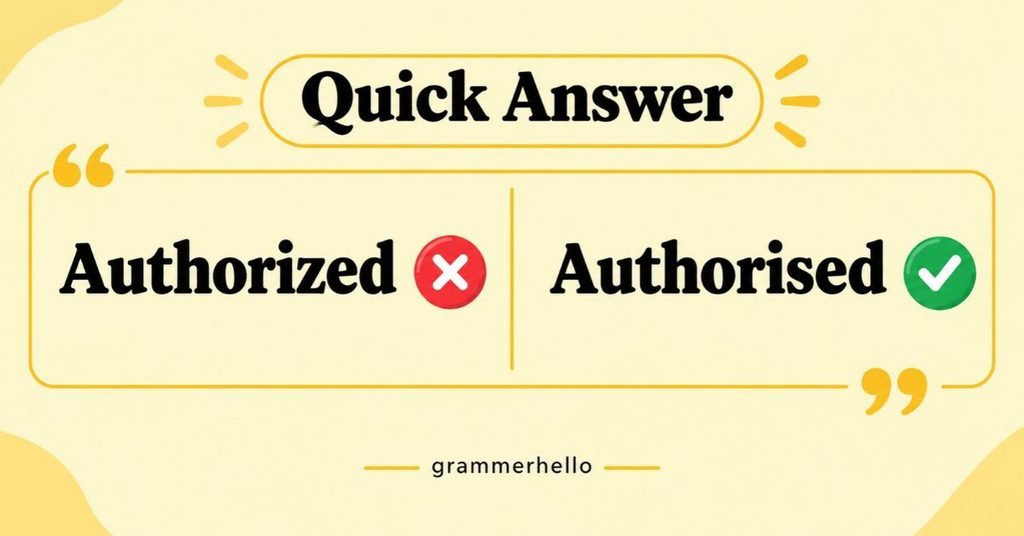
Use “authorized” for American and Canadian readers, and “authorised” for British, Australian, New Zealand, Irish, Indian, and South African readers. That single sentence solves most real-world cases, and you can safely remember it as your default.
Think of the pair the way you think of color and colour. They are not two different words. They are two regional spellings of one word, and each is correct in its own home territory.
What If Your Audience Is Global?
Sometimes you write for readers in many countries at once. In that case, choose the spelling used by your largest group of readers, and then apply it across the whole document without exception.
Consistency matters more than which version you pick. A reader will forgive either spelling, but a text that switches halfway through looks careless and may lose trust.
The Origin of Authorized or Authorised
From Latin to English
The word comes from the Latin auctor, which meant a creator, an originator, or a person with authority. This root also gave English the words author and authority, so the family ties are easy to see once you look for them.
From Latin, the word travelled through Medieval Latin and Old French before settling in English. Its “-ize” ending goes back to the Greek suffix -izein, used to turn nouns into verbs. This is why “authorize” is actually the older form, even in Britain.
How the Spellings Split
Noah Webster, the American lexicographer, promoted “-ize” in his dictionaries and encouraged simpler, more regular spelling. His influence helped make “-ize” the American standard, and it has stayed that way ever since.
In Britain, “-ise” grew more popular during the twentieth century, partly because French uses a similar ending. However, Oxford University Press and some other publishers kept “-ize” as house style, which explains why you may still see it in British books and journals.
British English vs American English Spelling
The Bigger Pattern
The authorized and authorised split is not a one-word quirk. It is part of a large group of verbs that can end in either “-ize” or “-ise.” American English almost always chooses “-ize,” as in organize, recognize, realize, and authorize.
British English commonly chooses “-ise,” as in organise, recognise, realise, and authorise. Learning this pattern helps you get dozens of words right at once, not just this one.
Words That Stay the Same
Some verbs end in “-ise” in both dialects because the ending is part of the word and not a suffix. Advertise, revise, supervise, surprise, and exercise are the best-known examples.
Writers who are trying hard to sound American sometimes turn these into “-ize” by mistake. That error looks worse than any regional difference, so keep these words as they are in every kind of English.
Comparison Table

Authorized vs. Authorised at a Glance
Use this table for a fast check before you publish. Notice that even the pronunciation matches, which means the difference appears only on the page and never in speech.
| Feature | Authorized | Authorised |
| Spelling style | American / Canadian | British / international |
| Part of speech | Verb (past tense), adjective | Verb (past tense), adjective |
| Meaning | Given official permission | Given official permission |
| Base verb | authorize | authorise |
| Noun form | authorization | authorisation |
| Opposite | unauthorized | unauthorised |
| Common regions | USA, Canada | UK, Australia, NZ, Ireland, India, South Africa |
| Sample phrase | authorized dealer | authorised dealer |
| Pronunciation | AW-thuh-ryzd | AW-thuh-ryzd |
Why the Table Matters
The table proves that every difference is spelling only. Grammar, meaning, and sound stay identical, so you never need to rebuild a sentence when you switch from one style to the other.
That also makes editing easy. If a client asks you to convert a document from British to American style, a careful search-and-replace on the endings will usually do most of the work.
How To Use “Authorised” In A Sentence
As a Verb
As a verb, the word describes the act of giving permission. “The director authorised the budget increase on Monday.” “Parliament authorised the use of emergency funds.” In both sentences, someone with power makes an official decision.
You can also use it in the passive voice when the person who gave permission is less important. “The payment was authorised within seconds” keeps the focus on the result and not on the person.
As an Adjective
As an adjective, the word describes something that has already been approved. “She bought the phone from an authorised retailer.” “Only an authorised representative may sign the contract.” The adjective usually comes before the noun.
It is especially common in business and law, where the question of who may act is important. Adding the word tells readers that the person or item has passed a formal check.
Patterns That Sound Natural
Three small patterns cover most situations. Use “authorised by” to name who gave permission, as in “The trip was authorised by the headteacher.” Use “authorised to” to introduce an action, as in “He is authorised to approve refunds.”
Use “authorised for” to name a purpose or item, as in “The device is authorised for medical use.” These patterns work the same way with the American spelling, so just swap the “s” for a “z.”
Synonyms and Opposites
Words With a Similar Meaning
Using one word again and again makes writing feel flat. Useful alternatives include approved, sanctioned, permitted, licensed, certified, accredited, cleared, and endorsed. Each carries a slightly different shade of meaning.
For example, licensed suggests a formal document, while cleared suggests that a check has been completed. Choose the word that matches the situation instead of using the first one that comes to mind.
| Synonym | Best used when |
| Approved | A formal decision has been made |
| Sanctioned | An official body gives backing |
| Permitted | Something is allowed under the rules |
| Licensed | A legal license has been issued |
| Certified | A person or product meets a standard |
| Accredited | An institution has formal recognition |
| Cleared | Access or approval has been granted |
| Endorsed | Someone supports it publicly |
Words With the Opposite Meaning
The main opposite is unauthorized (or unauthorised), alongside prohibited, banned, forbidden, unapproved, and unlicensed. These words describe actions or people that lack official permission.
Be careful with the difference in strength, though. Unauthorized does not always mean illegal. Using a company printer for personal documents is unauthorized, but it is not a crime, while a banned or forbidden act is usually far more serious.
Does Canadian or Australian English Follow British or American Rules?
Canada Leans American
Canadian English is a blend of both traditions. On this particular spelling, Canadians follow the American pattern and write authorized, organize, and recognize.
At the same time, they keep many British forms such as colour, centre, and neighbour. That mix is why Canadian writers sometimes feel unsure, even though the rule for “-ize” is quite stable.
Australia and the Rest Lean British
Australian English follows the British “-ise” pattern, so authorised is the normal choice. The Macquarie Dictionary, a respected Australian reference, lists the “-ise” form first, and “-ize” is rare in Australian publications.
New Zealand, Ireland, India, and South Africa also generally prefer “-ise” in everyday writing. Some academic publishers in these places may still use Oxford style, so check the guidelines when you submit work.
| Region | Preferred spelling |
| United States | authorized |
| Canada | authorized |
| United Kingdom | authorised (Oxford style is an exception) |
| Australia | authorised |
| New Zealand | authorised |
| Ireland, India, South Africa | authorised |
Which Spelling Should You Use?
Match Your Reader
Start with your audience and write the way they expect. A résumé for a US employer calls for authorized. An essay for a UK university calls for authorised. A report for an Australian client calls for authorised as well.
When readers see the spelling they use at home, the text feels natural and professional. When they see a foreign spelling, they may start to wonder whether the writer understands their market.
Follow a Style Guide
If you already work with a style guide, follow it. AP and Chicago are common for American writing, while the Oxford Style Manual and the Guardian style guide are popular for British writing. Canadian Press style helps with Canadian work.
A style guide removes guesswork and keeps a team consistent. If you have no guide, create a short one-page list of your preferred spellings and share it with everyone who writes for you.
Lock In Your Choice
Set your spell checker to the correct region, such as English (US), English (UK), English (Canada), or English (Australia). The software will then flag inconsistent spellings before a reader sees them.
Also apply the same spelling to headings, image captions, page titles, button labels, and metadata. Small hidden places are where mixed spellings usually sneak in.
Authorized vs. Authorised: Real-Life Examples
Work and Technology
In a US office, you might read “Only authorized employees may approve expense reports.” A UK office would write the same sentence with “authorised employees.” Nothing else needs to change.
In technology, a security alert says “unauthorized login attempt” in American English and “unauthorised login attempt” in British English. The same split appears in terms of service, privacy notices, and help pages.
Shopping and Services
Shoppers often see the word on warranty pages. “Buy only from an authorized reseller to keep your warranty” is typical American wording, while British sites say “authorised reseller.” The advice is the same, and so is the reason behind it.
Service networks use it too. A phone brand may promote an authorized service center in the US and an authorised service centre in the UK. Notice that “center” and “centre” follow the same regional split.
Government and Publishing
In government, “Congress authorized additional funding” is the American form, and “Parliament authorised additional funding” is the British one. Both describe a formal vote that gives permission to spend money.
In publishing, an authorized biography is one written with the subject’s cooperation. British books use “authorised biography.” The meaning never changes, so you can pick the spelling that fits the market where the book will be sold.
Common Mistakes with Authorized or Authorised
Mixing Spellings in One Document
This is the most frequent error. A writer may type “authorised user” in one paragraph and “authorization form” in the next. The two forms belong to different systems, so together they look sloppy.
The fix is simple. Decide on one system before you start, and use it for every related word: authorised with authorisation, or authorized with authorization. Read your final draft once just to check this.
Calling One Version a Typo
Neither spelling is an error. If you edit a British writer’s text and change every “s” to a “z,” you may introduce mistakes and annoy the author. The same is true in reverse.
Change the spelling only when your style guide, your publisher, or your audience requires it. Otherwise, respect the writer’s regional habit and focus on clarity instead.
Confusing It With Authoritative
Authorized means officially permitted. Authoritative means trustworthy, commanding, or backed by expertise. A source can be authoritative without being authorized, and a person can be authorized without being an expert.
For instance, a trainee may be authorized to use a machine under supervision, while a retired engineer may be an authoritative voice on that machine without any official role today.
Choosing the Wrong Preposition
Writers sometimes say “authorized with the task” or “authorized for approve.” The natural patterns are “authorized to do something,” “authorized by someone,” and “authorized for a purpose.”
Reading your sentence aloud helps. If the preposition sounds awkward, check it against one of these three patterns and rewrite the line.
Overcorrecting Other Words
Some writers learn the “-ize” rule and then apply it everywhere. They write “advertize” or “exercize,” which are wrong in every dialect. Keep these words with “-ise.”
Also remember that code, interface text, and error messages count as writing. Mixed spellings often hide in software, so scan buttons, alerts, and labels before you launch.
Authorized or Authorised in Everyday Examples

Money and the Internet
At the bank, you may see “Your card payment was authorized” in the US or “The transaction was authorised, but it may take a day to appear” in the UK. Both tell you that the bank has approved the payment.
Online, you will meet messages like “You are not authorized to view this page” or “Please sign in with an authorised account.” These short lines are common because websites constantly check who may enter.
Signs and Forms
Public signs say “Authorized vehicles only” in North America and “Authorised personnel only” in many other countries. These signs are short because they need to be understood at a glance.
The word is everywhere on forms and screens because it works as a quiet signal. It tells you that someone with the right authority has approved the action, and that anyone without that approval should stop.
Books and Media
In books, you may read about an authorised history of a football club or an authorized account of a famous journey. The label tells readers that the subject or the owner supports the work.
News stories use it as well. A report may say that an official “authorised the release” of a document or that police “authorized the search.” The word helps readers see who gave the green light.
Authorized or Authorised – Google Trends & Usage Data
Also Read This :Fryed vs. Fried: Correct Spelling, Meaning, and Examples
What Published Usage Shows
American spelling usually leads in raw global volume, because the US audience and its web content are so large. More people typing in English online means more instances of “authorized” appearing across the internet.
Yet regional data tells a different story. One language reference notes that in 21st-century edited British news publications, “authorise” appears about seven times for every “authorize.” The same source says “authorize” is even less common in Australian and New Zealand publications.
What Dictionaries Say
Major dictionaries list both forms as correct variants. The Oxford English Dictionary, which often favors British conventions, still presents “authorize” as the primary entry, which surprises many readers.
This shows that the “z” is not simply American. It has a long history in British scholarly writing, and some British publishers continue to use it by choice.
What to Expect on Google Trends
If you compare the two terms on Google Trends, expect “authorized” to lead overall, while “authorised” climbs in the UK, Australia, New Zealand, Ireland, and India. Interest often clusters around practical phrases such as authorized dealer, authorised signatory, and unauthorised access.
Trend numbers change constantly, so check live data yourself. Set the region filter to the United States, then to the United Kingdom, and compare the curves. This quick test is the best way to see how your own market searches.
Why This Matters for SEO
People search the way they spell. A UK retailer that wants local shoppers may do better with “authorised dealer,” while a US retailer should lean toward “authorized dealer.”
If you serve both markets, consider separate pages for each region, or use both spellings naturally in your content. Avoid cramming both into a single sentence, because that reads awkwardly and helps no one.
Authorized vs. Authorised in Legal and Official Documents
Spelling by Jurisdiction
In legal and financial writing, precision matters. UK regulators, government sites, and law firms typically use authorised, as in “authorised signatory,” “authorised representative,” and “authorised firm.”
US agencies, courts, and companies use authorized, as in “authorized agent,” “authorized shares,” and “authorized user.” Canadian legal writing generally uses authorized, while Australian legal writing generally uses authorised.
Tips for Contracts
Match the spelling to the governing law. A contract under English law should use British spelling, and a contract under New York law should use American spelling. This keeps the document in line with the legal culture it belongs to.
Define key terms once, and use the same capitalization every time, such as “Authorised Person.” If you quote a statute or form name, copy its spelling exactly, even when it differs from your own style.
Do Spelling Differences Change Legal Meaning?
In most cases, no. A court will understand both spellings as the same word. A mismatch will rarely cancel a contract or change its meaning.
Still, consistent wording looks professional and reduces confusion. Before you sign or file, search the document for both spellings and fix any stray forms.
Keyword Comparison Table
Regional Search Intent
This table shows typical regional intent, not exact search volumes. It helps you choose the right wording for product pages, forms, and policies.
| Keyword | Typical region | Common context |
| authorized | US, Canada | Business, tech, retail |
| authorised | UK, Australia, NZ, Ireland, India | Law, finance, government |
| authorized dealer | US, Canada | Retail, automotive |
| authorised dealer | UK, Australia, India | Retail, automotive |
| authorization | US, Canada | Software, payments, security |
| authorisation | UK, Australia, NZ | Regulation, healthcare, finance |
| unauthorized access | US, Canada | Cybersecurity |
| unauthorised access | UK, Australia | Cybersecurity, law |
| authorized signature | US | Banking, contracts |
| authorised signatory | UK, India | Banking, company filings |
How to Use the Table
Find the row that matches your market, and use that spelling in titles, headings, and body text. Doing so helps readers trust your page and helps search engines match your content to local searches.
If you serve two regions, build separate pages instead of mixing spellings on one. Each page can then speak naturally to its own audience.
Conclusion
Both authorized and authorised are correct and mean the same thing. Use “authorized” for American and Canadian readers, and “authorised” for most other English-speaking audiences.
Stay consistent from the first line to the last, and match the spelling to your reader or jurisdiction. Choose the one that fits your audience, and write with confidence.