

You are typing a quick message. “I’ll be there in a hour.” You pause. Something looks off. You change it to “an hour,” then wonder why.
You are not alone. “An hour or a hour” is one of the most searched article questions in English, and the confusion is easy to understand. The word hour starts with the letter h, and most h-words take “a.” So why does this one break the pattern?
The short answer is that English picks “a” or “an” by sound, not by spelling. This guide walks you through the rule step by step, with a comparison table, pronunciation help, real-life examples and fixes for the mistakes people make most often. By the end, you will know not only that “an hour” is correct, but exactly why, and you will be able to apply the same logic to words like honest, heir, hotel and historic.
Quick Answer
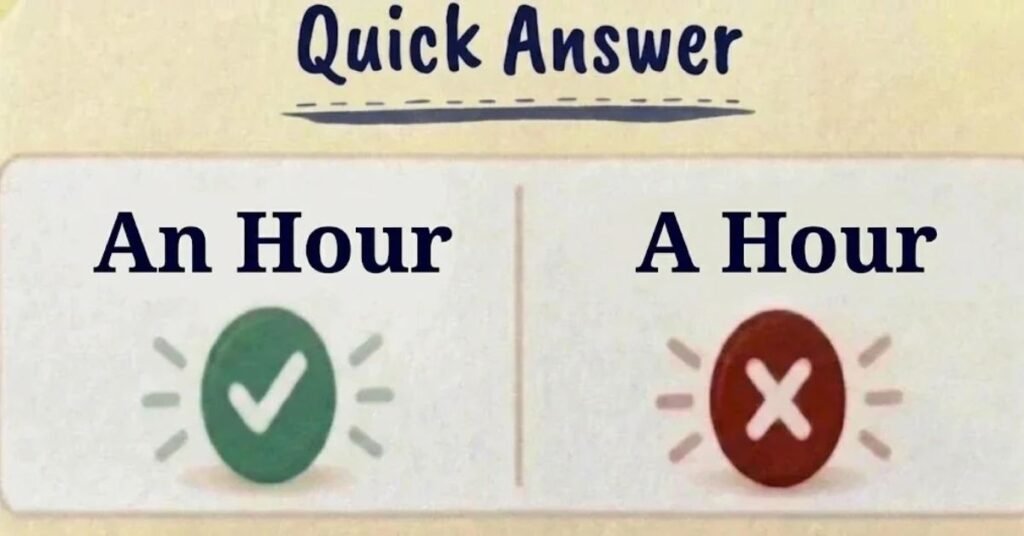
“An hour” is correct. “A hour” is incorrect.
The letter h in hour is silent. The word is pronounced like “our,” so it begins with a vowel sound. Words that begin with a vowel sound take an.
- Correct: I’ll call you back in an hour.
- Incorrect: I’ll call you back in a hour.
The one-line rule: use “an” before a vowel sound and “a” before a consonant sound. Hour starts with the vowel sound /aʊ/, so it takes “an.”
The Core Grammar Rule
Sound Beats Spelling
Most students learn that “an” goes before the vowels A, E, I, O and U, while “a” goes before every other letter. That shortcut works about nine times out of ten, but it is not the real rule.
The real rule is this:
- Say the word out loud.
- Listen to the first sound, not the first letter.
- If it is a vowel sound, use an.
- If it is a consonant sound, use a.
Articles exist to make speech flow. Saying “a hour” forces you to push two awkward sounds together. Saying “an hour” lets the n glide smoothly into the next vowel. That is why the rule follows pronunciation.
Why Is the H Silent in Hour?
The word hour came into English from Old French, which in turn took it from Latin hora and Greek hōra. French speakers had already stopped pronouncing the initial h. English borrowed the word and kept the spelling, but the sound never came along with it.
The same thing happened with several other words of French origin:
- hour (sounds like “our”)
- honest (sounds like “on-est”)
- honor or honour (sounds like “on-er”)
- heir (sounds like “air”)
So the silent h is not random. It is a leftover from the word’s history, and it is exactly why these words use “an.”
The Same Logic Works in Reverse
Sound also explains why some words that start with a vowel letter take “a.”
| Word | First Letter | First Sound | Article |
| hour | h (consonant) | vowel (/aʊ/) | an hour |
| honest | h (consonant) | vowel (/ɒ/) | an honest answer |
| umbrella | u (vowel) | vowel (/ʌ/) | an umbrella |
| university | u (vowel) | consonant (/j/) | a university |
| one-time | o (vowel) | consonant (/w/) | a one-time offer |
| hotel | h (consonant) | consonant (/h/) | a hotel |
Once you train your ear, you stop relying on the alphabet and start trusting the sound.
British English vs. American English: Is the Rule Different?

For “hour,” there is no difference. Both British and American English use “an hour.” Dictionaries and style guides on both sides of the Atlantic agree, and you will never see “a hour” in edited writing in either country.
The rule itself is the same everywhere. The only thing that varies is how a few other h-words are pronounced, and that changes which article you choose.
Where the Two Varieties Differ
| Word | Typical British Use | Typical American Use |
| hour | an hour | an hour |
| honest | an honest man | an honest man |
| herb | a herb (h pronounced) | an herb (h silent) |
| historic | a historic day (older texts: an historic) | a historic day |
| hotel | a hotel | a hotel |
| habitual | a habitual liar | a habitual liar |
The most famous example is herb. Americans and Canadians usually drop the h, so they say “an herb.” British and Australian speakers pronounce it, so they say “a herb.” Both are correct in their own variety because the article follows the speaker’s pronunciation.
The “An Historic” Question
Older British writing, and some formal American writing, uses “an historic” or “an historian.” This habit comes from a time when the h in unstressed syllables was often dropped. Classic usage guides such as Fowler’s noted that “an” before a weak-syllable h was once common and could still be heard.
Today, most style guides prefer “a historic” and “a historian” because the h is pronounced. If you hear someone say “an ‘istoric,” the article matches the dropped h. If you pronounce the h, use “a.”
Practical advice: pick the article that matches how you say the word. Then stay consistent in the same piece of writing.
When Each Form Is Correct
Here is a simple map of when to use each article, based on the first sound of the next word.
Use “An” When
- The next word begins with a vowel sound: an apple, an egg, an idea
- The next word begins with a silent h: an hour, an honest mistake, an heir, an honor
- An abbreviation or acronym begins with a vowel sound when read aloud: an MBA (em-bee-ay), an FBI agent (eff-bee-eye), an SOS call
Use “A” When
- The next word begins with a consonant sound: a book, a house, a hotel
- A word begins with a vowel letter but a consonant sound: a university, a unit, a European trip, a one-day sale
- An acronym is pronounced like a word starting with a consonant: a NASA mission, a UN meeting (you-en)
The Special Case of the Letter H Itself
The letter H is named “aitch” (/eɪtʃ/) in most English-speaking countries. That begins with a vowel sound, so abbreviations starting with H take “an”:
- an HTML file
- an HR manager
- an HIV test
In Irish English and some other varieties, the letter is pronounced “haitch.” Speakers who say “haitch” naturally write “a HR manager.” It is a regional difference, but “an HR manager” is the more widely accepted standard.
Key Difference At A Glance
Here is the entire topic in one quick view.
| Feature | An Hour | A Hour |
| Correct? | Yes | No |
| First sound | Vowel sound (/aʊ/) | Would be a consonant sound (/h/) |
| Is the H pronounced? | No, it is silent | Only if the h were pronounced, which it is not |
| Pronounced like | “our” | “ha-our” (not a real pronunciation) |
| Used in British English | Yes | No |
| Used in American English | Yes | No |
| Example | “The class lasts an hour.” | “The class lasts a hour.” |
| Verdict | Use this form | Avoid |
Quick memory trick: if you can replace hour with our and the sentence still sounds natural with “an,” use “an hour.” For example, “in an hour” matches “in an our” in sound.
How to Pronounce “An Hour”

The Sounds
- American English: /ˈaʊɚ/ (often “OW-er” or one blended syllable like “our”)
- British English: /ˈaʊə/ (“OW-uh”)
The word rhymes with flower, power, tower, shower and sour. It is also a homophone of the word our, so they sound identical.
How “An” and “Hour” Join Together
In natural speech, the n in “an” links to the vowel at the start of hour. You do not say “an… hour” with a break. You say something closer to “a-NOUR.”
| Written | Spoken Flow |
| an hour | a-NOUR |
| half an hour | half-a-NOUR |
| in an hour | in-a-NOUR |
| every hour | EV-ree-OWR |
Practice Tips
- Say “our” three times.
- Add “an” in front: “an our,” “an our,” “an our.”
- Now swap in the spelling: “an hour.”
- Use it in a sentence: “I’ll be there in an hour.”
- Record yourself and listen back, or compare with an online dictionary audio clip.
If you are an English learner, remember that the silent h is not a mistake in the spelling. It is simply part of the word’s history.
Real-World Examples
Seeing the phrase in context is the fastest way to lock it in.
Everyday Sentences
- “The train leaves in an hour.”
- “She waited an hour for the bus.”
- “We need an hour to finish the report.”
- “It took an hour and a half to cook the rice.”
- “The doctor is running an hour late.”
- “He studies for an hour every evening.”
At Work
- “Can we schedule an hour to review the budget?”
- “I bill an hourly rate for consulting.”
- “The meeting should take an hour, tops.”
- “Please give me an hour to reply.”
Travel and Plans
- “The airport is an hour from the city center.”
- “Arrive an hour before your flight.”
- “We have an hour layover in Dubai.”
Words Built From “Hour”
These related words also begin with the silent h, so they follow the same rule:
| Phrase | Example |
| an hourly wage | “She earns an hourly wage plus tips.” |
| an hourglass | “He turned over an hourglass on the desk.” |
| an hour hand | “The clock lost an hour hand.” |
| an hour-long meeting | “It was an hour-long meeting.” |
Compound Numbers Before “Hour”
This is where many people slip. The article depends on the word immediately after it.
- an eight-hour shift (eight begins with a vowel sound)
- a ten-hour flight (ten begins with a consonant sound)
- an eleven-hour drive (eleven begins with a vowel sound)
- a one-hour lesson (one begins with a /w/ consonant sound)
- a two-hour wait (two begins with a /t/ consonant sound)
In a phrase like “a two-hour wait,” the article attaches to two, not hour. That is why “a” is correct there.
Half an Hour or A Half-Hour?
Both are correct, but they are structured differently.
- Half an hour: “We waited half an hour.”
- A half-hour: “We had a half-hour break.”
In the first, “an” attaches to hour. In the second, “a” attaches to half, which begins with a consonant sound. The meaning stays the same.
Grammar Rule Details
What Are “A” and “An”?
A and an are the indefinite articles in English. They point to one non-specific thing. “I need a pen” means any pen, while “I need the pen” means a particular one.
Both forms mean the same thing. Only the sound that follows decides which one you pick.
Where Does “An” Come From?
Historically, “an” is the older form and comes from the Old English word for one. Over time, speakers dropped the n before consonant sounds because it made speech smoother, leaving “a” for those cases. “An” remained before vowel sounds to prevent a gap or awkward clash between vowels.
The Silent H Words You Should Know
A short list helps. These are the most common words where the h is silent and “an” is required.
| Word | Pronounced Like | Example |
| hour | our | an hour ago |
| honest | on-ist | an honest answer |
| honor / honour | on-er | an honor to meet you |
| honorable | on-er-uh-bul | an honorable decision |
| heir | air | an heir to the throne |
| heiress | air-ess | an heiress to the fortune |
Words Where H Is Pronounced
Do not be fooled into overcorrecting. These words do have a pronounced h, so they take “a.”
- a house
- a hotel
- a horse
- a hero
- a helpful tip
- a historic moment
- a habit
- a hundred
Quick Decision Flow
- Look at the word after the article.
- Say it out loud.
- Does it begin with a vowel sound? Use an.
- Does it begin with a consonant sound? Use a.
That is all there is to it.
What About Dialects That Drop the H?
Some regional accents in Britain, such as Cockney, drop the h from many words, including house and hotel. Standard written English still uses “a house” and “a hotel,” because the written standard follows the standard pronunciation, not every dialect.
So in writing, use the standard rule. In speech, the article will naturally follow how you say the word.
Common Mistakes (and Quick Fixes)

Even confident writers slip on this rule. Here are the most common errors and how to fix them.
Mistake 1: Writing “A Hour”
| Wrong | Right |
| I’ll be ready in a hour. | I’ll be ready in an hour. |
| The meeting lasted a hour. | The meeting lasted an hour. |
| Wait for a hour. | Wait for an hour. |
Why it happens: the spelling starts with h, which looks like a consonant. Fix: say the word out loud. You will hear “our.”
Mistake 2: Going by Letters Instead of Sounds
| Wrong | Right |
| He is an university student. | He is a university student. |
| She has an one-year contract. | She has a one-year contract. |
| It was a honest mistake. | It was an honest mistake. |
Fix: always check the first sound, not the first letter.
Mistake 3: Overcorrecting With Pronounced H Words
| Wrong | Right |
| We stayed at an hotel. | We stayed at a hotel. |
| It was an happy day. | It was a happy day. |
| He is an hero. | He is a hero. |
Why it happens: after learning “an hour,” some people apply “an” to every h-word. Fix: only use “an” when the h is truly silent.
Mistake 4: Mixing Up Acronyms
| Wrong | Right |
| She works as a HR officer. | She works as an HR officer. |
| He has a MBA. | He has an MBA. |
| It is an UN rule. | It is a UN rule. |
Fix: read the acronym aloud and choose the article based on its first spoken sound.
Mistake 5: Using “An Hour” Where “One Hour” Is Needed
Sometimes you want to stress the number. “An hour” is casual. “One hour” is more precise.
- “I’ll be there in an hour.” (casual)
- “The test is exactly one hour long.” (precise)
Mistake 6: Forgetting the Article Entirely
- Wrong: “I waited hour for the bus.”
- Right: “I waited an hour for the bus.”
Singular countable nouns need an article. Hour is countable, so it needs “a,” “an” or “the.”
Mistake 7: Using Different Articles in the Same Document
If you write “a herb” in one paragraph and “an herb” in another, readers may notice. Choose the variety you are writing in and keep your choices consistent.
Quick Self-Test
Also Read This:Referred or Refered: Which Is Correct? Meaning, Spelling, Differences & Examples (2026)
Try these. Choose “a” or “an.”
- ___ hour ago
- ___ honest person
- ___ hotel room
- ___ MBA degree
- ___ umbrella
- ___ one-hour class
- ___ heir to the throne
- ___ university
Answers: 1. an, 2. an, 3. a, 4. an, 5. an, 6. a, 7. an, 8. a.
If you got all eight right, you have the rule down.
A Simple Habit That Works
When you are unsure, do not guess. Say the phrase out loud once. Your ear will usually catch the awkward “a hour” before your eye does. After a few weeks of doing this, the choice becomes automatic.
Conclusion
“An hour” is correct because the h is silent and the word starts with a vowel sound. “A hour” is always wrong in standard British and American English, since English chooses “a” or “an” by sound, not by spelling.
Remember to listen to the first sound, watch out for tricky cases like a hotel, an honest and an HR, and trust your ear when in doubt. Once you apply this one habit, you can use “a” and “an” confidently in emails, essays and everyday writing in 2026 and beyond.