

You are typing an invitation, a contract clause, or a school essay, and you stop. Does that word need an apostrophe, or does it end in “ies”? It looks like a tiny decision, but it changes the meaning of the whole sentence.
Here is the short version. Parties is the plural of “party.” Party’s shows that something belongs to one party, or it is a shortened form of “party is” or “party has.” That is the heart of it. The rest of this guide explains why, shows you real examples, and gives you a simple test you can use any time you edit.
Quick Answer: Party’s or Parties?
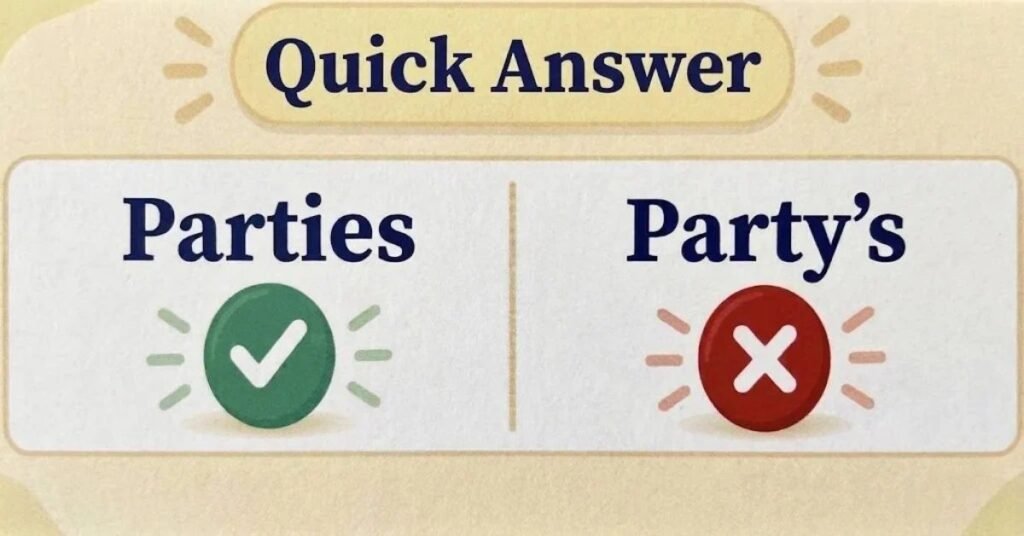
Use parties when you mean more than one party. Use party’s when something belongs to a single party, or when you are shortening “party is” or “party has.”
| Form | Type | Meaning | Example |
| party | Singular noun | One gathering, group, or side | The party starts at eight. |
| parties | Plural noun | More than one party | Both parties signed the agreement. |
| party’s | Singular possessive or contraction | Belonging to one party; or “party is / party has” | The party’s theme was space. |
| parties’ | Plural possessive | Belonging to more than one party | The parties’ lawyers met on Friday. |
Featured Snippet Answer
Party’s is the singular possessive form of “party” (the party’s budget) and the contraction of “party is” or “party has.” Parties is the plural form of “party” (three parties). If you mean more than one and nothing belongs to them, write parties with no apostrophe.
What Is the Difference Between Party’s and Parties?
The difference comes down to two jobs an apostrophe-s can do and one job a plain s can do.
- A plain s (or “ies” in this case) makes a noun plural. It answers the question, “How many?”
- An apostrophe + s makes a singular noun possessive. It answers the question, “Whose?”
- An apostrophe + s can also stand in for “is” or “has” in a contraction.
So “parties” tells you the number. “Party’s” tells you about ownership or shortens a verb. They are not interchangeable, even though they sound almost the same when spoken aloud. That is exactly why they cause so many typos in written work.
Party’s and Parties in British vs American English
Good news: there is no spelling split here. British, American, Canadian, and Australian English all use the same forms: party, parties, party’s, parties’.
There is one small habit that differs. In British English, collective nouns like “party” in the political sense are sometimes treated as plural: “The party are divided on the issue.” In American English, the same noun usually takes a singular verb: “The party is divided on the issue.” This changes the verb, not the spelling of party or parties.
Legal and business writing also uses “parties” the same way on both sides of the Atlantic, as in “the contracting parties.”
Meaning of Parties
Parties has two common roles in English.
1. Plural noun. It means more than one social event, political group, or side in an agreement.
- She planned three parties this year.
- Several political parties joined the coalition.
- The two parties reached a settlement.
2. Verb (third person singular). “Party” is also a verb meaning to celebrate. With he, she, or it, you add the ending.
- He parties every Friday night.
Context tells you which role is in play. If a number or words like “many,” “both,” or “several” appear nearby, you are almost certainly looking at the plural noun.
Meaning of Party’s
Party’s shows up in three situations. Learning to spot each one removes nearly all the confusion.
Party’s as a Singular Possessive
The first job is possession. If one party owns, has, or is linked to something, add an apostrophe and s.
- The party’s decorations were handmade.
- The party’s manifesto focused on education.
- The opposing party’s lawyer objected.
A quick check: you can usually rephrase the sentence with “of the party.” “The decorations of the party” works, so “the party’s decorations” is correct.
Party’s Meaning “Party Is”
Contractions squeeze two words into one, and the apostrophe marks the missing letters. “Party is” becomes “party’s.”
- The party’s at my house tonight. (The party is at my house tonight.)
- The party’s getting louder. (The party is getting louder.)
This form is common in speech and casual writing. It is less common in formal documents.
Party’s Meaning “Party Has”
The same contraction can stand in for “party has,” especially when “has” works as a helping verb.
- The party’s been going for hours. (The party has been going for hours.)
- The party’s already started. (The party has already started.)
How do you tell “is” from “has”? Try both in the sentence. Only one will sound natural. “The party’s been going” works as “has been,” while “the party is been going” does not.
This is also the answer to a question many writers ask: yes, party’s can mean “party is”, but only in contractions, and only when the sentence makes sense with those words restored.
What Is the Plural Form of Party?

The plural of party is parties. Not “partys.” Not “party’s.” Just parties.
If you remember only one rule from this article, make it this one: plurals do not take apostrophes in standard English. An apostrophe signals possession or a missing letter, never a plain plural.
Why Party Changes to Parties
English spelling often shifts a word’s ending before adding a plural. When a noun ends in a consonant followed by “y,” the “y” turns into “i” and the plural ending becomes “es.”
That is where “parties” comes from. Think of the word as “part-y.” The letter before the y is a consonant (t), so the y changes.
The Consonant + Y Rule
Here is the rule in plain terms:
- Look at the letter just before the final y.
- If it is a consonant, change y to i and add es.
- If it is a vowel (a, e, i, o, u), just add s.
| Singular | Letter before y | Plural |
| party | t (consonant) | parties |
| city | t (consonant) | cities |
| story | r (consonant) | stories |
| baby | b (consonant) | babies |
| key | e (vowel) | keys |
| toy | o (vowel) | toys |
| day | a (vowel) | days |
This rule also answers why “parties” is spelled with “ies.” It follows the same pattern as city, story, and baby. And that explains why “partys” is never correct in standard English. The only exception is when a proper name ends in y, such as “the Kennedys,” where you keep the y and add s.
When to Use Parties
Reach for “parties” whenever you are counting or referring to more than one party and nothing needs to belong to them.
Everyday Examples
- We went to two parties last weekend.
- Her birthday parties are always themed.
- Office parties can be awkward if the music is too loud.
- The kids love pool parties in summer.
- They throw surprise parties for everyone on the team.
Academic Writing Examples
In essays and research papers, “parties” often refers to political groups or to groups involved in a study or dispute.
- Smaller parties gained ground in the last election.
- The study compared how different political parties framed climate policy.
- Historians argue that rival parties shaped the early republic.
- Both parties in the debate cited the same data but reached different conclusions.
Business Writing Examples
In business and legal contexts, “parties” means the people or organizations on each side of an agreement.
- The parties agree to the terms outlined below.
- Disputes between the parties will go to arbitration.
- Third parties may not access confidential data without consent.
- Each of the contracting parties must keep a signed copy.
Notice that third parties is the plural form for more than one outside group. You would write “third party’s” only when something belongs to a single outside party, as in “the third party’s consent is required.”
When to Use Party’s
Choose “party’s” when something belongs to one party, or when you are contracting “party is” or “party has.”
- The party’s location is still a secret. (possessive)
- The host said the party’s over. (party is)
- The party’s been planned for months. (party has)
If your sentence is not about ownership and you cannot expand it into “party is” or “party has,” then you do not want an apostrophe.
Party vs Parties vs Party’s vs Parties’
Writers often forget there is a fourth form. The plural possessive, parties’, puts the apostrophe after the s. It applies when more than one party owns something.
| Form | Count | Shows ownership? | Quick test |
| party | One | No | Can you replace it with “event” or “group”? |
| parties | Many | No | Can you put a number in front of it? |
| party’s | One | Yes (or contraction) | Does “of the party” or “party is/has” fit? |
| parties’ | Many | Yes | Does “of the parties” fit? |
Example Sentences
- Party: The party was a huge success.
- Parties: Three parties were planned for the same night.
- Party’s: The party’s budget was small.
- Parties’: Both parties’ lawyers agreed on the schedule.
Here is a contrast that shows why the apostrophe matters:
- “The party’s lawyer arrived.” (one party, one lawyer)
- “The parties’ lawyers arrived.” (several parties, each with a lawyer)
- “The parties lawyers arrived.” (incorrect, because the possessive is missing)
How to Know Which Form to Use
Do not guess. Run the sentence through a quick sequence of questions.
Quick Decision Framework
- Is there more than one party? If yes, you need a plural. Go to step 2. If no, go to step 3.
- Does something belong to those parties? If yes, use parties’. If no, use parties.
- Does something belong to the single party? If yes, use party’s. If no, go to step 4.
- Can you replace the word with “party is” or “party has”? If yes, use party’s. If no, use plain party.
Here is how that works in practice.
- “Both ___ agreed to the plan.” There is more than one, nothing is owned, so: parties.
- “The ___ colors were red and gold.” One party, something belongs to it, so: party’s.
- “The ___ lawyers met for lunch.” Several, and the lawyers belong to them, so: parties’.
- “The ___ going to be fun.” Replace with “party is,” and it fits, so: party’s.
Easy Memory Trick
Use the “Of” test for possession and the “Count” test for plurals.
- Count test: If you can put a number or the word “several” before it, use parties.
- Of test: If you can flip the phrase into “of the party,” use party’s. If you can flip it into “of the parties,” use parties’.
Another handy trick is the swap test. Replace the word with a clearly plural or singular noun you already know, like “friends” and “friend’s.” If “friends” fits (no apostrophe), you need “parties.” If “friend’s” fits, you need “party’s.”
How to Edit and Proofread Party’s and Parties in Your Writing
Even confident writers slip on this one when they are typing quickly. Here is a short proofreading routine.
- Search your document for “partys,” “party’s,” “parties,” and “parties’.” Check each one in context.
- Read the sentence aloud and mentally replace the word with “party is” or “party has.” If it fits, an apostrophe is right.
- Check for numbers. If you see “two,” “many,” “several,” or “both” nearby, expect a plural without an apostrophe.
- Check ownership. Ask whether a noun after the word belongs to it (“party’s decorations”).
- Do not trust spellcheck alone. “Parties” and “party’s” are both valid words, so a spellchecker will not flag the wrong one.
- Read your final draft slowly at the end. Errors with apostrophes tend to hide in plain sight.
Common Mistakes With Party’s and Parties

Mistake #1: Using Party’s as a Plural
This is the most common error, and it often appears on flyers and social posts.
- Incorrect: We hosted three party’s this month.
- Correct: We hosted three parties this month.
The writer is counting parties, not showing ownership. No apostrophe is needed. This habit is sometimes called the “greengrocer’s apostrophe,” because it was once common on market signs like “apple’s for sale.”
Mistake #2: Writing Partys
Because many English plurals just add s, it feels natural to write “partys.” But a consonant followed by y changes to “ies.”
- Incorrect: Both partys signed the contract.
- Correct: Both parties signed the contract.
Mistake #3: Confusing Parties’ and Party’s
The position of the apostrophe tells readers how many owners there are.
- Party’s = one owner.
- Parties’ = more than one owner.
Compare:
- The party’s decision was final. (one party)
- The parties’ decision was final. (all the parties decided together)
Getting this wrong in a contract can change who is bound by a clause, which is why lawyers and editors check it closely.
Real-World Examples in Writing
Invitations
Invitations are one of the most common places to see these words, and they show the forms clearly.
- “Join us for the party’s grand opening.” (possessive)
- “The party’s at 7 p.m. on Saturday.” (contraction of “party is”)
- “We love hosting holiday parties.” (plural)
- “Please bring both parties’ guest lists.” (plural possessive, if you have two hosts or families)
If you are writing an invitation, aim for friendly and clear. Avoid adding an apostrophe just because it “looks right.”
Contracts
Legal drafting uses “parties” constantly. It is the standard term for the people or companies who sign.
- “The parties agree to resolve disputes through mediation.”
- “Neither party’s obligations are affected by this clause.” (singular possessive, “neither” points to one party at a time)
- “The parties’ respective obligations are listed in Schedule A.” (plural possessive)
Notice how a single apostrophe shifts the sense. “Neither party’s” speaks about each side individually. “The parties'” speaks about them as a group.
If you are not a lawyer, remember that for any legally binding document, a professional review is wise. A tiny punctuation change can alter the legal meaning.
School Assignments
Teachers often use this pair to test apostrophe skills in grammar lessons.
- “Our class held two parties this term.” (plural)
- “The party’s theme was the ocean.” (possessive)
- “The party’s about to begin.” (contraction)
A useful classroom strategy is to underline the noun and ask, “Is it counting, owning, or shortening?” If students can answer that, they will pick the right form.
Why Apostrophes Cause So Much Confusion
Also Read This:Seal vs. Seel: Which Is Correct? Meaning, Spelling, Differences & Examples (2026)
Apostrophes trip up learners and native speakers alike, for a few good reasons.
- They have multiple jobs. One mark shows possession, forms contractions, and occasionally appears in unusual plurals (like “mind your p’s and q’s”).
- The sounds match. Say “party’s” and “parties” out loud. In casual speech they sound nearly identical, so your ear gives you no help.
- English spelling changed over time. The apostrophe in possessives is a leftover from older forms of the language, and it stuck even though few people remember the history.
- Informal writing blurs the rules. Texting and social media have made the mistake look normal, so incorrect usage keeps reinforcing itself.
The fix is not memorizing a long list of rules. It is learning to ask the right short questions: How many? Whose? Is a verb missing?
Pro Tips for Remembering the Difference
- Plurals count, possessives own. “Parties” counts. “Party’s” owns.
- No apostrophe for a plain plural. If you are only saying “more than one,” skip it.
- Test with “is” or “has.” If either fits, the apostrophe is correct as a contraction.
- Try the “of” flip. “The decorations of the party” becomes “the party’s decorations.”
- Watch the apostrophe’s position. Before the s means one owner. After the s means more than one.
- Remember the consonant-y rule. Consonant + y becomes “ies,” just like cities, stories, and babies.
- Keep a short note with the four forms and one example for each. A sticky note near your desk is enough.
A Few Quick Answers
Writers often want a fast confirmation, so here are the key facts in one place.
- Is party’s grammatically correct? Yes. It is correct as a singular possessive and as a contraction of “party is” or “party has.” It is wrong as a plural.
- What is the plural of party? Parties.
- What is the possessive form of party? Party’s for one party, parties’ for more than one.
- Can party’s mean party is? Yes, in contractions such as “The party’s tonight.”
- Is it third parties or third party’s? Use “third parties” for the plural and “third party’s” only for something that belongs to a single third party.
- What is the plural possessive form of party? Parties’, with the apostrophe after the s.
- Why is parties spelled with ies? Because words ending in consonant + y change the y to i before adding es.
- Is partys ever correct? Not for the common noun. It only appears in proper names ending in y, like “the Kennedys.”
Final Verdict: Party’s or Parties?
Parties is the plural and simply counts, while party’s shows ownership by one party or shortens “party is” and “party has.” For more than one owner, use parties’ with the apostrophe after the s.
When you are unsure, ask three quick questions: can you count them, does something belong to them, and does “party is” or “party has” fit? Answer those, and you will pick the right form every time.