

You are typing a sentence about a lawsuit, and your fingers hesitate. Is it “suing” or “sueing”? The second one looks oddly familiar, yet something about it feels off. That hesitation is common, and it has a simple fix.
This guide gives you the answer in one line, then explains the reasoning so you never have to second-guess it again. You will see how dictionaries treat the word, how it sounds, where the mistake comes from, and which spelling rule sits behind it. There are plenty of examples, a few comparison tables, and a short rulebook for every other verb that ends in a silent e.
Quick Answer
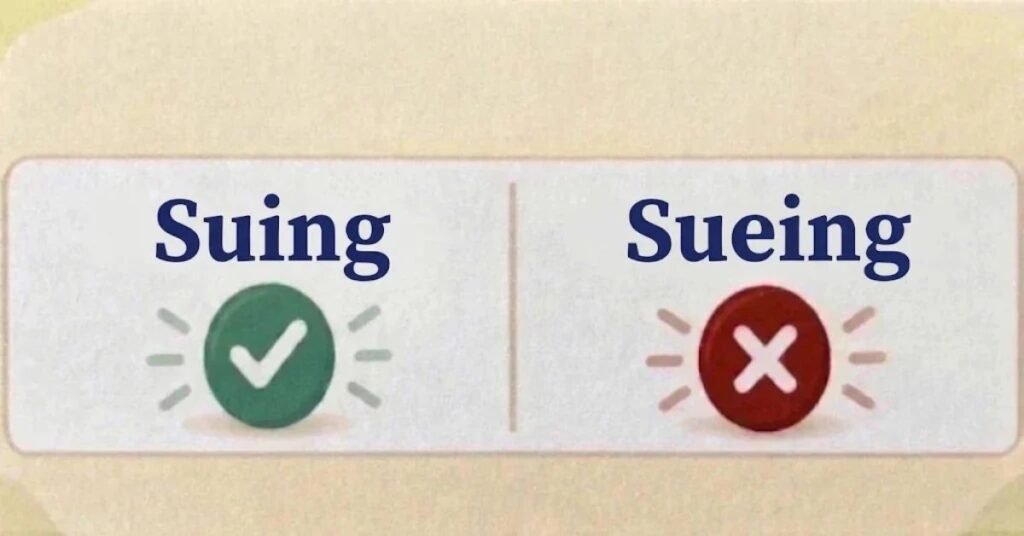
“Suing” is correct. “Sueing” is a misspelling.
“Suing” is the present participle of the verb sue, which means to take legal action against someone. You drop the final e from sue before adding -ing, just as you do with make and making or save and saving.
The rule works the same in American and British English. Major dictionaries, including Merriam-Webster, Oxford Learner’s Dictionaries, and Collins, list the forms of the verb as sue, sues, sued, suing. None of them records “sueing” as an accepted variant.
Quick memory trick: if you can say “making,” you can say “suing.” Same rule, same result.
Why People Confuse Them
Nobody invents “sueing” out of thin air. The error has understandable causes.
1. The silent e feels like it belongs. The word sue is only three letters long, and its e is the letter that signals the long “oo” sound. When you add -ing, deleting that letter can feel risky, as though the word might lose its sound. Writers cling to the e to protect it.
2. Some verbs really do keep the e. Words like dyeing, singeing, and canoeing hold on to their final e. Once you have seen those, “sueing” looks like it might follow the same pattern. It does not, and we will cover exactly why further down.
3. Three vowels in a row look strange. Spelling suing gives you the sequence u-i, which is perfectly normal. Spelling sueing gives you u-e-i, a cluster that most English readers find awkward. Ironically, the awkward-looking version is the wrong one, which is why trusting your eye can mislead you here.
4. People hear it more than they write it. When a word is learned by ear, the spelling stays fuzzy, and the brain fills the gap with a guess.
Understanding the cause helps because it shows the mistake is about spelling logic, not about meaning. Everybody who writes “sueing” knows exactly what they intend to say.
Suing in British English vs. American English

Here is some good news. This is not a case where British and American spelling diverge. Both varieties use suing.
Spelling differences between the two usually fall into familiar groups: -our versus -or (colour/color), -ise versus -ize (organise/organize), and -ce versus -se (licence/license). The verb sue does not belong to any of these groups, so no regional variant exists.
| Feature | American English | British English |
| Base verb | sue | sue |
| Third person singular | sues | sues |
| Past tense / past participle | sued | sued |
| Present participle (-ing form) | suing | suing |
| Accepted variant “sueing” | No | No |
| Pronunciation of “sue” | /suː/ | /suː/ (some speakers use /sjuː/) |
One small difference is worth noting. Some British speakers, particularly in older or more traditional accents, say a faint “y” glide before the vowel, so sue can come out closer to “syoo.” That is a matter of accent, not spelling. The written form stays the same on both sides of the Atlantic.
If you work with international readers, you can relax: there is no regional version of this word you need to track.
Key Differences At A Glance
The comparison here is really between a correct word and an incorrect spelling, so the table below makes the contrast easy to scan.
| Point | Suing | Sueing |
| Is it a real English word? | Yes | No |
| Found in standard dictionaries? | Yes | No |
| Part of speech | Present participle (also used as a gerund or noun-like form) | Not applicable |
| Follows the e-dropping rule? | Yes | No, it breaks the rule |
| Safe for essays, emails, and legal writing? | Yes | No, it will be marked as an error |
| Example | “She is suing her landlord.” | “She is sueing her landlord.” (incorrect) |
You may notice that the table treats “sueing” as an error and not as an alternative. That is deliberate. Some word pairs, like judgment and judgement, are both acceptable depending on context. This pair is not like that. One spelling is right, and the other is a slip.
Are They the Same Word?
Not really. Suing is a word. Sueing is a misspelling of that word.
Think of it this way. When someone writes “definately,” they mean definitely. The meaning is identical, but only one version exists in the dictionary. The same logic applies here. Both strings of letters point to the same idea, taking someone to court, but only suing is recognised as standard English.
It helps to understand where the word comes from, because the history explains why the spelling is so regular. According to Merriam-Webster and Oxford, sue came into English in the Middle Ages through Anglo-French, from a Latin root meaning “to follow.” The earliest uses were close to the sense of pursuing someone or something. Over time the legal meaning, to pursue a claim in court, became the main one. If that reminds you of suit, pursue, and even segue, that is no accident: they are relatives.
Because sue is a regular verb, its forms behave predictably:
- Base form: sue
- Third person singular: sues
- Past tense: sued
- Past participle: sued
- Present participle: suing
Nothing about these forms is irregular, so there is no reason for the -ing version to behave differently.
How to Pronounce Suing

The pronunciation is easy once you break it into two beats.
- Syllables: su-ing (two syllables)
- Stress: on the first syllable
- IPA: /ˈsuːɪŋ/
- Rhymes loosely with: “doing,” “ruing,” “brewing”
Say it as SOO-ing. The first syllable is the same sound as the girl’s name Sue, or the sou- in soup. The second syllable is a short “ing,” as in sing.
Oxford Learner’s Dictionaries gives /ˈsuːɪŋ/ for the -ing form, and the American and British pronunciations match.
Common pronunciation slips
- Saying “soo-WING.” Some learners add a “w” sound between the two syllables. Keep the glide light and let the u flow straight into the i.
- Saying “sying.” This confuses it with sighing or sign. The vowel is a long “oo,” not a long “i.”
- Merging it into one beat. Suing has two distinct syllables, so it should not sound like swing.
A handy practice trick is to say these three words in a row: do, doing, suing. The rhythm is nearly identical.
Which Spelling Should You Use?
Use suing. Every time.
There is no context in which “sueing” is the better choice. That includes:
- Academic essays and research papers
- News articles and blog posts
- Legal documents and contracts
- Emails, reports, and business messages
- Social media captions and texts
- Fiction and dialogue
A quick checklist before you hit send:
- Is the word describing legal action or a formal request? Then it is a form of sue.
- Are you adding -ing? Then drop the final e.
- Does the result read “suing”? Good, you are done.
Everyday Examples

Seeing the word in real sentences makes the pattern stick. Below are examples grouped by situation, all using the correct spelling.
Legal and business settings
- The tenant is suing the property manager over a broken heating system.
- Several shareholders are suing the company for misleading investors.
- She spent two years suing the airline after her luggage was lost and her trip was ruined.
- We would rather negotiate than end up suing each other.
News-style sentences
- A group of states is suing to block the new rule.
- The family is suing the hospital, claiming negligence.
- The musician is suing a former manager over unpaid royalties.
Casual conversation
- “Are you seriously suing your neighbour over a fence?”
- “I’m not suing anyone, I just want my deposit back.”
- “He kept talking about suing, but nothing ever happened.”
Past and passive forms (not -ing, but often mixed up with it)
- The contractor was sued last spring.
- If you ignore the contract, you could get sued.
- They sued for damages and won.
The formal, older sense of “sue for”
- The defeated army was forced to sue for peace.
- He sued for the court’s mercy.
That last pair shows that sue is not limited to lawsuits. In formal writing it can mean “to ask or plead for something.” The spelling of the -ing form stays the same: suing for peace, suing for mercy.
Tense table
| Tense | Example |
| Present simple | They sue companies that break the law. |
| Present continuous | They are suing the company now. |
| Past simple | They sued the company last year. |
| Past continuous | They were suing the company when we met. |
| Present perfect continuous | They have been suing the company for months. |
| Future continuous | They will be suing the company next spring. |
Notice that suing only appears in the continuous forms and in gerund-like uses. The simple past always takes sued.
When One Spelling Looks Wrong
Spelling can trick your eyes. After you stare at a word for a while, even a correct version can start to look strange. This is a well-known effect and it happens to confident writers too.
Here is how to test yourself when “suing” or “sueing” begins to look wrong.
Method 1: Swap in a familiar verb. Replace sue with use, save, or make, then add -ing. You get using, saving, making. You would never write useing (nobody does) or makeing. Apply the same pattern and suing stands.
Method 2: Say it out loud and count syllables. Suing has two syllables: su-ing. If you spell it sueing, you imply three letters of vowel clutter that you never actually pronounce.
Method 3: Check a trusted dictionary. Merriam-Webster lists the forms as sued; suing. Oxford Learner’s Dictionaries shows “-ing form: suing.” Collins gives sues, suing, sued. If three respected references agree, the question is closed.
The u-i sequence also appears in fruit, suit, and juice, so there is no real reason to distrust it in suing.
Common Mistakes (and Quick Fixes)

Beyond “sueing,” a handful of related errors turn up around this word. Here are the ones worth knowing.
| Mistake | Why it happens | Fix |
| sueing | Keeping the e out of habit | Drop the e: suing |
| suiing | Mixing up the dropped letter | Only one i: suing |
| suin | Dropping the g in casual writing | Write the full word: suing |
| sewing (when you mean suing) | Sound-alike confusion in speech-to-text | Check meaning: sewing is stitching, suing is a legal action |
| suiting (when you mean suing) | Typing error from similar letters | Suiting relates to clothing or fitting, not courts |
| “I sueing you” | Missing the helping verb | Add am: “I am suing you” |
| “He is sued the company” | Mixing passive and active | Use suing (or has sued) for the active form |
| “They been suing” | Dropping the auxiliary | “They have been suing” |
A few of these deserve extra comment.
Suing versus sewing. Voice typing and dictation tools sometimes hear “suing” and write “sewing” or “soon.” These are valid words, so a spell-checker will not catch them. The surrounding sentence is your only clue. If the sentence mentions court, damages, or a lawyer, double-check the word.
How to Form the -ing Form of Words Ending in E
Also Read This:Shaky or Shakey: Which Spelling Is Correct? Meaning, Usage & Examples (2026)
Once you understand the rule behind suing, you can spell hundreds of other words correctly. The core rule is short.
The main rule: drop the silent e before adding -ing.
| Base verb | -ing form |
| sue | suing |
| make | making |
| save | saving |
| write | writing |
| use | using |
| glue | gluing |
| rue | ruing |
| argue | arguing |
| value | valuing |
| issue | issuing |
| pursue | pursuing |
| continue | continuing |
| rescue | rescuing |
This works because the final e in these words is silent and exists only to shape the vowel sound. Adding -ing provides a new vowel (i) that does the job, so the old e is no longer needed.
Why does the pattern apply to words ending in “ue”?
Verbs such as sue, argue, and glue end in -ue. The u is pronounced, and the e is silent. When you add -ing, the silent e goes, but the u stays. This is why you get arguing and gluing, not arguening or glueing.
The exceptions you should know
A small group of verbs keep the e. They do so for clear reasons.
| Word | -ing form | Why the e stays |
| dye | dyeing | Prevents confusion with dying (from die) |
| singe | singeing | Prevents confusion with singing (from sing) |
| canoe | canoeing | Dropping the e would leave an odd ending |
| hoe | hoeing | Same reason |
| shoe | shoeing | Same reason |
| tiptoe | tiptoeing | Same reason |
| be | being | Irregular verb |
| see | seeing | Ends in double e, so the pair stays |
| agree | agreeing | Ends in double e, so the pair stays |
| flee | fleeing | Ends in double e, so the pair stays |
Two patterns explain nearly every exception:
- Words ending in -ee, -oe, or -ye keep their e, because dropping one would create confusion or look malformed.
- Words where dropping the e would produce a different real word keep it, as with dyeing versus dying.
Sue fits neither pattern. It ends in -ue, and dropping the e produces suing, which is exactly the word you want. No confusion, no exception.
A few words are genuinely flexible, such as queuing/queueing, cuing/cueing, and aging/ageing (the last varies by region). Suing is not one of them. It has a single, stable spelling.
Dictionary-Style Word Details
For quick reference, here is sue laid out the way a dictionary would present it.
| Detail | Information |
| Headword | sue |
| Part of speech | Verb (transitive and intransitive) |
| Forms | sue, sues, sued, suing |
| Pronunciation | /suː/ (base form), /ˈsuːɪŋ/ (suing) |
| Syllables | sue = 1; suing = 2 |
| Main meaning | To bring a legal claim against someone in court |
| Secondary meaning | To make a formal request or plead, as in “sue for peace” |
| Older meaning | To court or woo someone (archaic) |
| Origin | Middle English, from Anglo-French, from Latin sequi (“to follow”) |
| Related words | lawsuit, suit, countersue, suer, pursue |
| Common collocations | sue for damages, sue for breach of contract, threaten to sue, sue for peace |
| Typical registers | News, legal, business, everyday speech |
Useful collocations with suing
- suing for damages
- suing for negligence
- suing over a contract
- suing the government
- suing for wrongful termination
- suing for defamation
- suing in civil court
Conclusion
The answer is simple: suing is correct, and sueing is not. Because sue is a regular verb, you drop the silent e before adding -ing, just as you do with make or save. American and British English agree, and every major dictionary backs it up.
The confusion is easy to understand, since a few verbs like dyeing and canoeing really do keep their e. Once you know the rule, though, the doubt disappears. Write suing, say it as SOO-ing, and use sued for the past tense.